
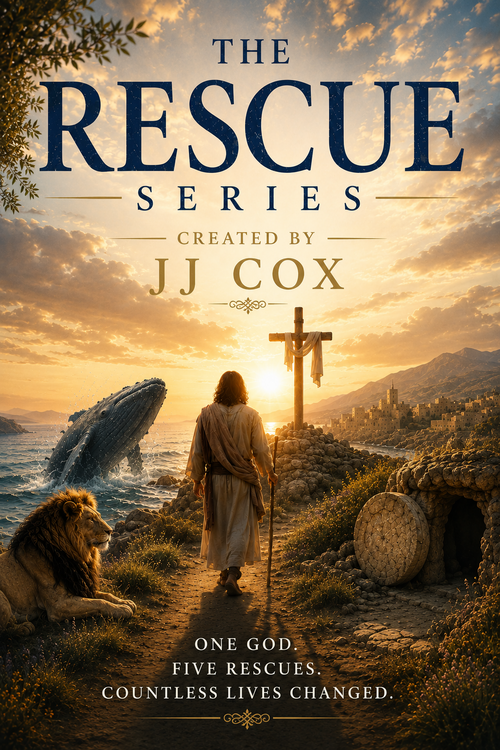
Chapter One
Rescued Through Faithfulness
Daniel
"May your God, whom you serve continually, rescue you!" — Daniel 6:16
Every person, at some point in life, will find themselves in a lion's den.
For some, it comes in the form of criticism. For others, it's betrayal, sickness, disappointment, financial hardship, or simply living in a world that seems increasingly opposed to biblical convictions. None of us are exempt from moments when obedience to God places us in difficult circumstances.
When those moments arrive, the question is rarely, "Can God rescue me?" Scripture has already answered that. The greater question is, "Will I remain faithful while I wait for God's rescue?"
Few people answer that question better than Daniel.
Daniel's story is one of the most familiar accounts in all of Scripture. Children learn about lions with mouths shut by the hand of God, but beneath that incredible miracle lies the story of a man who had already settled his faith long before he ever stepped into the den.
His rescue did not begin when God closed the mouths of the lions.
It began decades earlier when Daniel decided that his life belonged completely to God.
That decision changed everything.
Faithfulness Before Favor
One of the most interesting things about Daniel's story is that he didn't end up in the lion's den because he had done something wrong.
He was there because he had done everything right.
Most of us naturally assume hardship is the result of failure. We think if we're walking closely with God, life should become easier. Yet Daniel's experience teaches exactly the opposite.
The Bible tells us that Daniel distinguished himself above everyone else because of his exceptional qualities. He was trustworthy. Honest. Responsible. There was no corruption in him. No negligence. His integrity was so evident that the king intended to place him over the entire kingdom.
Think about that for a moment.
Daniel wasn't promoted because of favoritism.
He wasn't elevated because he knew the right people.
He wasn't rewarded because he manipulated the system.
He simply lived with such consistency that everyone around him recognized the difference.
Character always speaks louder than talent.
Talent may open a door, but character determines whether you remain in the room.
Unfortunately, integrity often attracts opposition.
The very qualities that should have been celebrated became the reason Daniel was attacked.
The other officials watched him receive favor, and instead of asking, "What can I learn from him?" they asked, "How can we destroy him?"
Jealousy has always worked that way.
Rather than inspiring improvement, it often seeks to eliminate the person who exposes our unwillingness to change.
There will always be people who are willing to work hard, serve faithfully, and pursue excellence with humility. But there will also be people who want the reward without the discipline. They want recognition without sacrifice. They want the position without developing the character required to sustain it.
When those two groups collide, jealousy is never far behind.
That is exactly what happened to Daniel.
His enemies searched every aspect of his public life looking for a weakness. They investigated his leadership. They examined his decisions. They looked for dishonesty, corruption, laziness, or compromise.
They found nothing.
Imagine living with such consistency that those determined to destroy your reputation couldn't find legitimate evidence against you.
Eventually they came to a remarkable conclusion:
"We will never find any basis for charges against this man Daniel unless it has something to do with the law of his God."
What an incredible statement.
If someone is going to criticize us, what do we want that criticism to be?
Daniel's enemies couldn't accuse him of dishonesty.
They couldn't accuse him of laziness.
They couldn't accuse him of corruption.
Their only complaint was that he loved God too much.
If that's the worst thing anyone can ever say about us, we've lived well.
Jesus never promised that following Him would earn the applause of the world. In fact, He warned the opposite. His followers would experience rejection because they belonged to Him. Paul echoed that truth when he wrote that everyone who desires to live a godly life in Christ Jesus will face persecution.
Faithfulness has never been measured by popularity.
It has always been measured by obedience.
Make Up Your Mind Before the Test Comes
One of the greatest lessons Daniel teaches us is that faithfulness is not born in the middle of a crisis. It is developed long before the crisis ever arrives.
Most people look at Daniel standing in the lion's den and admire his courage. But courage wasn't something Daniel suddenly discovered that night. His confidence wasn't the product of a last-minute decision to trust God. It was the result of a lifetime spent walking faithfully with Him.
The lion's den simply revealed what had already been settled in Daniel's heart.
Too often we think spiritual maturity happens in dramatic moments. We imagine that when the pressure is high enough, we'll somehow find the strength to do the right thing. Yet Scripture consistently teaches the opposite. The decisions we make in ordinary moments prepare us for extraordinary ones.
Daniel had already made up his mind.
Years before King Darius signed the decree that no one could pray to anyone except the king, Daniel had established a pattern of obedience that was woven into every part of his life. His devotion to God wasn't dependent on circumstances. It wasn't influenced by who happened to be in power. It wasn't adjusted based on public opinion.
His relationship with God was settled.
That is why, when the decree was issued, Daniel didn't panic. He didn't gather friends to debate what he should do. He didn't negotiate a compromise that would allow him to appear faithful while avoiding conflict.
He simply continued doing what he had always done.
That kind of consistency only comes when our convictions have already been established.
Earlier in Daniel's life we see this same pattern repeated.
As a young man living in Babylon, Daniel was offered food and wine from the king's table. It would have been easy to convince himself that everyone else was eating it. After all, he was far from Jerusalem. Surely God would understand.
Instead, Scripture tells us that Daniel resolved not to defile himself.
Notice that word—resolved.
There wasn't an internal debate.
There wasn't hesitation.
Daniel had already decided who he belonged to.
That single decision shaped every decision that followed.
Later, when King Nebuchadnezzar demanded someone reveal both his dream and its interpretation, Daniel didn't place confidence in his own intelligence. Instead, he declared that no human being could accomplish such a task, but there is a God in heaven who reveals mysteries. Again, Daniel demonstrated that his confidence rested entirely in God rather than himself.
Still later, when offered wealth and honor for interpreting the mysterious writing on the wall, Daniel refused to be motivated by personal gain. The gifts meant nothing to him because his integrity had already been settled. He would speak God's truth regardless of whether there was a reward attached to it.
Do you see the pattern?
Every major moment in Daniel's life had already been rehearsed through years of faithful obedience.
His body belonged to God.
His mind belonged to God.
His words belonged to God.
His future belonged to God.
By the time the lion's den appeared, there was really no decision left to make.
The same principle applies to us.
When we say yes to Christ, we are doing far more than agreeing with a set of beliefs. We are surrendering ownership of our lives.
Our ambitions become His.
Our resources become His.
Our relationships become His.
Our decisions become His.
Even our fears become opportunities to trust Him.
If we only seek God when life falls apart, we'll constantly find ourselves scrambling for strength that should have been cultivated long before the trial arrived.
But when we walk with Him every day—through ordinary mornings, routine conversations, quiet prayers, and daily obedience—we develop a faith that remains steady when everything around us begins to shake.
Faith isn't proven by dramatic moments.
Faith is built by daily surrender.
The greatest victories in the Christian life are usually won before anyone else ever notices.
Long before Daniel stood before hungry lions, he had already knelt before a faithful God.
And because he had learned to kneel in private, he was able to stand in public.
That may be one of the greatest challenges facing believers today.
We often ask God to prepare us for great opportunities, while neglecting the small acts of obedience that actually prepare us for them.
God shapes character long before He reveals purpose.
He develops conviction long before He calls for courage.
And He teaches faithfulness in the ordinary before He entrusts us with the extraordinary.
For Daniel, that process lasted a lifetime.
For us, it begins today.
God Rescues Us in the Lion's Den
There is a misconception that quietly finds its way into the hearts of many believers. It sounds something like this: If I'm faithful to God, He'll keep me from hardship.
It's an understandable thought. We want to believe that obedience produces comfort, that doing the right thing guarantees smooth sailing. Yet when we open the pages of Scripture, we find a very different story.
God never promised Daniel that faithfulness would keep him out of the lion's den.
He promised something even better.
He promised His presence.
After the decree was signed, Daniel continued doing what he had always done. He went to his home, opened the windows toward Jerusalem, and prayed just as he had before. He didn't pray to make a statement. He wasn't trying to provoke anyone. He simply refused to allow a temporary law to change an eternal commitment.
His enemies caught him exactly where they expected to find him.
Praying.
That alone says something about the consistency of Daniel's life.
If someone wanted to trap us because of our relationship with God, where would they look? Would they know where to find us? Would our patterns of worship, prayer, generosity, and service be so consistent that there would be no question about our devotion?
Daniel's enemies knew exactly where he would be because his relationship with God had never been a performance. It was simply who he was.
The king, realizing he had been manipulated, was devastated. He admired Daniel and desperately searched for a legal way to save him. But according to the law of the Medes and Persians, even the king himself could not reverse the decree.
So Daniel was lowered into the lion's den.
Imagine that moment.
The stone is rolled into place.
The voices above begin to disappear.
Darkness settles in.
The sound of hungry lions echoes through the cave.
No one would have blamed Daniel for wondering where God was.
Yet God had not abandoned His servant.
Sometimes God's greatest work happens in the places where everyone else assumes He has left.
Throughout Scripture we see this pattern repeated.
Joseph wasn't rescued from slavery before God used him.
Moses wasn't rescued from the wilderness before God called him.
David wasn't rescued from years of running before he became king.
Paul wasn't rescued from prison before writing letters that would encourage believers for generations.
And Daniel wasn't rescued from the lion's den.
He was rescued inside it.
That truth changes everything.
Many of us spend our prayers asking God to remove every difficult circumstance from our lives. We ask Him to eliminate every hardship, every disappointment, every painful season.
Sometimes He does.
But often He chooses something even greater.
He walks with us through it.
The next morning, King Darius hurried to the den with a heart full of uncertainty. He called out with a trembling voice, hoping against hope that Daniel might still be alive.
"Daniel, servant of the living God, has your God, whom you serve continually, been able to rescue you from the lions?"
Then came one of the most remarkable responses in all of Scripture.
"My God sent His angel, and He shut the mouths of the lions. They have not hurt me because I was found innocent in His sight."
Notice what Daniel did not say.
He didn't boast about his own faith.
He didn't celebrate his own courage.
He didn't say, "I survived because I was stronger."
His first words pointed directly to God.
"My God sent His angel."
The miracle wasn't Daniel's bravery.
The miracle was God's faithfulness.
That is always the focus of every rescue story.
Our attention naturally goes to the person being rescued, but Scripture continually redirects our eyes toward the One doing the rescuing.
God's faithfulness is always greater than our circumstances.
There is another lesson here that we cannot afford to miss.
Daniel's rescue wasn't just about Daniel.
When King Darius witnessed what God had done, everything changed. The same king who had reluctantly enforced the law now proclaimed throughout his kingdom that Daniel's God was the living God whose kingdom would never end. The miracle in the lion's den became a testimony that reached an entire empire.
Think about that.
If God had prevented Daniel from ever entering the den, the king would never have witnessed the miracle.
Sometimes God allows us to walk through difficult seasons because our faithfulness in those moments becomes the very testimony someone else needs to believe.
Our greatest trials often become God's greatest platform.
People are watching how we respond when life doesn't go according to plan.
Anyone can praise God when life is easy.
Faith becomes unmistakable when we continue trusting Him while surrounded by lions.
The den may not have looked like victory.
It certainly didn't feel comfortable.
But it became the stage upon which God's power was displayed.
The lions were real.
The danger was real.
But God's presence was more real still.
Perhaps your lion's den doesn't look like Daniel's.
Maybe it's a doctor's report.
A broken marriage.
Financial uncertainty.
The loss of someone you love.
An anxious heart.
A difficult child.
A closed door you never expected.
Whatever form it takes, remember this:
The presence of lions does not mean the absence of God.
He is still present.
He is still working.
He is still rescuing.
And sometimes the greatest miracle isn't that He removes us from the struggle.
Sometimes the greatest miracle is that He gives us peace, strength, and unwavering faith while we walk through it.
Chapter Two
Rescued From Yourself
Jonah
"The word of the Lord came to Jonah... 'Go to the great city of Nineveh and preach against it.' But Jonah ran away from the Lord..." — Jonah 1:1–3
Daniel showed us what unwavering faithfulness looks like. His convictions were settled long before the trial came, and because of that, he remained steadfast when the lions surrounded him. His story reminds us that God honors a heart devoted to Him, even when obedience is costly.
But Scripture doesn't only tell the stories of those who stood firm.
It also tells the stories of those who struggled.
Those who resisted.
Those who ran.
That is where we meet Jonah.
If Daniel reminds us that God rescues the faithful, Jonah reminds us that God also pursues the reluctant. Both men experienced God's rescue, but their journeys could not have been more different.
Daniel walked toward obedience.
Jonah ran from it.
Yet God's grace proved greater than both the lion's den and the storm at sea.
That should encourage every one of us.
There are seasons when we resemble Daniel, standing firm in our faith despite the pressure around us. There are other seasons when we look much more like Jonah. We know what God is asking of us, yet fear, pride, bitterness, or disappointment convince us to run in the opposite direction.
The amazing truth of Jonah's story is not simply that God called him.
It's that God refused to give up on him.
Jonah's account is often remembered because of the great fish. Children's Bibles are filled with colorful illustrations of a prophet inside the belly of an enormous sea creature. While that miracle certainly captures our attention, it isn't the heart of the story.
The story isn't really about the fish.
It's about the God who relentlessly pursues people—even when those people are running from Him.
Long before Jonah found himself inside the fish, he made a decision that revealed something deeper happening within his heart.
It was a character issue.
Character Matters
The opening verses of Jonah are surprisingly direct.
God spoke.
Jonah heard Him.
Jonah understood exactly what God was asking.
Then Jonah deliberately went the other direction.
There was no misunderstanding.
No confusion.
No delay while he prayed about what God meant.
God said, "Go."
Jonah said, "No."
Sometimes we make obedience sound far more complicated than it really is. We convince ourselves that we're waiting for more clarity, another confirmation, or a better opportunity, when in reality we've already heard what God has asked us to do.
The difficult part isn't hearing His voice.
The difficult part is surrendering our will.
Why did Jonah run?
It's a question people have asked for generations.
At first glance, we might assume he was simply afraid. After all, Nineveh was the capital of the Assyrian Empire, one of the most feared nations in the ancient world. Their cruelty was legendary. They conquered cities with unimaginable violence, leaving behind a trail of fear wherever they went. Jonah certainly knew the reputation of the people God was sending him to confront.
Fear may have been part of the equation.
But it wasn't the whole story.
As we continue reading, we discover that Jonah knew something about God.
He knew God was compassionate.
He knew God was merciful.
He knew that if the Ninevites repented, there was a real possibility God would forgive them.
And Jonah didn't want that to happen.
His problem wasn't simply with Nineveh.
His problem was with grace.
He believed the Assyrians deserved judgment.
He wanted justice.
God wanted redemption.
If we're honest, we understand Jonah better than we'd like to admit.
How often have we quietly hoped someone would receive exactly what we believed they deserved?
How often have we struggled when God showed mercy to someone we thought had gone too far?
Maybe it wasn't a nation.
Maybe it was a coworker who treated us unfairly.
A neighbor who made life difficult.
A family member whose words left lasting wounds.
Someone who never apologized.
Someone who never seemed to face the consequences of their actions.
Without realizing it, bitterness begins taking root.
Bitterness is dangerous because it disguises itself as righteousness.
It convinces us we're simply standing for justice when, in reality, our hearts have become hardened.
Jonah wasn't merely running from Nineveh.
He was running because his heart had become misaligned with God's heart.
The longer we carry bitterness, the more difficult obedience becomes.
Instead of seeing people the way God sees them, we begin seeing them only through the lens of what they've done.
We define them by their failures.
God sees them as people He still longs to redeem.
That difference changes everything.
There is another subtle lesson tucked into Jonah's story.
Every time we resist what God is asking us to do, we convince ourselves that our way is somehow better.
Jonah believed he knew how the story should end.
He believed Nineveh deserved destruction.
But God's plans are always greater than our preferences.
There are moments when obedience requires us to trust God's heart even when we don't fully understand His methods.
Jonah had forgotten that the same grace he desperately needed was the very grace God wanted to extend to others.
Perhaps that's why God refused to let him keep running.
Because before God wanted to rescue Nineveh...
He first needed to rescue Jonah.
Swim or Die
One decision can change the course of a person's life.
Jonah's did.
After boarding a ship bound for Tarshish, Jonah must have believed he had successfully escaped the assignment God had given him. The shoreline of Israel slowly disappeared behind him, and with every passing mile he may have convinced himself that the uncomfortable conversation with God was finally over.
But there is one problem with running from God.
You can never outrun His presence.
The farther Jonah sailed, the more determined God became—not to punish His prophet, but to bring him back.
That distinction is important.
God was not acting out of revenge.
He was acting out of love.
A loving Father refuses to let His children continue down a path that leads to destruction.
The storm that suddenly engulfed the ship wasn't evidence that God had abandoned Jonah. It was evidence that God was still pursuing him. Every crashing wave, every powerful gust of wind, and every moment of fear was another reminder that God's purpose for Jonah had not changed simply because Jonah had chosen another direction.
Sometimes we mistake God's discipline for His absence.
The truth is often just the opposite.
His discipline is proof that He still cares enough to pursue us.
Eventually the sailors realized the storm wasn't ordinary. They cast lots, and every finger pointed toward Jonah. When questioned, Jonah admitted exactly who he was.
"I am a Hebrew and I worship the Lord, the God of heaven, who made the sea and the land."
What an incredible confession.
Jonah knew exactly who God was.
He simply wasn't living in obedience to what he already knew.
Knowledge without obedience never produces spiritual maturity.
It only increases our responsibility.
Jonah understood there was only one solution.
The sailors would have to throw him overboard.
Imagine the scene.
The storm continues to rage.
The waves tower over the ship.
Experienced sailors are terrified.
And Jonah is lifted over the side into the sea.
From every human perspective, his story should have ended there.
But God's plans were far from finished.
Instead of allowing Jonah to drown, the Lord appointed a great fish to swallow him. Rather than becoming Jonah's judgment, the fish became God's instrument of rescue.
That is one of the great ironies of this story.
The very thing that appears to be God's punishment is actually His mercy.
Most of us would never choose Jonah's path.
None of us would volunteer to spend three days and three nights inside a great fish. Yet Jonah's greatest spiritual transformation began in the place he would have least expected.
Sometimes God uses unusual circumstances to accomplish extraordinary work.
God could have chosen someone else. He could have allowed Jonah to suffer the consequences of his rebellion and raised up another prophet to carry His message. Instead, God pursued Jonah with remarkable patience and compassion.
Why?
Because God's goal wasn't merely to complete His mission in Nineveh.
His goal was also to transform His messenger.
That is encouraging for every believer.
God isn't simply interested in what we accomplish for Him.
He is deeply interested in who we are becoming.
Sometimes He allows us to walk through seasons that slow us down enough to hear His voice again.
Jonah had nowhere to go.
Nothing to distract him.
Nothing to rely upon except the God from whom he had been running.
Inside the fish, Jonah prayed.
That simple statement carries tremendous significance.
The place that looked like the end of Jonah's story became the place where his heart began to change.
God often meets us in places we never expected.
Sometimes it's during an illness.
Sometimes it's after a failed relationship.
Sometimes it's the loss of a job.
Sometimes it's through disappointment, grief, or circumstances we would never have chosen for ourselves.
Looking back, many believers can identify moments that seemed painful at the time but eventually became turning points in their walk with Christ.
What felt like confinement became freedom.
What looked like failure became formation.
Jonah's three days inside the fish were not wasted.
God was doing a deeper work than simply preserving Jonah's life.
He was reshaping Jonah's heart.
That is often God's greatest rescue.
Not rescuing us from our circumstances...
But rescuing us from ourselves.
When Jonah finally emerged from the fish, he wasn't the same man who had boarded the ship.
His destination hadn't changed.
Nineveh was still waiting.
But God had begun changing the man who would carry the message.
And before God could use Jonah to transform a city...
He first transformed His prophet.
Bad Religion = Wrong Perspective
By the time Jonah stepped onto dry land, God had his attention.
The prophet who had once boarded a ship headed in the opposite direction was now moving toward Nineveh. From the outside, it looked as though everything had been corrected. Jonah was finally obeying.
But God wasn't interested in changing Jonah's direction alone.
He wanted to change his heart.
There is a significant difference between obedience and surrender.
A person can obey while still carrying resentment.
A person can do the right thing while secretly wishing they didn't have to.
That is exactly where we find Jonah.
He was going to Nineveh because he had learned he couldn't outrun God. But there was still something God needed to rescue him from.
His perspective.
Jonah had developed a deficient understanding of God. Many Israelites believed God's presence was somehow tied to Israel alone. Perhaps that is why Jonah imagined he could flee from the Lord by leaving the land. At the same time, Jonah's prayer from inside the fish began revealing that God was opening his eyes to something much bigger. Jonah declared, "Salvation comes from the Lord."
That statement is far more profound than it first appears.
Jonah was beginning to recognize that salvation belonged to God—not to Israel.
Grace belonged to God.
Mercy belonged to God.
Forgiveness belonged to God.
And if those things belonged to God, then He alone had the right to decide who would receive them.
That realization challenged everything Jonah believed.
For much of his life, Jonah had viewed God's favor through the lens of nationality.
Israel was God's people.
Everyone else was outside His concern.
Nineveh certainly didn't deserve His mercy.
Yet God was revealing a truth that echoes throughout all of Scripture.
God's heart has always been for the nations.
From the promise given to Abraham that all peoples on earth would be blessed through him, to the Great Commission commanding the gospel to be preached to every nation, God's mission has never been confined to one group of people.
His love reaches farther than our preferences.
His grace extends beyond our comfort zones.
Sometimes our greatest obstacle isn't open rebellion.
Sometimes it's a heart that quietly believes certain people are beyond God's reach.
Perhaps we would never admit it out loud.
But our attitudes often reveal what we truly believe.
We celebrate when God transforms someone whose story resembles ours.
We struggle when He extends that same grace to someone who has deeply wounded us.
Jonah wanted justice.
God wanted redemption.
The same tension still exists today.
It appears whenever we become more interested in winning arguments than winning people.
It appears whenever churches become known more for who they exclude than for the hope they proclaim.
It appears whenever we begin believing that God's grace is somehow reserved for people who look, think, vote, worship, or live exactly as we do.
Bad religion creates a wrong perspective. It convinces people that they alone possess God's favor while forgetting that the gospel has always been an invitation extended to the entire world.
Religion centered on pride builds walls.
The gospel tears them down.
Religion says, "People like them don't belong."
Jesus says, "Whoever comes to Me, I will never cast out."
Religion measures worth by performance.
Grace measures worth by the cross.
That doesn't mean God ignores sin.
Nineveh's wickedness was real.
Their violence was undeniable.
God wasn't overlooking evil.
He was offering repentance before judgment.
That is who He has always been.
Peter would later write that God is patient, not wanting anyone to perish but everyone to come to repentance.
The same God who pursued Jonah across the sea was pursuing an entire city that had never asked for Him.
What incredible mercy.
Perhaps the greatest evidence that Jonah still struggled with this lesson is found in what happened next.
He entered Nineveh.
He preached exactly what God told him to preach.
But there was very little warmth in his message.
Jonah's sermon was remarkably short—just eight words announcing judgment, with no invitation, no explanation, and no mention of God's mercy. It was the bare minimum required to deliver the message.
Yet something extraordinary happened.
God worked anyway.
That should encourage every believer.
The power of God's Word has never depended upon the perfection of the messenger.
God's Spirit can accomplish what our personalities never could.
He used reluctant Jonah to reach an entire city.
Imagine what He can do through willing hearts.
Jonah's perspective was still being transformed.
And perhaps ours needs continual transformation as well.
Every day we must ask God to replace our preferences with His compassion, our prejudice with His grace, and our limited vision with His heart for the world.
Only then will we begin seeing people the way He does.
Only then will we truly understand what it means to be rescued—not just from our circumstances, but from ourselves.
God Rescued Nineveh...Even Through Jonah
There is something both comforting and humbling about the ending of Jonah's story.
Comforting because it reminds us that God can accomplish His purposes even through imperfect people.
Humbling because it exposes how often God works in spite of us rather than because of us.
After everything Jonah had experienced—the storm, the sea, the great fish, and God's patient pursuit—you might expect him to arrive in Nineveh overflowing with compassion.
Instead, he arrived with a message.
Not much more.
Jonah's sermon consisted of only eight words:
"Forty more days and Nineveh will be overturned."
No explanation.
No invitation.
No description of God's mercy.
Simply a warning of coming judgment.
If anyone had reason to believe the mission would fail, it was Jonah himself.
Yet God has never depended on eloquent speakers to accomplish His work.
He has always worked through surrendered truth.
The message may have been brief, but God's Spirit was already preparing the hearts of the people who heard it.
From the greatest to the least, the city responded.
The king himself rose from his throne, removed his royal robes, clothed himself in sackcloth, and called the entire nation to fast before God. He urged everyone to turn from their evil ways and seek God's mercy, and when they did, God had compassion on them.
Think about the significance of that moment.
Nineveh was not a small village.
It was one of the greatest cities of the ancient world.
A city known for violence.
A city feared by surrounding nations.
A city whose reputation was built upon cruelty and power.
Yet one encounter with the Word of God changed everything.
It is another reminder that no heart is beyond God's reach.
Sometimes we look at people and quietly conclude they will never change.
They're too angry.
Too proud.
Too broken.
Too far gone.
We may never say those words aloud, but our actions often reveal that we've stopped believing God can transform certain lives.
Jonah believed Nineveh was beyond redemption.
God never did.
What Jonah saw as an enemy...
God saw as people created in His image.
What Jonah wanted destroyed...
God longed to restore.
Isn't that the very heart of the gospel?
Every one of us has a past.
Every one of us has sinned.
Every one of us has stood in need of mercy.
The difference between Jonah and the people of Nineveh wasn't that one group deserved grace more than the other.
Neither deserved it.
Grace, by its very nature, cannot be earned.
It is given.
That realization changes how we see people.
When we remember the mercy we've received, it becomes much harder to withhold mercy from someone else.
This is why Jesus repeatedly challenged His followers to love their enemies, pray for those who persecute them, and forgive as they themselves had been forgiven.
Grace always flows outward.
It was never meant to stop with us.
Perhaps the most remarkable part of Jonah's story is that God chose to use him despite the condition of his heart.
Jonah still had growing to do.
He still struggled with prejudice.
He still wrestled with bitterness.
He still didn't fully understand the breadth of God's compassion.
Yet God used him anyway.
That should encourage every believer.
None of us serves God perfectly.
There are still places where He is refining us.
There are attitudes He continues to correct.
There are blind spots we don't yet recognize.
And yet, in His grace, He continues inviting us into His work.
Not because we have everything figured out...
But because His power has never depended on our perfection.
It depends on His faithfulness.
Jonah's rescue wasn't complete when the fish spit him onto dry land.
God was rescuing him throughout the entire story.
Rescuing him from rebellion.
Rescuing him from bitterness.
Rescuing him from a narrow view of grace.
Rescuing him from believing God's love belonged only to people like himself.
The rescue of Nineveh and the rescue of Jonah happened simultaneously.
One city was transformed.
One prophet was still being transformed.
And perhaps that's the greatest lesson for us.
God's work in our lives is rarely finished in a single moment.
He rescues us...
Then He continues shaping us.
He forgives us...
Then He teaches us to forgive.
He extends grace to us...
Then He asks us to become people of grace.
The Christian life is not simply about being rescued from sin.
It is about being continually transformed into the likeness of Christ.
As we leave Jonah's story, we are reminded that God's mercy is greater than our rebellion, His compassion is wider than our prejudice, and His purposes are never limited by our imperfections.
He is still pursuing those who run.
Still calling those who resist.
Still extending grace where judgment seems deserved.
And that prepares us beautifully for the next story.
Because if Jonah teaches us that no one is beyond God's pursuit...
Rahab teaches us that no one is beyond God's redemption.
The woman history remembered for her shame would become one of Scripture's greatest examples of faith.
And once again, we discover that the God who rescues has a way of rewriting stories no one else thought could change.
Chapter Three
Rescued From Your Past
Rahab
"But Joshua spared Rahab the prostitute, with her family and all who belonged to her..." — Joshua 6:25
Jonah's story leaves us with a powerful reminder that no one is beyond the reach of God's grace. Even a reluctant prophet with a reluctant heart became an instrument in God's plan to rescue an entire city.
But what about those who carry the weight of a broken past?
What about the people whose failures seem to define them before anyone ever learns their name?
Most of us know what it feels like to be remembered for the worst decision we've ever made.
Perhaps it was a mistake that still follows us.
A relationship we wish had ended differently.
Words we wish we could take back.
A season of rebellion that continues to bring feelings of shame.
The world has a way of attaching labels to people.
Sometimes those labels are given by others.
Sometimes they are the ones we quietly place upon ourselves.
The longer we carry them, the easier it becomes to believe they are our identity.
Rahab knew exactly what that felt like.
Before we learn about her faith...
Before we see her courage...
Before we witness her incredible obedience...
Scripture introduces her with one painful description.
"Rahab the prostitute."
It is difficult to imagine living with a reputation that follows you everywhere.
Every introduction.
Every conversation.
Every first impression.
Imagine if every time someone spoke your name, they attached your greatest failure to it.
Michael the liar.
Sarah the adulterer.
Jimmy the thief.
Cassie the gossip.
It would be nearly impossible to escape.
That is exactly where Rahab's story begins.
Yet it is not where God intended it to end.
Just Call Her Rahab
When most people looked at Rahab, they saw a woman defined by her past.
God saw something entirely different.
That is one of the beautiful truths woven throughout Scripture.
People tend to define us by our failures.
God defines us by what His grace is accomplishing within us.
Although Rahab is introduced by her profession, that label quickly becomes far too small to describe who she really was. As we begin reading her story, we discover a woman of remarkable courage, wisdom, and faith.
She was willing to take risks.
When the Israelite spies entered Jericho, Rahab welcomed them into her home instead of handing them over to the king.
That decision placed her own life in danger.
If she had been discovered, the consequences would have been immediate and severe.
Yet she acted anyway.
Faith often requires courage before it provides clarity.
Rahab also possessed remarkable discernment.
She understood what was happening around her.
News of Israel's victories had spread throughout the land, and while others responded with fear alone, Rahab recognized something deeper.
The God of Israel was unlike every other god she had ever known.
He was alive.
He was powerful.
And He was accomplishing exactly what He had promised.
Her faith was not built upon wishful thinking.
It was built upon recognizing the unmistakable hand of God moving through history.
There is another detail about Rahab that often goes unnoticed.
She wasn't thinking only about herself.
When she negotiated with the spies, her request wasn't simply, "Save me."
It was, "Save my family."
Her parents.
Her brothers.
Her sisters.
Everyone connected to her.
Selfishness asks, "How do I survive?"
Faith asks, "Who else can I bring with me?"
That is the heart of someone whose life has begun to change.
God's grace doesn't make us think less about others.
It causes us to think more about them.
Still, despite these remarkable qualities, the world continued to see Rahab through the lens of her past.
To the people of Jericho, she was disposable.
To many Israelites, she would have been viewed as unclean—not only because of her profession, but because she was a Canaanite.
Nearly everyone who looked at Rahab saw reasons to dismiss her.
God saw reasons to redeem her.
There is a lesson here every believer needs to hear.
The enemy loves labels.
He constantly reminds us of our failures because he hopes we'll confuse our past with our identity.
He whispers that we'll never change.
That we'll never overcome.
That our mistakes have become who we are.
But God's voice speaks differently.
He never denies our past.
He simply refuses to let it determine our future.
When we allow sin to define us, sin becomes the controlling influence in our lives and defeat follows. But when we allow God to define us, He becomes the object of our faith, and sin loses its power to determine our identity. Scripture begins calling us children of God, friends of Christ, heirs with Him, more than conquerors, and people created for a divine purpose.
That is the miracle of redemption.
God does not simply forgive people.
He gives them a new identity.
Rahab's past was real.
Her failures were real.
But neither of those things had the final word.
God did.
And He still does.
Hall of Fame Confession
Every person places their faith in something.
Some trust in wealth.
Others trust in power, influence, education, or their own abilities.
The people of Jericho were no different.
Their confidence rested in the strength of their city walls, the size of their army, and the hundreds of gods they believed controlled every aspect of life. The Canaanites worshiped countless gods—gods of fertility, rain, war, death, wisdom, and nearly every imaginable part of life. Their security was built upon these false gods and the belief that pleasing them would ensure their future.
Rahab had grown up surrounded by that belief system.
She knew the customs.
She knew the rituals.
She understood everything her culture believed.
Yet somewhere along the way, something began to change.
She heard stories.
Stories about people who had crossed the Red Sea.
Stories about victories that could not be explained by military strength alone.
Stories about a God unlike anything she had ever known.
As those stories spread throughout the land, fear settled over Jericho.
Most people responded by hardening their hearts.
Rahab responded by opening hers.
That is often how faith begins.
God starts revealing Himself long before we realize what He is doing.
Sometimes He speaks through circumstances.
Sometimes through another person's testimony.
Sometimes through His Word.
Sometimes through moments that leave us asking questions we cannot answer on our own.
Long before Rahab ever met the Israelite spies, God had already been preparing her heart.
When the spies entered her home, she made one of the greatest confessions of faith found anywhere in the Old Testament.
"The Lord your God is God in heaven above and on the earth below."
What an extraordinary statement.
Remember who is saying these words.
Not an Israelite.
Not a priest.
Not a prophet.
A Canaanite woman living in a city devoted to false gods.
In a culture filled with hundreds of competing deities, Rahab declared that there was only one true God.
She wasn't simply acknowledging that Israel had a powerful God.
She was confessing that He alone was God over heaven and earth.
That confession changed everything.
Faith always begins with recognizing God for who He truly is.
It is more than believing He exists.
It is trusting His authority.
His character.
His promises.
His power to save.
Rahab was not the only person in Jericho who had heard about the God of Israel. Others had heard the same reports. They had witnessed the same events from a distance. The difference was that Rahab responded in faith while everyone else continued in unbelief. Hebrews 11 later explains that it was "by faith" that Rahab welcomed the spies and was spared.
That is an important distinction.
Information alone does not transform a life.
Many people know about God.
Many know Bible stories.
Many have heard sermons for years.
But faith is not measured by what we know.
It is revealed by how we respond.
Rahab acted on what she believed.
She hid the spies.
She protected them.
She trusted the promise they made.
She placed her future entirely in the hands of the God she had only recently come to know.
Real faith always moves us toward obedience.
James would later write that faith without works is dead.
Rahab's life illustrates that truth beautifully.
Her actions did not earn God's favor.
They revealed that she already believed Him.
That same invitation remains before every person today.
God continually reveals Himself.
He shows His faithfulness through His Word.
He displays His power through changed lives.
He demonstrates His love most clearly through Jesus Christ.
The question is not whether God has spoken.
The question is how we will respond.
Rahab teaches us that faith is not reserved for people with perfect backgrounds.
It belongs to anyone willing to trust the God who saves.
Her confession placed her among the great men and women of faith recorded in Hebrews 11—not because her past disappeared, but because her faith became greater than her past.
And that is exactly what God still does.
He takes ordinary people.
Broken people.
People the world has counted out.
And through faith, He writes them into His story of redemption.
God Changed Her Story
There is something beautiful about the way God works.
He doesn't simply rescue people from their circumstances.
He rescues them from the identities the world has placed upon them.
That is exactly what He did for Rahab.
When Joshua and the Israelites marched around the city of Jericho, Rahab waited.
Can you imagine what those days must have felt like?
She had hidden the spies.
She had confessed her faith in the God of Israel.
She had tied the scarlet cord in her window exactly as she had been instructed.
Now all she could do was trust.
Faith often requires waiting.
There are moments when God asks us to take a step of obedience and then simply rest in the confidence that He will keep His promises. Those moments are rarely easy, but they are often where faith grows the deepest.
Rahab had no control over what would happen next.
She couldn't stop the Israelite army.
She couldn't defend her home.
She couldn't save herself or her family.
Everything depended upon whether God would remain faithful to His word.
He did.
When the walls of Jericho fell, one house remained standing.
One family was spared.
One scarlet cord testified that God's promises never fail.
Joshua honored the promise that had been made, and Rahab, along with everyone gathered inside her home, was brought safely out of the city.
Think about what happened that day.
The woman everyone knew as "Rahab the prostitute" walked out of Jericho as a woman rescued by the grace of God.
Her past had not disappeared.
But it no longer defined her future.
That is what redemption does.
God doesn't pretend our past never happened.
He transforms it into a testimony of His grace.
How many people spend their entire lives believing their greatest mistake is the truest thing about them?
Some are still carrying decisions they made decades ago.
Others continue living beneath labels that someone else placed on them years earlier.
Failure.
Addiction.
Divorce.
Abuse.
Broken.
Unworthy.
Ashamed.
The enemy loves those labels because they keep our eyes focused on where we've been instead of where God is leading us.
But throughout Scripture, God consistently calls people by what His grace is making them rather than by what their past once declared.
Abram became Abraham.
Simon became Peter.
Saul became Paul.
And Rahab became something far greater than the reputation she carried in Jericho.
She became a woman of faith.
What amazes me most is not simply that Rahab was rescued.
It's what happened afterward.
She became part of the people of Israel.
She married Salmon.
She became the mother of Boaz.
The grandmother of Obed.
The great-grandmother of Jesse.
An ancestor of King David.
And generations later, her name appears again.
This time in the genealogy of Jesus Christ.
Only God could write a story like that.
The woman whose life began in shame became part of the greatest story ever told.
Her rescue wasn't just about saving one family from the destruction of Jericho.
God was weaving her life into His plan of redemption for the entire world.
That should encourage every person who has ever wondered whether God can still use them.
He specializes in rewriting stories.
He takes broken lives and fills them with purpose.
He takes people the world overlooks and places them exactly where He wants them.
He has always done that.
Perhaps that's why Rahab's story appears in Hebrews 11 alongside some of the greatest men and women of faith.
Not because she lived a perfect life.
Not because she had an impressive background.
But because she believed God.
Faith—not perfection—has always been the defining characteristic of God's people.
The same invitation remains for us today.
We cannot change yesterday.
We cannot rewrite our past.
We cannot undo the mistakes we've made.
But we can place our faith in the God who has always been in the business of making all things new.
The world may continue to remember where you've been.
God is far more interested in where He's taking you.
When He rescues us, He doesn't simply improve our story.
He gives us a new one.
And somewhere, someone else may discover hope because they watched Him rewrite yours.
Chapter Four
The Rescue We All Needed
Good Friday
"For Christ died for sins once for all, the righteous for the unrighteous, to bring you to God." — 1 Peter 3:18
Every rescue story we've looked at so far has pointed us somewhere.
Daniel was rescued from the lions.
Jonah was rescued from rebellion.
Rahab was rescued from her past.
Each of those stories reveals something about the heart of God.
He protects.
He pursues.
He redeems.
But every one of those rescues also points beyond itself.
None of them could solve humanity's greatest problem.
Daniel would one day die.
Jonah would one day die.
Rahab would one day die.
Every rescue in the Old Testament was temporary because something far greater still needed to happen.
Humanity didn't simply need to be rescued from difficult circumstances.
We needed to be rescued from sin.
That is why Good Friday stands at the center of history.
Without the cross, every rescue story remains incomplete.
The lion's den reminds us that God protects His people.
The great fish reminds us that God pursues His people.
Jericho reminds us that God redeems broken people.
But Calvary reveals how God made all of those rescues possible.
Everything in Scripture moves toward that moment.
Every sacrifice.
Every promise.
Every prophecy.
Every rescue.
They all point to one hill outside Jerusalem where the Son of God stretched out His hands and willingly gave His life for the world.
When Peter wrote that Christ died "once for all, the righteous for the unrighteous, to bring you to God," he summarized the greatest rescue mission in history.
Jesus did not die because His life had been taken from Him.
He gave it.
He was not another victim of Roman cruelty.
He became the willing sacrifice for every sinner who would ever live.
That is what makes the cross unlike anything the world has ever known.
It wasn't simply an execution.
It was redemption.
Christ Died for Sin
When people hear the word sin, they often think about actions.
Lying.
Stealing.
Adultery.
Murder.
Those things certainly are sin.
But Scripture takes us much deeper than outward behavior.
Sin is anything that breaks the relationship God created us to have with Him. It is the barrier that separates the Creator from His creation.
That changes the conversation.
Many people compare themselves to others and conclude they're doing fairly well.
"I've never committed a terrible crime."
"I've tried to be a good person."
"I've lived a decent life."
But Jesus refused to let us measure righteousness by comparison.
He said that hatred begins long before murder.
Adultery begins long before physical unfaithfulness.
Sin is first a matter of the heart.
That means every one of us stands on equal ground before the cross.
No one escapes the reality of sin.
The Apostle Paul wrote that "all have sinned and fall short of the glory of God."
Not some.
All.
That can feel discouraging until we understand why Scripture tells us the truth.
God never exposes our need without also providing the answer.
The diagnosis is serious because the cure is magnificent.
Peter reminds us that Christ died for sins—not His own, but ours. The New Testament repeatedly emphasizes that Jesus became the sacrifice for the sins of the world because He alone lived without sin Himself. Had He sinned even once, His death could only have paid for His own guilt. Instead, His perfect life qualified Him to become the perfect sacrifice.
Think about that.
The only person who never deserved death willingly accepted it.
The only perfectly righteous man suffered in the place of the unrighteous.
Jesus took what belonged to us...
So that we could receive what belonged to Him.
That is grace.
We often speak about forgiveness as though it were free.
It isn't.
Forgiveness always costs someone.
When a debt is forgiven, someone absorbs the loss.
When a relationship is restored, someone chooses to bear the hurt.
The forgiveness God offers through Christ was never without cost.
The cost was the cross.
Every nail.
Every wound.
Every moment of suffering.
Every drop of blood.
Jesus willingly endured it because rescue required a sacrifice.
Our sin demanded justice.
God answered with mercy.
The cross is where those two realities met.
Justice was satisfied.
Mercy was offered.
Love was displayed.
That is why the cross remains the greatest demonstration of God's heart.
He did not simply tell us He loved us.
He proved it.
And because He did, every rescue story that came before finally finds its fulfillment in Him.
Christ Was the Only Sacrifice
From the very beginning, God taught His people that sin carried a price.
Throughout the Old Testament, sacrifices were offered continually. Lambs, bulls, goats, and other animals were brought before the Lord as reminders that sin required the shedding of blood. Day after day...year after year...the sacrifices continued.
Yet every sacrifice pointed to the same reality.
None of them could permanently remove sin.
They were never intended to.
They pointed forward to the day when God Himself would provide the perfect sacrifice.
Peter reminds us that Christ died once for all. Those three words carry tremendous significance. Jesus did not become one sacrifice among many. He became the final sacrifice that would never need to be repeated.
Imagine living under the old covenant.
Every time you became aware of your sin, another sacrifice had to be offered.
Another reminder.
Another payment.
Another trip to the altar.
It was a continual reminder that sin had not yet been fully dealt with.
Then Jesus came.
The spotless Lamb of God.
The only One who had never sinned.
When He offered Himself on the cross, everything changed.
The writer of Hebrews tells us that unlike the priests who continually offered sacrifices, Christ offered Himself once for all. His work was complete. Nothing else would ever need to be added to what He accomplished at Calvary.
That is why, just before Jesus died, He declared,
"It is finished."
Not, "It has begun."
Not, "There is more to do."
Finished.
The debt had been paid.
Justice had been satisfied.
The work of redemption had been completed.
That truth brings incredible freedom.
How many people spend their lives trying to earn God's acceptance?
They believe if they pray enough...
Serve enough...
Give enough...
Work hard enough...
Perhaps then God will finally accept them.
But the gospel tells a different story.
We do not work for God's acceptance.
We work because we have already been accepted through Christ.
There is nothing we can add to what Jesus accomplished.
No amount of good work can improve upon a perfect sacrifice.
No religious activity can increase what Christ has already completed.
That doesn't mean obedience is unimportant.
It means obedience becomes a response to grace rather than an attempt to earn it.
Love always changes our motivation.
A child doesn't obey loving parents in order to become part of the family.
They obey because they already are.
The same is true in our relationship with God.
The cross settled forever what needed to be settled.
Our standing before God is based upon Christ's finished work, not our imperfect efforts.
That truth removes both pride and despair.
Pride disappears because none of us saved ourselves.
Despair disappears because Christ accomplished everything necessary for our salvation.
The cross leaves no room for boasting.
It leaves only room for worship.
Every sacrifice that came before Jesus whispered,
"Someone greater is coming."
The cross declared,
"He has arrived."
And because His sacrifice was perfect, it never has to be repeated.
The rescue we needed has already been accomplished.
The invitation now is simply to receive it.
Christ Died for Everyone
One of the most remarkable truths about the cross is not simply that Jesus died.
It is who He died for.
Peter writes that Christ died, "the righteous for the unrighteous." Those few words remind us that the cross was never reserved for a select group of people. It was God's answer for all of humanity.
Think about the people we've met throughout this book.
Daniel.
A man of unwavering character.
Jonah.
A reluctant prophet who ran from God.
Rahab.
A woman whose past was marked by shame.
On the surface, they couldn't have been more different.
One was known for faithfulness.
One was known for rebellion.
One was known for brokenness.
Yet every one of them needed the same Savior.
That is the beauty of the gospel.
The cross levels the ground at the foot of Calvary.
No one stands above another.
No one earns a better place.
No one deserves salvation more than someone else.
The most respected religious leader and the most notorious sinner both come to Christ exactly the same way—through grace.
That isn't always easy for us to accept.
We naturally compare ourselves with others.
We find someone whose life appears more broken than ours and quietly convince ourselves that we're doing pretty well.
But the cross doesn't invite comparison.
It calls for surrender.
The standard has never been whether we're better than someone else.
The standard is the holiness of God.
Measured against that standard, every one of us falls short.
That is why Christ came.
He didn't wait until we became worthy of His sacrifice.
He loved us while we were still sinners.
His compassion wasn't based on our performance.
It flowed from His character.
Think about the people Jesus encountered during His earthly ministry.
He welcomed children.
He touched lepers.
He forgave adulterers.
He called tax collectors.
He restored fishermen.
He spoke with Samaritans.
He ate with sinners.
Again and again, Jesus crossed the barriers people had built because He understood something we often forget.
Every person bears the image of God.
Every person has value.
Every person matters.
That doesn't mean every choice people make is good.
It doesn't mean sin is ignored.
It means that God's love is greater than our failure.
Peter reminds us that Christ died for the righteous and the unrighteous alike because every person needed what only He could provide.
That truth should transform the way we see people.
It should change the way we see our neighbors.
Our coworkers.
The difficult family member.
The person whose beliefs oppose ours.
The individual society has forgotten.
If Christ was willing to die for them...
How can we refuse to love them?
One of the greatest dangers in the Christian life is forgetting how much grace we ourselves have received.
When we lose sight of that, we begin believing that some people deserve God's mercy more than others.
The cross reminds us otherwise.
Every one of us came to Christ empty-handed.
Every one of us stood in need of forgiveness.
Every one of us was rescued by grace.
Perhaps that is why the gospel remains such good news.
No one is too far away.
No past is too dark.
No life is too broken.
No failure is too great.
The invitation of Christ has always been the same.
"Come."
Not because you've earned it.
Not because you've cleaned yourself up.
But because He has already done everything necessary to make your rescue possible.
That invitation is still being extended today.
It reaches the faithful like Daniel.
The runaway like Jonah.
The broken like Rahab.
And every one of us who finds ourselves somewhere in between.
The cross is large enough to cover us all.
Christ Died to Bring Us to God
The cross accomplished far more than the forgiveness of sin.
It restored a relationship.
Peter concludes his statement by saying that Christ died "to bring you to God." Those words reveal the ultimate purpose behind everything Jesus accomplished on the cross. Salvation has never been merely about escaping judgment. It has always been about restoring fellowship between God and His people.
From the very beginning of creation, God's desire has been to dwell with His people.
In the Garden of Eden, Adam and Eve enjoyed unhindered fellowship with Him.
There was no shame.
No fear.
No separation.
But when sin entered the world, everything changed.
The relationship that had once been perfect was broken.
Throughout the Old Testament, that separation was illustrated in a powerful way.
Inside the Temple stood a thick curtain separating the Holy Place from the Most Holy Place—the place where God's presence dwelled among His people. Only the high priest could enter beyond that curtain, and only once each year under very specific instructions.
The curtain served as a constant reminder.
Sin separates.
Humanity could not simply walk into the presence of a holy God.
There was a barrier.
Not because God didn't desire a relationship.
But because His holiness could not ignore sin.
For centuries that curtain stood as a symbol of what had been lost.
Then came Good Friday.
As Jesus hung on the cross, bearing the weight of the world's sin, something extraordinary happened.
Matthew tells us that at the very moment Jesus breathed His last, the curtain of the Temple was torn from top to bottom.
Notice how it was torn.
Not from the bottom up, as though human hands had accomplished it.
From the top down.
God Himself removed the barrier.
The way into His presence was now open.
No longer would people need to approach Him through an earthly priest.
No longer would repeated sacrifices stand between God and humanity.
Jesus had become both the perfect sacrifice and our great High Priest.
Through Him, every believer now has direct access to the Father.
That truth is easy to overlook because we have grown accustomed to it.
We bow our heads in prayer almost without thinking.
We open God's Word freely.
We gather for worship without wondering whether we are welcome in His presence.
Yet every one of those privileges was purchased by the cross.
Access was never something we earned.
It was something Christ provided.
That changes the way we understand prayer.
Prayer is not an attempt to convince God to listen.
It is an invitation to draw near because Christ has already made the way.
It changes the way we understand worship.
We don't worship from a distance.
We worship as sons and daughters welcomed into the Father's presence.
It changes the way we understand hope.
No matter what burden we carry, no matter how many times we've fallen, no matter how broken life may feel, we never approach God as strangers.
We come as those who have been invited.
That invitation is one of the greatest gifts the cross has given us.
Throughout this book, we've seen God rescue people in remarkable ways.
He rescued Daniel from the lions.
He rescued Jonah from the depths of the sea.
He rescued Rahab from the destruction of Jericho.
Each rescue demonstrated His power.
But the cross reveals something even greater.
It reveals His heart.
God did not simply rescue us from something.
He rescued us for Someone.
For Himself.
The greatest blessing of salvation is not merely the promise of heaven someday.
It is the privilege of knowing God today.
Walking with Him.
Trusting Him.
Growing in Him.
Living every day in the presence of the One who made us and loves us.
That is the rescue every human heart has been searching for.
And it is available because Jesus willingly went to the cross.
The rescue stories we've explored throughout this book all point here.
Every act of deliverance.
Every miracle.
Every expression of God's faithfulness.
They all find their fulfillment in Christ.
Without the cross, Daniel's rescue would simply be an amazing story.
Without the cross, Jonah's rescue would be another incredible miracle.
Without the cross, Rahab's rescue would be an inspiring account of redemption.
But because of the cross, every one of those stories becomes part of a much greater story.
The story of a God who has always been pursuing His people.
A God willing to do whatever was necessary to bring them home.
And that prepares us for the final rescue story in this book.
Because after seeing what Christ accomplished on Good Friday, we meet a man whose life demonstrates exactly what that rescue looks like.
A man trapped by darkness.
A man abandoned by society.
A man no one believed could ever change.
Until he met Jesus.
His story reminds us that the power displayed at the cross is not merely something to admire.
It is a power that still transforms lives today.
And that is where our journey takes us next.
Chapter Five
Rescued for a Purpose
The Demon-Possessed Man
"When Jesus got out of the boat, a man with an evil spirit came from the tombs to meet Him." — Mark 5:2
Every rescue story we've explored has revealed another part of God's heart.
Daniel showed us that God rescues those who remain faithful.
Jonah reminded us that God pursues those who run.
Rahab proved that God rewrites the stories of people the world has written off.
The cross revealed the price God was willing to pay so every person could be rescued.
Now we arrive at one of the most dramatic rescue stories in all of Scripture.
It is a story that reminds us no life is beyond the reach of Jesus Christ.
When Jesus stepped out of the boat on the eastern shore of the Sea of Galilee, He wasn't welcomed by crowds eager to hear Him teach.
He wasn't greeted by religious leaders.
He wasn't surrounded by people celebrating His arrival.
Instead, a man came running toward Him.
A man no one else wanted near.
A man who had become known by his condition instead of his name.
A man whose life appeared completely beyond hope.
Mark tells us this man lived among the tombs. No one could restrain him anymore—not even with chains.
Just imagine the picture.
The tombs were not places where people gathered.
They were places people avoided.
They represented death.
Isolation.
Hopelessness.
Most people would have gone out of their way to stay as far from this man as possible.
Jesus did exactly the opposite.
He went looking for him.
That may be one of the most encouraging truths in this entire book.
Jesus doesn't avoid broken people.
He moves toward them.
While everyone else saw someone beyond saving...
Jesus saw someone worth rescuing.
The disciples had just experienced one miracle.
Only hours earlier, Jesus had spoken to a violent storm, and the wind and waves obeyed His voice.
Now they stepped onto dry land only to encounter another storm.
This one wasn't on the sea.
It was inside a man.
His life had become completely consumed by darkness.
Mark tells us he had lived among the tombs for a long time. People had tried to restrain him with chains, but he repeatedly broke free. Day and night he wandered among the tombs and the hills, crying out and cutting himself with stones.
What a heartbreaking picture.
This wasn't simply a man struggling.
This was a man completely isolated.
Separated from his family.
Separated from his community.
Separated from any sense of peace.
The enemy had convinced him that life among the dead was the only life he would ever know.
Satan has always desired that outcome.
His purpose has never changed.
To steal.
To kill.
To destroy.
Everything about this man's life reflected those intentions.
His relationships had been destroyed.
His peace had been stolen.
His life had become a picture of death rather than life.
Yet the moment Jesus stepped onto the shore...
Everything began to change.
Rescued from Abuse
One detail in this story has always stood out to me.
When the man reached Jesus, the first words that came from his mouth were unexpected.
"What do You want with me, Jesus, Son of the Most High God? Swear to God that You won't torture me!"
Think about that for a moment.
Here stood the only Person who had the power to set him free.
The only Person who had come to rescue him.
Yet his greatest fear was that Jesus might hurt him.
Fear has a way of distorting our view of God.
When people have experienced abuse, betrayal, or manipulation, they often begin expecting everyone else—including God—to treat them the same way.
Pain reshapes expectations.
Trust becomes difficult.
Hope begins to disappear.
As I studied this passage, I couldn't help but notice how closely this man's life reflects the effects of abuse.
He lived in constant fear.
He isolated himself from others.
He harmed himself.
He had become convinced that pain was simply part of who he was.
Many people understand those feelings all too well.
Some have experienced emotional abuse.
Others have endured physical abuse.
Still others carry deep spiritual wounds inflicted by people who misused God's name instead of reflecting God's heart.
The pain may look different, but the result is often the same.
Fear replaces trust.
Shame replaces identity.
Isolation replaces relationships.
The beautiful truth of this story is that Jesus never treated this man the way the world had treated him.
He didn't avoid him.
He didn't shame him.
He didn't condemn him.
He moved toward him with compassion.
That is who Jesus has always been.
The religious leaders often moved away from broken people.
Jesus moved closer.
Where others saw someone dangerous...
Jesus saw someone worth dying for.
Where others saw a problem...
Jesus saw a person.
That changes everything.
One encounter with Jesus accomplished what chains never could.
People had tried to control this man.
Jesus chose to restore him.
There is a tremendous difference.
The world often manages behavior.
Jesus transforms hearts.
Perhaps you've spent years believing your past determines your future.
Perhaps someone else's actions convinced you that you have little value.
Perhaps you've carried wounds no one else can see.
Hear this clearly.
Jesus is not the author of your abuse.
He is the One who came to rescue you from it.
He sees every wound.
Every tear.
Every hidden scar.
And just as He stepped onto that shoreline for one broken man, He still steps into broken lives today.
No amount of darkness has ever been greater than His light.
No chain has ever been stronger than His power.
No life has ever been beyond His ability to restore.
Because that is what Jesus does.
He rescues people everyone else has given up on.
Rescued to Family
One of the things I love most about Jesus is that He never stops at the miracle.
He always looks beyond the immediate need to the life that still has to be lived afterward.
It would have been enough if Jesus had simply delivered this man from the demons that had tormented him for so many years. That alone would have been a remarkable display of His authority and power.
But Jesus wasn't interested in giving this man only freedom.
He wanted to give him a future.
Mark tells us that after the demons were cast out, the people found the man sitting at Jesus' feet, clothed and in his right mind. The one who had once wandered among the tombs in torment was now experiencing a peace he had likely forgotten was possible.
Can you imagine what that moment must have been like?
For the first time in years, his mind was quiet.
The voices that had tormented him were gone.
The fear had been replaced by peace.
The man who had once been uncontrollable was now simply sitting in the presence of Jesus.
That is what real freedom looks like.
It is far more than the absence of bondage.
It is the presence of Christ.
The transformation was so complete that those who had known him before could hardly believe what they were seeing.
The same man who had terrified the countryside now sat peacefully at the feet of the One who had rescued him.
There is something beautiful about that picture.
Before we are called to do anything for Christ, we are first invited simply to be with Him.
Healing often begins in His presence.
So does restoration.
As Jesus prepared to leave, the man made what seems like the most natural request imaginable.
He begged Jesus to let him go along.
After everything Jesus had done, why wouldn't he want to stay close to the One who had rescued him?
If we had been standing there that day, we probably would have expected Jesus to welcome him into the group of disciples.
After all, who wouldn't want someone with a testimony like his?
His story could inspire crowds.
His life was living proof of Christ's power.
Surely he would become one of Jesus' followers as He continued traveling throughout Galilee.
But Jesus had something different in mind.
Instead of saying, "Come with Me," He said, "Go home."
"Go home to your family and tell them how much the Lord has done for you and how He has had mercy on you."
What an unexpected command.
Sometimes we assume the greatest ministry always happens somewhere else.
Across the country.
Across the world.
On a stage.
Behind a pulpit.
Yet Jesus often begins much closer to home.
The first people who needed to hear this man's story were the very people who had suffered alongside him.
We know he had a family.
The Scriptures don't tell us much about them, but they undoubtedly carried years of heartache.
Perhaps they had watched him slowly lose himself.
Perhaps they had tried everything they knew to help.
Perhaps they had spent countless nights wondering if they would ever see the son, brother, husband, or father they once knew.
Imagine the joy of seeing him walk through the door.
Not angry.
Not tormented.
Not running.
But whole.
Sometimes we focus so much on the person being rescued that we forget everyone else who has been affected by the brokenness.
Addiction impacts families.
Bitterness impacts families.
Abuse impacts families.
Sin rarely wounds only one person.
Neither does redemption.
When God changes one life, the effects often ripple through an entire family.
Jesus understood that.
Before this man became a witness to strangers, he needed to become a testimony to those who knew him best.
There is another lesson here that is worth remembering.
Healing was never meant to happen in isolation.
God created us for relationships.
For encouragement.
For accountability.
For community.
That is why the family—and the family of faith—is such a gift from God.
None of us was meant to walk through life alone.
Some people have been blessed with families that reflect God's love in beautiful ways.
Others carry deep wounds because the people who should have protected them failed them.
If that's part of your story, don't lose sight of the fact that God also gives us another family.
The Church.
Not a perfect family.
But a redeemed one.
A place where people growing in Christ walk beside one another, carry one another's burdens, pray for one another, and continually point one another back to Jesus.
That is the kind of community every rescued person needs.
Freedom may happen in a moment.
Growth happens over a lifetime.
Jesus knew this man would need people who would remind him of who he now was.
People who would celebrate what God had done.
People who would encourage him as he learned to live the new life Christ had given him.
The same is true for us.
Our rescue is never the end of the story.
It is the beginning of a new one.
And one of God's greatest gifts in that new life is the people He places around us to help us continue growing in Him.
Rescued into Ministry
One of the greatest misconceptions in the Christian life is that God rescues us simply so we can be comfortable.
Comfort is certainly part of His kindness.
Peace is one of His promises.
Joy is one of His gifts.
But God's rescue has always had a greater purpose.
He rescues us so that others might come to know Him through our lives.
That is exactly what Jesus had in mind for this man.
As much as he wanted to stay with Jesus, there was another assignment waiting for him.
His story wasn't finished.
It was just beginning.
Jesus sent him home with a simple instruction.
"Go home to your family and tell them how much the Lord has done for you and how He has had mercy on you."
What I find interesting is that Jesus didn't tell him to attend a school.
He didn't ask him to become a scholar.
He didn't require years of preparation before serving.
He simply said,
"Tell your story."
There is tremendous power in that.
Every follower of Christ has a story.
Some stories are dramatic.
Others seem ordinary.
Some people remember the exact day they gave their lives to Christ.
Others cannot remember a specific moment because they grew up walking with Him from an early age.
Neither story is greater than the other.
Both testify to the goodness of God.
This man's story happened to be unforgettable.
People throughout the region knew who he had been.
They remembered the cries coming from the tombs.
They remembered the broken chains.
They remembered the fear he created whenever he appeared.
Now they would meet a different man altogether.
The greatest evidence that Jesus changes lives isn't found only in what He says.
It's found in what He does.
Changed lives become living testimonies.
Mark tells us that the man obeyed Jesus. He went throughout the Decapolis telling everyone how much Jesus had done for him, and the people were amazed.
Notice what amazed them.
Not the man.
Jesus.
The goal of every testimony is not to make much of ourselves.
It is to make much of the Savior.
People may remember our story.
But they should leave talking about Christ.
Sometimes we hesitate to share our faith because we think we don't know enough.
We worry someone will ask a question we can't answer.
We convince ourselves that only pastors, teachers, or missionaries are qualified to speak about Jesus.
This man had none of those concerns.
He simply told people what Christ had done.
No one can argue with a changed life.
No one can deny what God has done in your heart.
Your story may be the very thing God uses to open someone else's heart to the gospel.
Never underestimate the power of a faithful testimony.
God has always used ordinary people to accomplish extraordinary things.
A shepherd named David.
A fisherman named Peter.
A tax collector named Matthew.
A former persecutor named Paul.
A woman named Rahab.
A reluctant prophet named Jonah.
A faithful exile named Daniel.
And now a man who once lived among the tombs.
The common thread isn't that they were extraordinary people.
The common thread is that they encountered an extraordinary Savior.
That is still how God works today.
He takes ordinary people who have experienced His grace and sends them into the lives of others with a story to tell.
Perhaps your ministry doesn't begin behind a pulpit.
Perhaps it begins around your dinner table.
In your workplace.
At school.
With your neighbors.
Among your friends.
The places where God has already placed you are often the very places He intends to use you.
The greatest mission field most of us will ever have is the one we already live in.
This man's ministry didn't begin after years of preparation.
It began the moment he obeyed Jesus.
The same invitation is before us today.
We don't have to know everything.
We simply need to faithfully tell others what Jesus has done.
That has always been the heart of evangelism.
One rescued person telling another rescued person where hope can be found.
As I look back over every story in this book, I notice something remarkable.
Daniel's rescue strengthened the faith of a king.
Jonah's rescue led an entire city to repentance.
Rahab's rescue changed generations.
The cross made rescue possible for the whole world.
And this man's rescue became a testimony throughout an entire region.
None of these stories ended with rescue.
Every one of them continued with purpose.
That is because God's work never ends the moment He saves us.
It begins there.
Every rescue story is meant to become a witness to His grace.
And one day, someone else's story may begin because they first heard yours.
Final Thoughts
The God Who Still Rescues
Every one of us loves a good rescue story.
There's something about watching hope emerge from hopelessness that stirs something deep within us. Whether it's a child pulled from danger, a lost hiker finally found, or someone given a second chance at life, rescue reminds us that despair doesn't have to have the final word.
That is why the Bible is filled with rescue stories.
Not because God wanted to entertain us with remarkable events, but because He wanted us to know His heart.
From Genesis to Revelation, Scripture tells one story.
It is the story of a God who relentlessly pursues people.
As we've walked through these pages together, we've met people whose lives couldn't have been more different.
Daniel was a man known for his integrity. He honored God when no one was watching, and when the pressure came, his faith remained unshaken. His story reminds us that faithfulness is never wasted. God may not always keep us out of the lion's den, but He has promised to be with us in it.
Jonah was a prophet who knew God's voice but chose to run from it. His story reminds us that even when we wander, God's grace pursues us. He loves us too much to let us keep running toward destruction. Sometimes His greatest act of mercy is refusing to leave us where we are.
Rahab was known by her past. The world had given her a label, and many people assumed her story had already been written. But God saw something no one else could see. He saw faith. He saw courage. He saw a woman whose life would become part of His redemptive plan. Her story reminds us that God doesn't define us by our worst moment. He defines us by His grace.
Then we stood at the foot of the cross.
Every rescue in Scripture points there.
Without Good Friday, Daniel's deliverance would be an incredible miracle.
Without Good Friday, Jonah's second chance would simply be another story of survival.
Without Good Friday, Rahab's redemption would be temporary.
But because Jesus willingly took our place, every rescue story finds its meaning.
The cross is where justice and mercy met.
It is where sin lost its power.
It is where death was defeated.
It is where every one of us was invited back into fellowship with God.
Finally, we met a man who lived among the tombs.
He had been abandoned by society, tormented by darkness, and convinced that life would never change.
Then he met Jesus.
Everything changed.
Not only was he rescued from his bondage, but he was also given a purpose. Jesus sent him back to tell others what God had done in his life.
That is the pattern we see throughout Scripture.
God rescues people.
Then He sends them.
As I reflect on these stories, one truth becomes impossible to ignore.
The hero has never been Daniel.
It has never been Jonah.
It has never been Rahab.
It has never been the man from the tombs.
The Hero has always been God.
He is the One who shuts the mouths of lions.
He is the One who pursues runaway prophets.
He is the One who transforms broken lives.
He is the One who tears down the walls separating sinners from Himself.
He is the One who speaks freedom over those held captive by darkness.
He is still the God who rescues.
Perhaps as you've read this book, you've found yourself in one of these stories.
Maybe you're standing where Daniel stood, trying to remain faithful while the world around you pulls in another direction.
Maybe you're running like Jonah, knowing exactly what God is asking of you but struggling to surrender.
Maybe you've spent years believing the labels others have placed on you, wondering if your past has become your future.
Maybe you've never fully understood what Christ accomplished for you on the cross.
Or maybe you feel like the man living among the tombs—isolated, overwhelmed, and wondering if anyone could ever truly change your life.
Wherever you find yourself, remember this:
The same God who rescued them is the same God who meets us today.
He has not changed.
His love has not diminished.
His grace has not run out.
His power has not weakened.
He is still calling people to Himself.
He is still forgiving sinners.
He is still restoring families.
He is still healing broken hearts.
He is still transforming lives.
And He is still writing stories that only He could write.
One day, someone may ask you how you made it through your own lion's den.
How you found hope after years of running.
How your past no longer defines you.
How you found peace in Christ.
When that day comes, don't make much of yourself.
Tell them about Jesus.
Tell them about the God who refused to leave you where He found you.
Tell them about the Savior who went to the cross so you could come home.
Tell them about the One who rescued you.
Because in the end, every rescue story has always been pointing to Him.
And perhaps the greatest rescue story still being written...is yours.
Rescued Through Faithfulness
Daniel
"May your God, whom you serve continually, rescue you!" — Daniel 6:16
Every person, at some point in life, will find themselves in a lion's den.
For some, it comes in the form of criticism. For others, it's betrayal, sickness, disappointment, financial hardship, or simply living in a world that seems increasingly opposed to biblical convictions. None of us are exempt from moments when obedience to God places us in difficult circumstances.
When those moments arrive, the question is rarely, "Can God rescue me?" Scripture has already answered that. The greater question is, "Will I remain faithful while I wait for God's rescue?"
Few people answer that question better than Daniel.
Daniel's story is one of the most familiar accounts in all of Scripture. Children learn about lions with mouths shut by the hand of God, but beneath that incredible miracle lies the story of a man who had already settled his faith long before he ever stepped into the den.
His rescue did not begin when God closed the mouths of the lions.
It began decades earlier when Daniel decided that his life belonged completely to God.
That decision changed everything.
Faithfulness Before Favor
One of the most interesting things about Daniel's story is that he didn't end up in the lion's den because he had done something wrong.
He was there because he had done everything right.
Most of us naturally assume hardship is the result of failure. We think if we're walking closely with God, life should become easier. Yet Daniel's experience teaches exactly the opposite.
The Bible tells us that Daniel distinguished himself above everyone else because of his exceptional qualities. He was trustworthy. Honest. Responsible. There was no corruption in him. No negligence. His integrity was so evident that the king intended to place him over the entire kingdom.
Think about that for a moment.
Daniel wasn't promoted because of favoritism.
He wasn't elevated because he knew the right people.
He wasn't rewarded because he manipulated the system.
He simply lived with such consistency that everyone around him recognized the difference.
Character always speaks louder than talent.
Talent may open a door, but character determines whether you remain in the room.
Unfortunately, integrity often attracts opposition.
The very qualities that should have been celebrated became the reason Daniel was attacked.
The other officials watched him receive favor, and instead of asking, "What can I learn from him?" they asked, "How can we destroy him?"
Jealousy has always worked that way.
Rather than inspiring improvement, it often seeks to eliminate the person who exposes our unwillingness to change.
There will always be people who are willing to work hard, serve faithfully, and pursue excellence with humility. But there will also be people who want the reward without the discipline. They want recognition without sacrifice. They want the position without developing the character required to sustain it.
When those two groups collide, jealousy is never far behind.
That is exactly what happened to Daniel.
His enemies searched every aspect of his public life looking for a weakness. They investigated his leadership. They examined his decisions. They looked for dishonesty, corruption, laziness, or compromise.
They found nothing.
Imagine living with such consistency that those determined to destroy your reputation couldn't find legitimate evidence against you.
Eventually they came to a remarkable conclusion:
"We will never find any basis for charges against this man Daniel unless it has something to do with the law of his God."
What an incredible statement.
If someone is going to criticize us, what do we want that criticism to be?
Daniel's enemies couldn't accuse him of dishonesty.
They couldn't accuse him of laziness.
They couldn't accuse him of corruption.
Their only complaint was that he loved God too much.
If that's the worst thing anyone can ever say about us, we've lived well.
Jesus never promised that following Him would earn the applause of the world. In fact, He warned the opposite. His followers would experience rejection because they belonged to Him. Paul echoed that truth when he wrote that everyone who desires to live a godly life in Christ Jesus will face persecution.
Faithfulness has never been measured by popularity.
It has always been measured by obedience.
Make Up Your Mind Before the Test Comes
One of the greatest lessons Daniel teaches us is that faithfulness is not born in the middle of a crisis. It is developed long before the crisis ever arrives.
Most people look at Daniel standing in the lion's den and admire his courage. But courage wasn't something Daniel suddenly discovered that night. His confidence wasn't the product of a last-minute decision to trust God. It was the result of a lifetime spent walking faithfully with Him.
The lion's den simply revealed what had already been settled in Daniel's heart.
Too often we think spiritual maturity happens in dramatic moments. We imagine that when the pressure is high enough, we'll somehow find the strength to do the right thing. Yet Scripture consistently teaches the opposite. The decisions we make in ordinary moments prepare us for extraordinary ones.
Daniel had already made up his mind.
Years before King Darius signed the decree that no one could pray to anyone except the king, Daniel had established a pattern of obedience that was woven into every part of his life. His devotion to God wasn't dependent on circumstances. It wasn't influenced by who happened to be in power. It wasn't adjusted based on public opinion.
His relationship with God was settled.
That is why, when the decree was issued, Daniel didn't panic. He didn't gather friends to debate what he should do. He didn't negotiate a compromise that would allow him to appear faithful while avoiding conflict.
He simply continued doing what he had always done.
That kind of consistency only comes when our convictions have already been established.
Earlier in Daniel's life we see this same pattern repeated.
As a young man living in Babylon, Daniel was offered food and wine from the king's table. It would have been easy to convince himself that everyone else was eating it. After all, he was far from Jerusalem. Surely God would understand.
Instead, Scripture tells us that Daniel resolved not to defile himself.
Notice that word—resolved.
There wasn't an internal debate.
There wasn't hesitation.
Daniel had already decided who he belonged to.
That single decision shaped every decision that followed.
Later, when King Nebuchadnezzar demanded someone reveal both his dream and its interpretation, Daniel didn't place confidence in his own intelligence. Instead, he declared that no human being could accomplish such a task, but there is a God in heaven who reveals mysteries. Again, Daniel demonstrated that his confidence rested entirely in God rather than himself.
Still later, when offered wealth and honor for interpreting the mysterious writing on the wall, Daniel refused to be motivated by personal gain. The gifts meant nothing to him because his integrity had already been settled. He would speak God's truth regardless of whether there was a reward attached to it.
Do you see the pattern?
Every major moment in Daniel's life had already been rehearsed through years of faithful obedience.
His body belonged to God.
His mind belonged to God.
His words belonged to God.
His future belonged to God.
By the time the lion's den appeared, there was really no decision left to make.
The same principle applies to us.
When we say yes to Christ, we are doing far more than agreeing with a set of beliefs. We are surrendering ownership of our lives.
Our ambitions become His.
Our resources become His.
Our relationships become His.
Our decisions become His.
Even our fears become opportunities to trust Him.
If we only seek God when life falls apart, we'll constantly find ourselves scrambling for strength that should have been cultivated long before the trial arrived.
But when we walk with Him every day—through ordinary mornings, routine conversations, quiet prayers, and daily obedience—we develop a faith that remains steady when everything around us begins to shake.
Faith isn't proven by dramatic moments.
Faith is built by daily surrender.
The greatest victories in the Christian life are usually won before anyone else ever notices.
Long before Daniel stood before hungry lions, he had already knelt before a faithful God.
And because he had learned to kneel in private, he was able to stand in public.
That may be one of the greatest challenges facing believers today.
We often ask God to prepare us for great opportunities, while neglecting the small acts of obedience that actually prepare us for them.
God shapes character long before He reveals purpose.
He develops conviction long before He calls for courage.
And He teaches faithfulness in the ordinary before He entrusts us with the extraordinary.
For Daniel, that process lasted a lifetime.
For us, it begins today.
God Rescues Us in the Lion's Den
There is a misconception that quietly finds its way into the hearts of many believers. It sounds something like this: If I'm faithful to God, He'll keep me from hardship.
It's an understandable thought. We want to believe that obedience produces comfort, that doing the right thing guarantees smooth sailing. Yet when we open the pages of Scripture, we find a very different story.
God never promised Daniel that faithfulness would keep him out of the lion's den.
He promised something even better.
He promised His presence.
After the decree was signed, Daniel continued doing what he had always done. He went to his home, opened the windows toward Jerusalem, and prayed just as he had before. He didn't pray to make a statement. He wasn't trying to provoke anyone. He simply refused to allow a temporary law to change an eternal commitment.
His enemies caught him exactly where they expected to find him.
Praying.
That alone says something about the consistency of Daniel's life.
If someone wanted to trap us because of our relationship with God, where would they look? Would they know where to find us? Would our patterns of worship, prayer, generosity, and service be so consistent that there would be no question about our devotion?
Daniel's enemies knew exactly where he would be because his relationship with God had never been a performance. It was simply who he was.
The king, realizing he had been manipulated, was devastated. He admired Daniel and desperately searched for a legal way to save him. But according to the law of the Medes and Persians, even the king himself could not reverse the decree.
So Daniel was lowered into the lion's den.
Imagine that moment.
The stone is rolled into place.
The voices above begin to disappear.
Darkness settles in.
The sound of hungry lions echoes through the cave.
No one would have blamed Daniel for wondering where God was.
Yet God had not abandoned His servant.
Sometimes God's greatest work happens in the places where everyone else assumes He has left.
Throughout Scripture we see this pattern repeated.
Joseph wasn't rescued from slavery before God used him.
Moses wasn't rescued from the wilderness before God called him.
David wasn't rescued from years of running before he became king.
Paul wasn't rescued from prison before writing letters that would encourage believers for generations.
And Daniel wasn't rescued from the lion's den.
He was rescued inside it.
That truth changes everything.
Many of us spend our prayers asking God to remove every difficult circumstance from our lives. We ask Him to eliminate every hardship, every disappointment, every painful season.
Sometimes He does.
But often He chooses something even greater.
He walks with us through it.
The next morning, King Darius hurried to the den with a heart full of uncertainty. He called out with a trembling voice, hoping against hope that Daniel might still be alive.
"Daniel, servant of the living God, has your God, whom you serve continually, been able to rescue you from the lions?"
Then came one of the most remarkable responses in all of Scripture.
"My God sent His angel, and He shut the mouths of the lions. They have not hurt me because I was found innocent in His sight."
Notice what Daniel did not say.
He didn't boast about his own faith.
He didn't celebrate his own courage.
He didn't say, "I survived because I was stronger."
His first words pointed directly to God.
"My God sent His angel."
The miracle wasn't Daniel's bravery.
The miracle was God's faithfulness.
That is always the focus of every rescue story.
Our attention naturally goes to the person being rescued, but Scripture continually redirects our eyes toward the One doing the rescuing.
God's faithfulness is always greater than our circumstances.
There is another lesson here that we cannot afford to miss.
Daniel's rescue wasn't just about Daniel.
When King Darius witnessed what God had done, everything changed. The same king who had reluctantly enforced the law now proclaimed throughout his kingdom that Daniel's God was the living God whose kingdom would never end. The miracle in the lion's den became a testimony that reached an entire empire.
Think about that.
If God had prevented Daniel from ever entering the den, the king would never have witnessed the miracle.
Sometimes God allows us to walk through difficult seasons because our faithfulness in those moments becomes the very testimony someone else needs to believe.
Our greatest trials often become God's greatest platform.
People are watching how we respond when life doesn't go according to plan.
Anyone can praise God when life is easy.
Faith becomes unmistakable when we continue trusting Him while surrounded by lions.
The den may not have looked like victory.
It certainly didn't feel comfortable.
But it became the stage upon which God's power was displayed.
The lions were real.
The danger was real.
But God's presence was more real still.
Perhaps your lion's den doesn't look like Daniel's.
Maybe it's a doctor's report.
A broken marriage.
Financial uncertainty.
The loss of someone you love.
An anxious heart.
A difficult child.
A closed door you never expected.
Whatever form it takes, remember this:
The presence of lions does not mean the absence of God.
He is still present.
He is still working.
He is still rescuing.
And sometimes the greatest miracle isn't that He removes us from the struggle.
Sometimes the greatest miracle is that He gives us peace, strength, and unwavering faith while we walk through it.
Chapter Two
Rescued From Yourself
Jonah
"The word of the Lord came to Jonah... 'Go to the great city of Nineveh and preach against it.' But Jonah ran away from the Lord..." — Jonah 1:1–3
Daniel showed us what unwavering faithfulness looks like. His convictions were settled long before the trial came, and because of that, he remained steadfast when the lions surrounded him. His story reminds us that God honors a heart devoted to Him, even when obedience is costly.
But Scripture doesn't only tell the stories of those who stood firm.
It also tells the stories of those who struggled.
Those who resisted.
Those who ran.
That is where we meet Jonah.
If Daniel reminds us that God rescues the faithful, Jonah reminds us that God also pursues the reluctant. Both men experienced God's rescue, but their journeys could not have been more different.
Daniel walked toward obedience.
Jonah ran from it.
Yet God's grace proved greater than both the lion's den and the storm at sea.
That should encourage every one of us.
There are seasons when we resemble Daniel, standing firm in our faith despite the pressure around us. There are other seasons when we look much more like Jonah. We know what God is asking of us, yet fear, pride, bitterness, or disappointment convince us to run in the opposite direction.
The amazing truth of Jonah's story is not simply that God called him.
It's that God refused to give up on him.
Jonah's account is often remembered because of the great fish. Children's Bibles are filled with colorful illustrations of a prophet inside the belly of an enormous sea creature. While that miracle certainly captures our attention, it isn't the heart of the story.
The story isn't really about the fish.
It's about the God who relentlessly pursues people—even when those people are running from Him.
Long before Jonah found himself inside the fish, he made a decision that revealed something deeper happening within his heart.
It was a character issue.
Character Matters
The opening verses of Jonah are surprisingly direct.
God spoke.
Jonah heard Him.
Jonah understood exactly what God was asking.
Then Jonah deliberately went the other direction.
There was no misunderstanding.
No confusion.
No delay while he prayed about what God meant.
God said, "Go."
Jonah said, "No."
Sometimes we make obedience sound far more complicated than it really is. We convince ourselves that we're waiting for more clarity, another confirmation, or a better opportunity, when in reality we've already heard what God has asked us to do.
The difficult part isn't hearing His voice.
The difficult part is surrendering our will.
Why did Jonah run?
It's a question people have asked for generations.
At first glance, we might assume he was simply afraid. After all, Nineveh was the capital of the Assyrian Empire, one of the most feared nations in the ancient world. Their cruelty was legendary. They conquered cities with unimaginable violence, leaving behind a trail of fear wherever they went. Jonah certainly knew the reputation of the people God was sending him to confront.
Fear may have been part of the equation.
But it wasn't the whole story.
As we continue reading, we discover that Jonah knew something about God.
He knew God was compassionate.
He knew God was merciful.
He knew that if the Ninevites repented, there was a real possibility God would forgive them.
And Jonah didn't want that to happen.
His problem wasn't simply with Nineveh.
His problem was with grace.
He believed the Assyrians deserved judgment.
He wanted justice.
God wanted redemption.
If we're honest, we understand Jonah better than we'd like to admit.
How often have we quietly hoped someone would receive exactly what we believed they deserved?
How often have we struggled when God showed mercy to someone we thought had gone too far?
Maybe it wasn't a nation.
Maybe it was a coworker who treated us unfairly.
A neighbor who made life difficult.
A family member whose words left lasting wounds.
Someone who never apologized.
Someone who never seemed to face the consequences of their actions.
Without realizing it, bitterness begins taking root.
Bitterness is dangerous because it disguises itself as righteousness.
It convinces us we're simply standing for justice when, in reality, our hearts have become hardened.
Jonah wasn't merely running from Nineveh.
He was running because his heart had become misaligned with God's heart.
The longer we carry bitterness, the more difficult obedience becomes.
Instead of seeing people the way God sees them, we begin seeing them only through the lens of what they've done.
We define them by their failures.
God sees them as people He still longs to redeem.
That difference changes everything.
There is another subtle lesson tucked into Jonah's story.
Every time we resist what God is asking us to do, we convince ourselves that our way is somehow better.
Jonah believed he knew how the story should end.
He believed Nineveh deserved destruction.
But God's plans are always greater than our preferences.
There are moments when obedience requires us to trust God's heart even when we don't fully understand His methods.
Jonah had forgotten that the same grace he desperately needed was the very grace God wanted to extend to others.
Perhaps that's why God refused to let him keep running.
Because before God wanted to rescue Nineveh...
He first needed to rescue Jonah.
Swim or Die
One decision can change the course of a person's life.
Jonah's did.
After boarding a ship bound for Tarshish, Jonah must have believed he had successfully escaped the assignment God had given him. The shoreline of Israel slowly disappeared behind him, and with every passing mile he may have convinced himself that the uncomfortable conversation with God was finally over.
But there is one problem with running from God.
You can never outrun His presence.
The farther Jonah sailed, the more determined God became—not to punish His prophet, but to bring him back.
That distinction is important.
God was not acting out of revenge.
He was acting out of love.
A loving Father refuses to let His children continue down a path that leads to destruction.
The storm that suddenly engulfed the ship wasn't evidence that God had abandoned Jonah. It was evidence that God was still pursuing him. Every crashing wave, every powerful gust of wind, and every moment of fear was another reminder that God's purpose for Jonah had not changed simply because Jonah had chosen another direction.
Sometimes we mistake God's discipline for His absence.
The truth is often just the opposite.
His discipline is proof that He still cares enough to pursue us.
Eventually the sailors realized the storm wasn't ordinary. They cast lots, and every finger pointed toward Jonah. When questioned, Jonah admitted exactly who he was.
"I am a Hebrew and I worship the Lord, the God of heaven, who made the sea and the land."
What an incredible confession.
Jonah knew exactly who God was.
He simply wasn't living in obedience to what he already knew.
Knowledge without obedience never produces spiritual maturity.
It only increases our responsibility.
Jonah understood there was only one solution.
The sailors would have to throw him overboard.
Imagine the scene.
The storm continues to rage.
The waves tower over the ship.
Experienced sailors are terrified.
And Jonah is lifted over the side into the sea.
From every human perspective, his story should have ended there.
But God's plans were far from finished.
Instead of allowing Jonah to drown, the Lord appointed a great fish to swallow him. Rather than becoming Jonah's judgment, the fish became God's instrument of rescue.
That is one of the great ironies of this story.
The very thing that appears to be God's punishment is actually His mercy.
Most of us would never choose Jonah's path.
None of us would volunteer to spend three days and three nights inside a great fish. Yet Jonah's greatest spiritual transformation began in the place he would have least expected.
Sometimes God uses unusual circumstances to accomplish extraordinary work.
God could have chosen someone else. He could have allowed Jonah to suffer the consequences of his rebellion and raised up another prophet to carry His message. Instead, God pursued Jonah with remarkable patience and compassion.
Why?
Because God's goal wasn't merely to complete His mission in Nineveh.
His goal was also to transform His messenger.
That is encouraging for every believer.
God isn't simply interested in what we accomplish for Him.
He is deeply interested in who we are becoming.
Sometimes He allows us to walk through seasons that slow us down enough to hear His voice again.
Jonah had nowhere to go.
Nothing to distract him.
Nothing to rely upon except the God from whom he had been running.
Inside the fish, Jonah prayed.
That simple statement carries tremendous significance.
The place that looked like the end of Jonah's story became the place where his heart began to change.
God often meets us in places we never expected.
Sometimes it's during an illness.
Sometimes it's after a failed relationship.
Sometimes it's the loss of a job.
Sometimes it's through disappointment, grief, or circumstances we would never have chosen for ourselves.
Looking back, many believers can identify moments that seemed painful at the time but eventually became turning points in their walk with Christ.
What felt like confinement became freedom.
What looked like failure became formation.
Jonah's three days inside the fish were not wasted.
God was doing a deeper work than simply preserving Jonah's life.
He was reshaping Jonah's heart.
That is often God's greatest rescue.
Not rescuing us from our circumstances...
But rescuing us from ourselves.
When Jonah finally emerged from the fish, he wasn't the same man who had boarded the ship.
His destination hadn't changed.
Nineveh was still waiting.
But God had begun changing the man who would carry the message.
And before God could use Jonah to transform a city...
He first transformed His prophet.
Bad Religion = Wrong Perspective
By the time Jonah stepped onto dry land, God had his attention.
The prophet who had once boarded a ship headed in the opposite direction was now moving toward Nineveh. From the outside, it looked as though everything had been corrected. Jonah was finally obeying.
But God wasn't interested in changing Jonah's direction alone.
He wanted to change his heart.
There is a significant difference between obedience and surrender.
A person can obey while still carrying resentment.
A person can do the right thing while secretly wishing they didn't have to.
That is exactly where we find Jonah.
He was going to Nineveh because he had learned he couldn't outrun God. But there was still something God needed to rescue him from.
His perspective.
Jonah had developed a deficient understanding of God. Many Israelites believed God's presence was somehow tied to Israel alone. Perhaps that is why Jonah imagined he could flee from the Lord by leaving the land. At the same time, Jonah's prayer from inside the fish began revealing that God was opening his eyes to something much bigger. Jonah declared, "Salvation comes from the Lord."
That statement is far more profound than it first appears.
Jonah was beginning to recognize that salvation belonged to God—not to Israel.
Grace belonged to God.
Mercy belonged to God.
Forgiveness belonged to God.
And if those things belonged to God, then He alone had the right to decide who would receive them.
That realization challenged everything Jonah believed.
For much of his life, Jonah had viewed God's favor through the lens of nationality.
Israel was God's people.
Everyone else was outside His concern.
Nineveh certainly didn't deserve His mercy.
Yet God was revealing a truth that echoes throughout all of Scripture.
God's heart has always been for the nations.
From the promise given to Abraham that all peoples on earth would be blessed through him, to the Great Commission commanding the gospel to be preached to every nation, God's mission has never been confined to one group of people.
His love reaches farther than our preferences.
His grace extends beyond our comfort zones.
Sometimes our greatest obstacle isn't open rebellion.
Sometimes it's a heart that quietly believes certain people are beyond God's reach.
Perhaps we would never admit it out loud.
But our attitudes often reveal what we truly believe.
We celebrate when God transforms someone whose story resembles ours.
We struggle when He extends that same grace to someone who has deeply wounded us.
Jonah wanted justice.
God wanted redemption.
The same tension still exists today.
It appears whenever we become more interested in winning arguments than winning people.
It appears whenever churches become known more for who they exclude than for the hope they proclaim.
It appears whenever we begin believing that God's grace is somehow reserved for people who look, think, vote, worship, or live exactly as we do.
Bad religion creates a wrong perspective. It convinces people that they alone possess God's favor while forgetting that the gospel has always been an invitation extended to the entire world.
Religion centered on pride builds walls.
The gospel tears them down.
Religion says, "People like them don't belong."
Jesus says, "Whoever comes to Me, I will never cast out."
Religion measures worth by performance.
Grace measures worth by the cross.
That doesn't mean God ignores sin.
Nineveh's wickedness was real.
Their violence was undeniable.
God wasn't overlooking evil.
He was offering repentance before judgment.
That is who He has always been.
Peter would later write that God is patient, not wanting anyone to perish but everyone to come to repentance.
The same God who pursued Jonah across the sea was pursuing an entire city that had never asked for Him.
What incredible mercy.
Perhaps the greatest evidence that Jonah still struggled with this lesson is found in what happened next.
He entered Nineveh.
He preached exactly what God told him to preach.
But there was very little warmth in his message.
Jonah's sermon was remarkably short—just eight words announcing judgment, with no invitation, no explanation, and no mention of God's mercy. It was the bare minimum required to deliver the message.
Yet something extraordinary happened.
God worked anyway.
That should encourage every believer.
The power of God's Word has never depended upon the perfection of the messenger.
God's Spirit can accomplish what our personalities never could.
He used reluctant Jonah to reach an entire city.
Imagine what He can do through willing hearts.
Jonah's perspective was still being transformed.
And perhaps ours needs continual transformation as well.
Every day we must ask God to replace our preferences with His compassion, our prejudice with His grace, and our limited vision with His heart for the world.
Only then will we begin seeing people the way He does.
Only then will we truly understand what it means to be rescued—not just from our circumstances, but from ourselves.
God Rescued Nineveh...Even Through Jonah
There is something both comforting and humbling about the ending of Jonah's story.
Comforting because it reminds us that God can accomplish His purposes even through imperfect people.
Humbling because it exposes how often God works in spite of us rather than because of us.
After everything Jonah had experienced—the storm, the sea, the great fish, and God's patient pursuit—you might expect him to arrive in Nineveh overflowing with compassion.
Instead, he arrived with a message.
Not much more.
Jonah's sermon consisted of only eight words:
"Forty more days and Nineveh will be overturned."
No explanation.
No invitation.
No description of God's mercy.
Simply a warning of coming judgment.
If anyone had reason to believe the mission would fail, it was Jonah himself.
Yet God has never depended on eloquent speakers to accomplish His work.
He has always worked through surrendered truth.
The message may have been brief, but God's Spirit was already preparing the hearts of the people who heard it.
From the greatest to the least, the city responded.
The king himself rose from his throne, removed his royal robes, clothed himself in sackcloth, and called the entire nation to fast before God. He urged everyone to turn from their evil ways and seek God's mercy, and when they did, God had compassion on them.
Think about the significance of that moment.
Nineveh was not a small village.
It was one of the greatest cities of the ancient world.
A city known for violence.
A city feared by surrounding nations.
A city whose reputation was built upon cruelty and power.
Yet one encounter with the Word of God changed everything.
It is another reminder that no heart is beyond God's reach.
Sometimes we look at people and quietly conclude they will never change.
They're too angry.
Too proud.
Too broken.
Too far gone.
We may never say those words aloud, but our actions often reveal that we've stopped believing God can transform certain lives.
Jonah believed Nineveh was beyond redemption.
God never did.
What Jonah saw as an enemy...
God saw as people created in His image.
What Jonah wanted destroyed...
God longed to restore.
Isn't that the very heart of the gospel?
Every one of us has a past.
Every one of us has sinned.
Every one of us has stood in need of mercy.
The difference between Jonah and the people of Nineveh wasn't that one group deserved grace more than the other.
Neither deserved it.
Grace, by its very nature, cannot be earned.
It is given.
That realization changes how we see people.
When we remember the mercy we've received, it becomes much harder to withhold mercy from someone else.
This is why Jesus repeatedly challenged His followers to love their enemies, pray for those who persecute them, and forgive as they themselves had been forgiven.
Grace always flows outward.
It was never meant to stop with us.
Perhaps the most remarkable part of Jonah's story is that God chose to use him despite the condition of his heart.
Jonah still had growing to do.
He still struggled with prejudice.
He still wrestled with bitterness.
He still didn't fully understand the breadth of God's compassion.
Yet God used him anyway.
That should encourage every believer.
None of us serves God perfectly.
There are still places where He is refining us.
There are attitudes He continues to correct.
There are blind spots we don't yet recognize.
And yet, in His grace, He continues inviting us into His work.
Not because we have everything figured out...
But because His power has never depended on our perfection.
It depends on His faithfulness.
Jonah's rescue wasn't complete when the fish spit him onto dry land.
God was rescuing him throughout the entire story.
Rescuing him from rebellion.
Rescuing him from bitterness.
Rescuing him from a narrow view of grace.
Rescuing him from believing God's love belonged only to people like himself.
The rescue of Nineveh and the rescue of Jonah happened simultaneously.
One city was transformed.
One prophet was still being transformed.
And perhaps that's the greatest lesson for us.
God's work in our lives is rarely finished in a single moment.
He rescues us...
Then He continues shaping us.
He forgives us...
Then He teaches us to forgive.
He extends grace to us...
Then He asks us to become people of grace.
The Christian life is not simply about being rescued from sin.
It is about being continually transformed into the likeness of Christ.
As we leave Jonah's story, we are reminded that God's mercy is greater than our rebellion, His compassion is wider than our prejudice, and His purposes are never limited by our imperfections.
He is still pursuing those who run.
Still calling those who resist.
Still extending grace where judgment seems deserved.
And that prepares us beautifully for the next story.
Because if Jonah teaches us that no one is beyond God's pursuit...
Rahab teaches us that no one is beyond God's redemption.
The woman history remembered for her shame would become one of Scripture's greatest examples of faith.
And once again, we discover that the God who rescues has a way of rewriting stories no one else thought could change.
Chapter Three
Rescued From Your Past
Rahab
"But Joshua spared Rahab the prostitute, with her family and all who belonged to her..." — Joshua 6:25
Jonah's story leaves us with a powerful reminder that no one is beyond the reach of God's grace. Even a reluctant prophet with a reluctant heart became an instrument in God's plan to rescue an entire city.
But what about those who carry the weight of a broken past?
What about the people whose failures seem to define them before anyone ever learns their name?
Most of us know what it feels like to be remembered for the worst decision we've ever made.
Perhaps it was a mistake that still follows us.
A relationship we wish had ended differently.
Words we wish we could take back.
A season of rebellion that continues to bring feelings of shame.
The world has a way of attaching labels to people.
Sometimes those labels are given by others.
Sometimes they are the ones we quietly place upon ourselves.
The longer we carry them, the easier it becomes to believe they are our identity.
Rahab knew exactly what that felt like.
Before we learn about her faith...
Before we see her courage...
Before we witness her incredible obedience...
Scripture introduces her with one painful description.
"Rahab the prostitute."
It is difficult to imagine living with a reputation that follows you everywhere.
Every introduction.
Every conversation.
Every first impression.
Imagine if every time someone spoke your name, they attached your greatest failure to it.
Michael the liar.
Sarah the adulterer.
Jimmy the thief.
Cassie the gossip.
It would be nearly impossible to escape.
That is exactly where Rahab's story begins.
Yet it is not where God intended it to end.
Just Call Her Rahab
When most people looked at Rahab, they saw a woman defined by her past.
God saw something entirely different.
That is one of the beautiful truths woven throughout Scripture.
People tend to define us by our failures.
God defines us by what His grace is accomplishing within us.
Although Rahab is introduced by her profession, that label quickly becomes far too small to describe who she really was. As we begin reading her story, we discover a woman of remarkable courage, wisdom, and faith.
She was willing to take risks.
When the Israelite spies entered Jericho, Rahab welcomed them into her home instead of handing them over to the king.
That decision placed her own life in danger.
If she had been discovered, the consequences would have been immediate and severe.
Yet she acted anyway.
Faith often requires courage before it provides clarity.
Rahab also possessed remarkable discernment.
She understood what was happening around her.
News of Israel's victories had spread throughout the land, and while others responded with fear alone, Rahab recognized something deeper.
The God of Israel was unlike every other god she had ever known.
He was alive.
He was powerful.
And He was accomplishing exactly what He had promised.
Her faith was not built upon wishful thinking.
It was built upon recognizing the unmistakable hand of God moving through history.
There is another detail about Rahab that often goes unnoticed.
She wasn't thinking only about herself.
When she negotiated with the spies, her request wasn't simply, "Save me."
It was, "Save my family."
Her parents.
Her brothers.
Her sisters.
Everyone connected to her.
Selfishness asks, "How do I survive?"
Faith asks, "Who else can I bring with me?"
That is the heart of someone whose life has begun to change.
God's grace doesn't make us think less about others.
It causes us to think more about them.
Still, despite these remarkable qualities, the world continued to see Rahab through the lens of her past.
To the people of Jericho, she was disposable.
To many Israelites, she would have been viewed as unclean—not only because of her profession, but because she was a Canaanite.
Nearly everyone who looked at Rahab saw reasons to dismiss her.
God saw reasons to redeem her.
There is a lesson here every believer needs to hear.
The enemy loves labels.
He constantly reminds us of our failures because he hopes we'll confuse our past with our identity.
He whispers that we'll never change.
That we'll never overcome.
That our mistakes have become who we are.
But God's voice speaks differently.
He never denies our past.
He simply refuses to let it determine our future.
When we allow sin to define us, sin becomes the controlling influence in our lives and defeat follows. But when we allow God to define us, He becomes the object of our faith, and sin loses its power to determine our identity. Scripture begins calling us children of God, friends of Christ, heirs with Him, more than conquerors, and people created for a divine purpose.
That is the miracle of redemption.
God does not simply forgive people.
He gives them a new identity.
Rahab's past was real.
Her failures were real.
But neither of those things had the final word.
God did.
And He still does.
Hall of Fame Confession
Every person places their faith in something.
Some trust in wealth.
Others trust in power, influence, education, or their own abilities.
The people of Jericho were no different.
Their confidence rested in the strength of their city walls, the size of their army, and the hundreds of gods they believed controlled every aspect of life. The Canaanites worshiped countless gods—gods of fertility, rain, war, death, wisdom, and nearly every imaginable part of life. Their security was built upon these false gods and the belief that pleasing them would ensure their future.
Rahab had grown up surrounded by that belief system.
She knew the customs.
She knew the rituals.
She understood everything her culture believed.
Yet somewhere along the way, something began to change.
She heard stories.
Stories about people who had crossed the Red Sea.
Stories about victories that could not be explained by military strength alone.
Stories about a God unlike anything she had ever known.
As those stories spread throughout the land, fear settled over Jericho.
Most people responded by hardening their hearts.
Rahab responded by opening hers.
That is often how faith begins.
God starts revealing Himself long before we realize what He is doing.
Sometimes He speaks through circumstances.
Sometimes through another person's testimony.
Sometimes through His Word.
Sometimes through moments that leave us asking questions we cannot answer on our own.
Long before Rahab ever met the Israelite spies, God had already been preparing her heart.
When the spies entered her home, she made one of the greatest confessions of faith found anywhere in the Old Testament.
"The Lord your God is God in heaven above and on the earth below."
What an extraordinary statement.
Remember who is saying these words.
Not an Israelite.
Not a priest.
Not a prophet.
A Canaanite woman living in a city devoted to false gods.
In a culture filled with hundreds of competing deities, Rahab declared that there was only one true God.
She wasn't simply acknowledging that Israel had a powerful God.
She was confessing that He alone was God over heaven and earth.
That confession changed everything.
Faith always begins with recognizing God for who He truly is.
It is more than believing He exists.
It is trusting His authority.
His character.
His promises.
His power to save.
Rahab was not the only person in Jericho who had heard about the God of Israel. Others had heard the same reports. They had witnessed the same events from a distance. The difference was that Rahab responded in faith while everyone else continued in unbelief. Hebrews 11 later explains that it was "by faith" that Rahab welcomed the spies and was spared.
That is an important distinction.
Information alone does not transform a life.
Many people know about God.
Many know Bible stories.
Many have heard sermons for years.
But faith is not measured by what we know.
It is revealed by how we respond.
Rahab acted on what she believed.
She hid the spies.
She protected them.
She trusted the promise they made.
She placed her future entirely in the hands of the God she had only recently come to know.
Real faith always moves us toward obedience.
James would later write that faith without works is dead.
Rahab's life illustrates that truth beautifully.
Her actions did not earn God's favor.
They revealed that she already believed Him.
That same invitation remains before every person today.
God continually reveals Himself.
He shows His faithfulness through His Word.
He displays His power through changed lives.
He demonstrates His love most clearly through Jesus Christ.
The question is not whether God has spoken.
The question is how we will respond.
Rahab teaches us that faith is not reserved for people with perfect backgrounds.
It belongs to anyone willing to trust the God who saves.
Her confession placed her among the great men and women of faith recorded in Hebrews 11—not because her past disappeared, but because her faith became greater than her past.
And that is exactly what God still does.
He takes ordinary people.
Broken people.
People the world has counted out.
And through faith, He writes them into His story of redemption.
God Changed Her Story
There is something beautiful about the way God works.
He doesn't simply rescue people from their circumstances.
He rescues them from the identities the world has placed upon them.
That is exactly what He did for Rahab.
When Joshua and the Israelites marched around the city of Jericho, Rahab waited.
Can you imagine what those days must have felt like?
She had hidden the spies.
She had confessed her faith in the God of Israel.
She had tied the scarlet cord in her window exactly as she had been instructed.
Now all she could do was trust.
Faith often requires waiting.
There are moments when God asks us to take a step of obedience and then simply rest in the confidence that He will keep His promises. Those moments are rarely easy, but they are often where faith grows the deepest.
Rahab had no control over what would happen next.
She couldn't stop the Israelite army.
She couldn't defend her home.
She couldn't save herself or her family.
Everything depended upon whether God would remain faithful to His word.
He did.
When the walls of Jericho fell, one house remained standing.
One family was spared.
One scarlet cord testified that God's promises never fail.
Joshua honored the promise that had been made, and Rahab, along with everyone gathered inside her home, was brought safely out of the city.
Think about what happened that day.
The woman everyone knew as "Rahab the prostitute" walked out of Jericho as a woman rescued by the grace of God.
Her past had not disappeared.
But it no longer defined her future.
That is what redemption does.
God doesn't pretend our past never happened.
He transforms it into a testimony of His grace.
How many people spend their entire lives believing their greatest mistake is the truest thing about them?
Some are still carrying decisions they made decades ago.
Others continue living beneath labels that someone else placed on them years earlier.
Failure.
Addiction.
Divorce.
Abuse.
Broken.
Unworthy.
Ashamed.
The enemy loves those labels because they keep our eyes focused on where we've been instead of where God is leading us.
But throughout Scripture, God consistently calls people by what His grace is making them rather than by what their past once declared.
Abram became Abraham.
Simon became Peter.
Saul became Paul.
And Rahab became something far greater than the reputation she carried in Jericho.
She became a woman of faith.
What amazes me most is not simply that Rahab was rescued.
It's what happened afterward.
She became part of the people of Israel.
She married Salmon.
She became the mother of Boaz.
The grandmother of Obed.
The great-grandmother of Jesse.
An ancestor of King David.
And generations later, her name appears again.
This time in the genealogy of Jesus Christ.
Only God could write a story like that.
The woman whose life began in shame became part of the greatest story ever told.
Her rescue wasn't just about saving one family from the destruction of Jericho.
God was weaving her life into His plan of redemption for the entire world.
That should encourage every person who has ever wondered whether God can still use them.
He specializes in rewriting stories.
He takes broken lives and fills them with purpose.
He takes people the world overlooks and places them exactly where He wants them.
He has always done that.
Perhaps that's why Rahab's story appears in Hebrews 11 alongside some of the greatest men and women of faith.
Not because she lived a perfect life.
Not because she had an impressive background.
But because she believed God.
Faith—not perfection—has always been the defining characteristic of God's people.
The same invitation remains for us today.
We cannot change yesterday.
We cannot rewrite our past.
We cannot undo the mistakes we've made.
But we can place our faith in the God who has always been in the business of making all things new.
The world may continue to remember where you've been.
God is far more interested in where He's taking you.
When He rescues us, He doesn't simply improve our story.
He gives us a new one.
And somewhere, someone else may discover hope because they watched Him rewrite yours.
Chapter Four
The Rescue We All Needed
Good Friday
"For Christ died for sins once for all, the righteous for the unrighteous, to bring you to God." — 1 Peter 3:18
Every rescue story we've looked at so far has pointed us somewhere.
Daniel was rescued from the lions.
Jonah was rescued from rebellion.
Rahab was rescued from her past.
Each of those stories reveals something about the heart of God.
He protects.
He pursues.
He redeems.
But every one of those rescues also points beyond itself.
None of them could solve humanity's greatest problem.
Daniel would one day die.
Jonah would one day die.
Rahab would one day die.
Every rescue in the Old Testament was temporary because something far greater still needed to happen.
Humanity didn't simply need to be rescued from difficult circumstances.
We needed to be rescued from sin.
That is why Good Friday stands at the center of history.
Without the cross, every rescue story remains incomplete.
The lion's den reminds us that God protects His people.
The great fish reminds us that God pursues His people.
Jericho reminds us that God redeems broken people.
But Calvary reveals how God made all of those rescues possible.
Everything in Scripture moves toward that moment.
Every sacrifice.
Every promise.
Every prophecy.
Every rescue.
They all point to one hill outside Jerusalem where the Son of God stretched out His hands and willingly gave His life for the world.
When Peter wrote that Christ died "once for all, the righteous for the unrighteous, to bring you to God," he summarized the greatest rescue mission in history.
Jesus did not die because His life had been taken from Him.
He gave it.
He was not another victim of Roman cruelty.
He became the willing sacrifice for every sinner who would ever live.
That is what makes the cross unlike anything the world has ever known.
It wasn't simply an execution.
It was redemption.
Christ Died for Sin
When people hear the word sin, they often think about actions.
Lying.
Stealing.
Adultery.
Murder.
Those things certainly are sin.
But Scripture takes us much deeper than outward behavior.
Sin is anything that breaks the relationship God created us to have with Him. It is the barrier that separates the Creator from His creation.
That changes the conversation.
Many people compare themselves to others and conclude they're doing fairly well.
"I've never committed a terrible crime."
"I've tried to be a good person."
"I've lived a decent life."
But Jesus refused to let us measure righteousness by comparison.
He said that hatred begins long before murder.
Adultery begins long before physical unfaithfulness.
Sin is first a matter of the heart.
That means every one of us stands on equal ground before the cross.
No one escapes the reality of sin.
The Apostle Paul wrote that "all have sinned and fall short of the glory of God."
Not some.
All.
That can feel discouraging until we understand why Scripture tells us the truth.
God never exposes our need without also providing the answer.
The diagnosis is serious because the cure is magnificent.
Peter reminds us that Christ died for sins—not His own, but ours. The New Testament repeatedly emphasizes that Jesus became the sacrifice for the sins of the world because He alone lived without sin Himself. Had He sinned even once, His death could only have paid for His own guilt. Instead, His perfect life qualified Him to become the perfect sacrifice.
Think about that.
The only person who never deserved death willingly accepted it.
The only perfectly righteous man suffered in the place of the unrighteous.
Jesus took what belonged to us...
So that we could receive what belonged to Him.
That is grace.
We often speak about forgiveness as though it were free.
It isn't.
Forgiveness always costs someone.
When a debt is forgiven, someone absorbs the loss.
When a relationship is restored, someone chooses to bear the hurt.
The forgiveness God offers through Christ was never without cost.
The cost was the cross.
Every nail.
Every wound.
Every moment of suffering.
Every drop of blood.
Jesus willingly endured it because rescue required a sacrifice.
Our sin demanded justice.
God answered with mercy.
The cross is where those two realities met.
Justice was satisfied.
Mercy was offered.
Love was displayed.
That is why the cross remains the greatest demonstration of God's heart.
He did not simply tell us He loved us.
He proved it.
And because He did, every rescue story that came before finally finds its fulfillment in Him.
Christ Was the Only Sacrifice
From the very beginning, God taught His people that sin carried a price.
Throughout the Old Testament, sacrifices were offered continually. Lambs, bulls, goats, and other animals were brought before the Lord as reminders that sin required the shedding of blood. Day after day...year after year...the sacrifices continued.
Yet every sacrifice pointed to the same reality.
None of them could permanently remove sin.
They were never intended to.
They pointed forward to the day when God Himself would provide the perfect sacrifice.
Peter reminds us that Christ died once for all. Those three words carry tremendous significance. Jesus did not become one sacrifice among many. He became the final sacrifice that would never need to be repeated.
Imagine living under the old covenant.
Every time you became aware of your sin, another sacrifice had to be offered.
Another reminder.
Another payment.
Another trip to the altar.
It was a continual reminder that sin had not yet been fully dealt with.
Then Jesus came.
The spotless Lamb of God.
The only One who had never sinned.
When He offered Himself on the cross, everything changed.
The writer of Hebrews tells us that unlike the priests who continually offered sacrifices, Christ offered Himself once for all. His work was complete. Nothing else would ever need to be added to what He accomplished at Calvary.
That is why, just before Jesus died, He declared,
"It is finished."
Not, "It has begun."
Not, "There is more to do."
Finished.
The debt had been paid.
Justice had been satisfied.
The work of redemption had been completed.
That truth brings incredible freedom.
How many people spend their lives trying to earn God's acceptance?
They believe if they pray enough...
Serve enough...
Give enough...
Work hard enough...
Perhaps then God will finally accept them.
But the gospel tells a different story.
We do not work for God's acceptance.
We work because we have already been accepted through Christ.
There is nothing we can add to what Jesus accomplished.
No amount of good work can improve upon a perfect sacrifice.
No religious activity can increase what Christ has already completed.
That doesn't mean obedience is unimportant.
It means obedience becomes a response to grace rather than an attempt to earn it.
Love always changes our motivation.
A child doesn't obey loving parents in order to become part of the family.
They obey because they already are.
The same is true in our relationship with God.
The cross settled forever what needed to be settled.
Our standing before God is based upon Christ's finished work, not our imperfect efforts.
That truth removes both pride and despair.
Pride disappears because none of us saved ourselves.
Despair disappears because Christ accomplished everything necessary for our salvation.
The cross leaves no room for boasting.
It leaves only room for worship.
Every sacrifice that came before Jesus whispered,
"Someone greater is coming."
The cross declared,
"He has arrived."
And because His sacrifice was perfect, it never has to be repeated.
The rescue we needed has already been accomplished.
The invitation now is simply to receive it.
Christ Died for Everyone
One of the most remarkable truths about the cross is not simply that Jesus died.
It is who He died for.
Peter writes that Christ died, "the righteous for the unrighteous." Those few words remind us that the cross was never reserved for a select group of people. It was God's answer for all of humanity.
Think about the people we've met throughout this book.
Daniel.
A man of unwavering character.
Jonah.
A reluctant prophet who ran from God.
Rahab.
A woman whose past was marked by shame.
On the surface, they couldn't have been more different.
One was known for faithfulness.
One was known for rebellion.
One was known for brokenness.
Yet every one of them needed the same Savior.
That is the beauty of the gospel.
The cross levels the ground at the foot of Calvary.
No one stands above another.
No one earns a better place.
No one deserves salvation more than someone else.
The most respected religious leader and the most notorious sinner both come to Christ exactly the same way—through grace.
That isn't always easy for us to accept.
We naturally compare ourselves with others.
We find someone whose life appears more broken than ours and quietly convince ourselves that we're doing pretty well.
But the cross doesn't invite comparison.
It calls for surrender.
The standard has never been whether we're better than someone else.
The standard is the holiness of God.
Measured against that standard, every one of us falls short.
That is why Christ came.
He didn't wait until we became worthy of His sacrifice.
He loved us while we were still sinners.
His compassion wasn't based on our performance.
It flowed from His character.
Think about the people Jesus encountered during His earthly ministry.
He welcomed children.
He touched lepers.
He forgave adulterers.
He called tax collectors.
He restored fishermen.
He spoke with Samaritans.
He ate with sinners.
Again and again, Jesus crossed the barriers people had built because He understood something we often forget.
Every person bears the image of God.
Every person has value.
Every person matters.
That doesn't mean every choice people make is good.
It doesn't mean sin is ignored.
It means that God's love is greater than our failure.
Peter reminds us that Christ died for the righteous and the unrighteous alike because every person needed what only He could provide.
That truth should transform the way we see people.
It should change the way we see our neighbors.
Our coworkers.
The difficult family member.
The person whose beliefs oppose ours.
The individual society has forgotten.
If Christ was willing to die for them...
How can we refuse to love them?
One of the greatest dangers in the Christian life is forgetting how much grace we ourselves have received.
When we lose sight of that, we begin believing that some people deserve God's mercy more than others.
The cross reminds us otherwise.
Every one of us came to Christ empty-handed.
Every one of us stood in need of forgiveness.
Every one of us was rescued by grace.
Perhaps that is why the gospel remains such good news.
No one is too far away.
No past is too dark.
No life is too broken.
No failure is too great.
The invitation of Christ has always been the same.
"Come."
Not because you've earned it.
Not because you've cleaned yourself up.
But because He has already done everything necessary to make your rescue possible.
That invitation is still being extended today.
It reaches the faithful like Daniel.
The runaway like Jonah.
The broken like Rahab.
And every one of us who finds ourselves somewhere in between.
The cross is large enough to cover us all.
Christ Died to Bring Us to God
The cross accomplished far more than the forgiveness of sin.
It restored a relationship.
Peter concludes his statement by saying that Christ died "to bring you to God." Those words reveal the ultimate purpose behind everything Jesus accomplished on the cross. Salvation has never been merely about escaping judgment. It has always been about restoring fellowship between God and His people.
From the very beginning of creation, God's desire has been to dwell with His people.
In the Garden of Eden, Adam and Eve enjoyed unhindered fellowship with Him.
There was no shame.
No fear.
No separation.
But when sin entered the world, everything changed.
The relationship that had once been perfect was broken.
Throughout the Old Testament, that separation was illustrated in a powerful way.
Inside the Temple stood a thick curtain separating the Holy Place from the Most Holy Place—the place where God's presence dwelled among His people. Only the high priest could enter beyond that curtain, and only once each year under very specific instructions.
The curtain served as a constant reminder.
Sin separates.
Humanity could not simply walk into the presence of a holy God.
There was a barrier.
Not because God didn't desire a relationship.
But because His holiness could not ignore sin.
For centuries that curtain stood as a symbol of what had been lost.
Then came Good Friday.
As Jesus hung on the cross, bearing the weight of the world's sin, something extraordinary happened.
Matthew tells us that at the very moment Jesus breathed His last, the curtain of the Temple was torn from top to bottom.
Notice how it was torn.
Not from the bottom up, as though human hands had accomplished it.
From the top down.
God Himself removed the barrier.
The way into His presence was now open.
No longer would people need to approach Him through an earthly priest.
No longer would repeated sacrifices stand between God and humanity.
Jesus had become both the perfect sacrifice and our great High Priest.
Through Him, every believer now has direct access to the Father.
That truth is easy to overlook because we have grown accustomed to it.
We bow our heads in prayer almost without thinking.
We open God's Word freely.
We gather for worship without wondering whether we are welcome in His presence.
Yet every one of those privileges was purchased by the cross.
Access was never something we earned.
It was something Christ provided.
That changes the way we understand prayer.
Prayer is not an attempt to convince God to listen.
It is an invitation to draw near because Christ has already made the way.
It changes the way we understand worship.
We don't worship from a distance.
We worship as sons and daughters welcomed into the Father's presence.
It changes the way we understand hope.
No matter what burden we carry, no matter how many times we've fallen, no matter how broken life may feel, we never approach God as strangers.
We come as those who have been invited.
That invitation is one of the greatest gifts the cross has given us.
Throughout this book, we've seen God rescue people in remarkable ways.
He rescued Daniel from the lions.
He rescued Jonah from the depths of the sea.
He rescued Rahab from the destruction of Jericho.
Each rescue demonstrated His power.
But the cross reveals something even greater.
It reveals His heart.
God did not simply rescue us from something.
He rescued us for Someone.
For Himself.
The greatest blessing of salvation is not merely the promise of heaven someday.
It is the privilege of knowing God today.
Walking with Him.
Trusting Him.
Growing in Him.
Living every day in the presence of the One who made us and loves us.
That is the rescue every human heart has been searching for.
And it is available because Jesus willingly went to the cross.
The rescue stories we've explored throughout this book all point here.
Every act of deliverance.
Every miracle.
Every expression of God's faithfulness.
They all find their fulfillment in Christ.
Without the cross, Daniel's rescue would simply be an amazing story.
Without the cross, Jonah's rescue would be another incredible miracle.
Without the cross, Rahab's rescue would be an inspiring account of redemption.
But because of the cross, every one of those stories becomes part of a much greater story.
The story of a God who has always been pursuing His people.
A God willing to do whatever was necessary to bring them home.
And that prepares us for the final rescue story in this book.
Because after seeing what Christ accomplished on Good Friday, we meet a man whose life demonstrates exactly what that rescue looks like.
A man trapped by darkness.
A man abandoned by society.
A man no one believed could ever change.
Until he met Jesus.
His story reminds us that the power displayed at the cross is not merely something to admire.
It is a power that still transforms lives today.
And that is where our journey takes us next.
Chapter Five
Rescued for a Purpose
The Demon-Possessed Man
"When Jesus got out of the boat, a man with an evil spirit came from the tombs to meet Him." — Mark 5:2
Every rescue story we've explored has revealed another part of God's heart.
Daniel showed us that God rescues those who remain faithful.
Jonah reminded us that God pursues those who run.
Rahab proved that God rewrites the stories of people the world has written off.
The cross revealed the price God was willing to pay so every person could be rescued.
Now we arrive at one of the most dramatic rescue stories in all of Scripture.
It is a story that reminds us no life is beyond the reach of Jesus Christ.
When Jesus stepped out of the boat on the eastern shore of the Sea of Galilee, He wasn't welcomed by crowds eager to hear Him teach.
He wasn't greeted by religious leaders.
He wasn't surrounded by people celebrating His arrival.
Instead, a man came running toward Him.
A man no one else wanted near.
A man who had become known by his condition instead of his name.
A man whose life appeared completely beyond hope.
Mark tells us this man lived among the tombs. No one could restrain him anymore—not even with chains.
Just imagine the picture.
The tombs were not places where people gathered.
They were places people avoided.
They represented death.
Isolation.
Hopelessness.
Most people would have gone out of their way to stay as far from this man as possible.
Jesus did exactly the opposite.
He went looking for him.
That may be one of the most encouraging truths in this entire book.
Jesus doesn't avoid broken people.
He moves toward them.
While everyone else saw someone beyond saving...
Jesus saw someone worth rescuing.
The disciples had just experienced one miracle.
Only hours earlier, Jesus had spoken to a violent storm, and the wind and waves obeyed His voice.
Now they stepped onto dry land only to encounter another storm.
This one wasn't on the sea.
It was inside a man.
His life had become completely consumed by darkness.
Mark tells us he had lived among the tombs for a long time. People had tried to restrain him with chains, but he repeatedly broke free. Day and night he wandered among the tombs and the hills, crying out and cutting himself with stones.
What a heartbreaking picture.
This wasn't simply a man struggling.
This was a man completely isolated.
Separated from his family.
Separated from his community.
Separated from any sense of peace.
The enemy had convinced him that life among the dead was the only life he would ever know.
Satan has always desired that outcome.
His purpose has never changed.
To steal.
To kill.
To destroy.
Everything about this man's life reflected those intentions.
His relationships had been destroyed.
His peace had been stolen.
His life had become a picture of death rather than life.
Yet the moment Jesus stepped onto the shore...
Everything began to change.
Rescued from Abuse
One detail in this story has always stood out to me.
When the man reached Jesus, the first words that came from his mouth were unexpected.
"What do You want with me, Jesus, Son of the Most High God? Swear to God that You won't torture me!"
Think about that for a moment.
Here stood the only Person who had the power to set him free.
The only Person who had come to rescue him.
Yet his greatest fear was that Jesus might hurt him.
Fear has a way of distorting our view of God.
When people have experienced abuse, betrayal, or manipulation, they often begin expecting everyone else—including God—to treat them the same way.
Pain reshapes expectations.
Trust becomes difficult.
Hope begins to disappear.
As I studied this passage, I couldn't help but notice how closely this man's life reflects the effects of abuse.
He lived in constant fear.
He isolated himself from others.
He harmed himself.
He had become convinced that pain was simply part of who he was.
Many people understand those feelings all too well.
Some have experienced emotional abuse.
Others have endured physical abuse.
Still others carry deep spiritual wounds inflicted by people who misused God's name instead of reflecting God's heart.
The pain may look different, but the result is often the same.
Fear replaces trust.
Shame replaces identity.
Isolation replaces relationships.
The beautiful truth of this story is that Jesus never treated this man the way the world had treated him.
He didn't avoid him.
He didn't shame him.
He didn't condemn him.
He moved toward him with compassion.
That is who Jesus has always been.
The religious leaders often moved away from broken people.
Jesus moved closer.
Where others saw someone dangerous...
Jesus saw someone worth dying for.
Where others saw a problem...
Jesus saw a person.
That changes everything.
One encounter with Jesus accomplished what chains never could.
People had tried to control this man.
Jesus chose to restore him.
There is a tremendous difference.
The world often manages behavior.
Jesus transforms hearts.
Perhaps you've spent years believing your past determines your future.
Perhaps someone else's actions convinced you that you have little value.
Perhaps you've carried wounds no one else can see.
Hear this clearly.
Jesus is not the author of your abuse.
He is the One who came to rescue you from it.
He sees every wound.
Every tear.
Every hidden scar.
And just as He stepped onto that shoreline for one broken man, He still steps into broken lives today.
No amount of darkness has ever been greater than His light.
No chain has ever been stronger than His power.
No life has ever been beyond His ability to restore.
Because that is what Jesus does.
He rescues people everyone else has given up on.
Rescued to Family
One of the things I love most about Jesus is that He never stops at the miracle.
He always looks beyond the immediate need to the life that still has to be lived afterward.
It would have been enough if Jesus had simply delivered this man from the demons that had tormented him for so many years. That alone would have been a remarkable display of His authority and power.
But Jesus wasn't interested in giving this man only freedom.
He wanted to give him a future.
Mark tells us that after the demons were cast out, the people found the man sitting at Jesus' feet, clothed and in his right mind. The one who had once wandered among the tombs in torment was now experiencing a peace he had likely forgotten was possible.
Can you imagine what that moment must have been like?
For the first time in years, his mind was quiet.
The voices that had tormented him were gone.
The fear had been replaced by peace.
The man who had once been uncontrollable was now simply sitting in the presence of Jesus.
That is what real freedom looks like.
It is far more than the absence of bondage.
It is the presence of Christ.
The transformation was so complete that those who had known him before could hardly believe what they were seeing.
The same man who had terrified the countryside now sat peacefully at the feet of the One who had rescued him.
There is something beautiful about that picture.
Before we are called to do anything for Christ, we are first invited simply to be with Him.
Healing often begins in His presence.
So does restoration.
As Jesus prepared to leave, the man made what seems like the most natural request imaginable.
He begged Jesus to let him go along.
After everything Jesus had done, why wouldn't he want to stay close to the One who had rescued him?
If we had been standing there that day, we probably would have expected Jesus to welcome him into the group of disciples.
After all, who wouldn't want someone with a testimony like his?
His story could inspire crowds.
His life was living proof of Christ's power.
Surely he would become one of Jesus' followers as He continued traveling throughout Galilee.
But Jesus had something different in mind.
Instead of saying, "Come with Me," He said, "Go home."
"Go home to your family and tell them how much the Lord has done for you and how He has had mercy on you."
What an unexpected command.
Sometimes we assume the greatest ministry always happens somewhere else.
Across the country.
Across the world.
On a stage.
Behind a pulpit.
Yet Jesus often begins much closer to home.
The first people who needed to hear this man's story were the very people who had suffered alongside him.
We know he had a family.
The Scriptures don't tell us much about them, but they undoubtedly carried years of heartache.
Perhaps they had watched him slowly lose himself.
Perhaps they had tried everything they knew to help.
Perhaps they had spent countless nights wondering if they would ever see the son, brother, husband, or father they once knew.
Imagine the joy of seeing him walk through the door.
Not angry.
Not tormented.
Not running.
But whole.
Sometimes we focus so much on the person being rescued that we forget everyone else who has been affected by the brokenness.
Addiction impacts families.
Bitterness impacts families.
Abuse impacts families.
Sin rarely wounds only one person.
Neither does redemption.
When God changes one life, the effects often ripple through an entire family.
Jesus understood that.
Before this man became a witness to strangers, he needed to become a testimony to those who knew him best.
There is another lesson here that is worth remembering.
Healing was never meant to happen in isolation.
God created us for relationships.
For encouragement.
For accountability.
For community.
That is why the family—and the family of faith—is such a gift from God.
None of us was meant to walk through life alone.
Some people have been blessed with families that reflect God's love in beautiful ways.
Others carry deep wounds because the people who should have protected them failed them.
If that's part of your story, don't lose sight of the fact that God also gives us another family.
The Church.
Not a perfect family.
But a redeemed one.
A place where people growing in Christ walk beside one another, carry one another's burdens, pray for one another, and continually point one another back to Jesus.
That is the kind of community every rescued person needs.
Freedom may happen in a moment.
Growth happens over a lifetime.
Jesus knew this man would need people who would remind him of who he now was.
People who would celebrate what God had done.
People who would encourage him as he learned to live the new life Christ had given him.
The same is true for us.
Our rescue is never the end of the story.
It is the beginning of a new one.
And one of God's greatest gifts in that new life is the people He places around us to help us continue growing in Him.
Rescued into Ministry
One of the greatest misconceptions in the Christian life is that God rescues us simply so we can be comfortable.
Comfort is certainly part of His kindness.
Peace is one of His promises.
Joy is one of His gifts.
But God's rescue has always had a greater purpose.
He rescues us so that others might come to know Him through our lives.
That is exactly what Jesus had in mind for this man.
As much as he wanted to stay with Jesus, there was another assignment waiting for him.
His story wasn't finished.
It was just beginning.
Jesus sent him home with a simple instruction.
"Go home to your family and tell them how much the Lord has done for you and how He has had mercy on you."
What I find interesting is that Jesus didn't tell him to attend a school.
He didn't ask him to become a scholar.
He didn't require years of preparation before serving.
He simply said,
"Tell your story."
There is tremendous power in that.
Every follower of Christ has a story.
Some stories are dramatic.
Others seem ordinary.
Some people remember the exact day they gave their lives to Christ.
Others cannot remember a specific moment because they grew up walking with Him from an early age.
Neither story is greater than the other.
Both testify to the goodness of God.
This man's story happened to be unforgettable.
People throughout the region knew who he had been.
They remembered the cries coming from the tombs.
They remembered the broken chains.
They remembered the fear he created whenever he appeared.
Now they would meet a different man altogether.
The greatest evidence that Jesus changes lives isn't found only in what He says.
It's found in what He does.
Changed lives become living testimonies.
Mark tells us that the man obeyed Jesus. He went throughout the Decapolis telling everyone how much Jesus had done for him, and the people were amazed.
Notice what amazed them.
Not the man.
Jesus.
The goal of every testimony is not to make much of ourselves.
It is to make much of the Savior.
People may remember our story.
But they should leave talking about Christ.
Sometimes we hesitate to share our faith because we think we don't know enough.
We worry someone will ask a question we can't answer.
We convince ourselves that only pastors, teachers, or missionaries are qualified to speak about Jesus.
This man had none of those concerns.
He simply told people what Christ had done.
No one can argue with a changed life.
No one can deny what God has done in your heart.
Your story may be the very thing God uses to open someone else's heart to the gospel.
Never underestimate the power of a faithful testimony.
God has always used ordinary people to accomplish extraordinary things.
A shepherd named David.
A fisherman named Peter.
A tax collector named Matthew.
A former persecutor named Paul.
A woman named Rahab.
A reluctant prophet named Jonah.
A faithful exile named Daniel.
And now a man who once lived among the tombs.
The common thread isn't that they were extraordinary people.
The common thread is that they encountered an extraordinary Savior.
That is still how God works today.
He takes ordinary people who have experienced His grace and sends them into the lives of others with a story to tell.
Perhaps your ministry doesn't begin behind a pulpit.
Perhaps it begins around your dinner table.
In your workplace.
At school.
With your neighbors.
Among your friends.
The places where God has already placed you are often the very places He intends to use you.
The greatest mission field most of us will ever have is the one we already live in.
This man's ministry didn't begin after years of preparation.
It began the moment he obeyed Jesus.
The same invitation is before us today.
We don't have to know everything.
We simply need to faithfully tell others what Jesus has done.
That has always been the heart of evangelism.
One rescued person telling another rescued person where hope can be found.
As I look back over every story in this book, I notice something remarkable.
Daniel's rescue strengthened the faith of a king.
Jonah's rescue led an entire city to repentance.
Rahab's rescue changed generations.
The cross made rescue possible for the whole world.
And this man's rescue became a testimony throughout an entire region.
None of these stories ended with rescue.
Every one of them continued with purpose.
That is because God's work never ends the moment He saves us.
It begins there.
Every rescue story is meant to become a witness to His grace.
And one day, someone else's story may begin because they first heard yours.
Final Thoughts
The God Who Still Rescues
Every one of us loves a good rescue story.
There's something about watching hope emerge from hopelessness that stirs something deep within us. Whether it's a child pulled from danger, a lost hiker finally found, or someone given a second chance at life, rescue reminds us that despair doesn't have to have the final word.
That is why the Bible is filled with rescue stories.
Not because God wanted to entertain us with remarkable events, but because He wanted us to know His heart.
From Genesis to Revelation, Scripture tells one story.
It is the story of a God who relentlessly pursues people.
As we've walked through these pages together, we've met people whose lives couldn't have been more different.
Daniel was a man known for his integrity. He honored God when no one was watching, and when the pressure came, his faith remained unshaken. His story reminds us that faithfulness is never wasted. God may not always keep us out of the lion's den, but He has promised to be with us in it.
Jonah was a prophet who knew God's voice but chose to run from it. His story reminds us that even when we wander, God's grace pursues us. He loves us too much to let us keep running toward destruction. Sometimes His greatest act of mercy is refusing to leave us where we are.
Rahab was known by her past. The world had given her a label, and many people assumed her story had already been written. But God saw something no one else could see. He saw faith. He saw courage. He saw a woman whose life would become part of His redemptive plan. Her story reminds us that God doesn't define us by our worst moment. He defines us by His grace.
Then we stood at the foot of the cross.
Every rescue in Scripture points there.
Without Good Friday, Daniel's deliverance would be an incredible miracle.
Without Good Friday, Jonah's second chance would simply be another story of survival.
Without Good Friday, Rahab's redemption would be temporary.
But because Jesus willingly took our place, every rescue story finds its meaning.
The cross is where justice and mercy met.
It is where sin lost its power.
It is where death was defeated.
It is where every one of us was invited back into fellowship with God.
Finally, we met a man who lived among the tombs.
He had been abandoned by society, tormented by darkness, and convinced that life would never change.
Then he met Jesus.
Everything changed.
Not only was he rescued from his bondage, but he was also given a purpose. Jesus sent him back to tell others what God had done in his life.
That is the pattern we see throughout Scripture.
God rescues people.
Then He sends them.
As I reflect on these stories, one truth becomes impossible to ignore.
The hero has never been Daniel.
It has never been Jonah.
It has never been Rahab.
It has never been the man from the tombs.
The Hero has always been God.
He is the One who shuts the mouths of lions.
He is the One who pursues runaway prophets.
He is the One who transforms broken lives.
He is the One who tears down the walls separating sinners from Himself.
He is the One who speaks freedom over those held captive by darkness.
He is still the God who rescues.
Perhaps as you've read this book, you've found yourself in one of these stories.
Maybe you're standing where Daniel stood, trying to remain faithful while the world around you pulls in another direction.
Maybe you're running like Jonah, knowing exactly what God is asking of you but struggling to surrender.
Maybe you've spent years believing the labels others have placed on you, wondering if your past has become your future.
Maybe you've never fully understood what Christ accomplished for you on the cross.
Or maybe you feel like the man living among the tombs—isolated, overwhelmed, and wondering if anyone could ever truly change your life.
Wherever you find yourself, remember this:
The same God who rescued them is the same God who meets us today.
He has not changed.
His love has not diminished.
His grace has not run out.
His power has not weakened.
He is still calling people to Himself.
He is still forgiving sinners.
He is still restoring families.
He is still healing broken hearts.
He is still transforming lives.
And He is still writing stories that only He could write.
One day, someone may ask you how you made it through your own lion's den.
How you found hope after years of running.
How your past no longer defines you.
How you found peace in Christ.
When that day comes, don't make much of yourself.
Tell them about Jesus.
Tell them about the God who refused to leave you where He found you.
Tell them about the Savior who went to the cross so you could come home.
Tell them about the One who rescued you.
Because in the end, every rescue story has always been pointing to Him.
And perhaps the greatest rescue story still being written...is yours.