
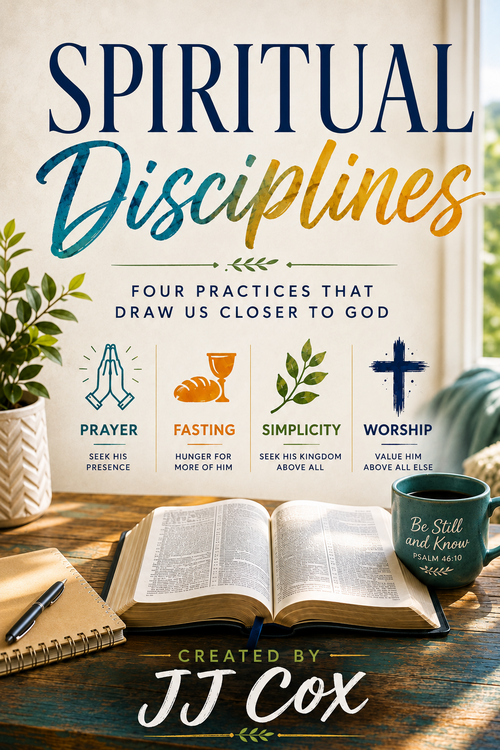
Spiritual Disciplines
Introduction
Every healthy relationship is strengthened by intentional time together.
Whether it is a marriage, a friendship, or the relationship between a parent and child, lasting relationships are not built on occasional moments of attention. They are formed through consistent habits that deepen trust, strengthen love, and create lasting intimacy. Our relationship with God is no different.
Many Christians genuinely desire to grow spiritually, yet often find themselves asking why they feel stuck. They attend church, read an occasional passage of Scripture, and believe in Christ, but still sense that something is missing. More often than not, the issue is not a lack of desire. It is a lack of intentional practice.
Throughout Scripture we find ordinary men and women who cultivated lives that consistently sought after God. They prayed. They fasted. They worshiped. They learned to live with hearts that were not consumed by the distractions of this world but were instead fixed upon the presence of God. These practices have become known as the spiritual disciplines.
The word discipline can sometimes carry a negative meaning. It sounds rigid or demanding, as though Christianity were merely a list of rules to follow. Nothing could be further from the truth. Spiritual disciplines are not about earning God's love or proving our worthiness. We are saved entirely by the grace of God through faith in Jesus Christ. His love is not something we achieve—it is something we receive.
The disciplines simply position us to know Him more deeply.
They move us beyond surface-level living and invite us into a life where our faith becomes more than knowledge. They help us experience the presence of God in ways that transform our hearts, renew our minds, and shape every area of our lives.
These disciplines are not reserved for pastors, scholars, or Christians who have followed Christ for decades. They are for every believer who desires to grow. They do not require extraordinary knowledge or remarkable ability. They simply require a willing heart that is committed to pursuing God consistently.
Over the next several chapters we will explore four foundational spiritual disciplines that have shaped the lives of believers throughout history:
Prayer.
Fasting.
Simplicity.
Worship.
Each one teaches us something unique about God's character while revealing something about our own hearts. Each one invites us to surrender another area of our lives to His leadership. Together they become habits that move us beyond simply believing in Christ toward becoming more like Him.
The goal of this book is not to master four spiritual practices.
The goal is to know God more intimately.
My prayer is that these chapters will encourage you to go farther than you have allowed yourself to go before. That your walk with Christ will become deeper, your faith stronger, and your desire for His presence greater than it has ever been.
God has always desired more than outward obedience.
He desires hearts that seek Him.
May these pages challenge us to become people who do exactly that.
Chapter One
Prayer
"Very early in the morning, while it was still dark, Jesus got up, left the house and went off to a solitary place, where he prayed." — Mark 1:35
Prayer has always been one of the defining characteristics of God's people. Throughout Scripture, we see men and women calling upon the Lord in moments of joy, sorrow, uncertainty, and victory. From Genesis to Revelation, prayer is woven into the lives of those who walked closely with God. Yet no example is more compelling than the life of Jesus Himself.
If anyone could have accomplished the work of God without stopping to pray, it would have been Jesus.
He possessed all authority. He knew the Father's will perfectly. He was without sin and fully capable of accomplishing every task set before Him. Yet, repeatedly throughout the Gospels, we find Him withdrawing from the crowds to spend time alone with His Father.
That should immediately capture our attention.
Prayer was never an afterthought for Jesus. It was never something He did only when life became difficult. It was not reserved for emergencies or moments of desperation. Prayer was woven into the rhythm of His life because communion with the Father was His highest priority.
Mark gives us a remarkable glimpse into one of those moments.
Before we arrive at verse thirty-five, we have already witnessed what most of us would consider an exhausting day. Jesus had entered the synagogue and taught with authority. He cast out an unclean spirit before those who were present. Leaving the synagogue, He entered Peter's home where He healed Peter's mother-in-law of her fever. As evening arrived, people from throughout the town began bringing the sick, the hurting, and those oppressed by demons. Scripture says the whole town gathered at the door as Jesus continued ministering late into the evening.
Imagine the physical demands of that day.
Conversation after conversation.
Healing after healing.
Teaching.
Encouraging.
Ministering.
Listening.
Serving.
By the time the crowds finally dispersed, very little of the night would have remained. Most of us would have looked forward to sleeping in the following morning.
Jesus did something altogether different.
"Very early in the morning, while it was still dark, Jesus got up, left the house and went off to a solitary place, where he prayed."
That single verse reveals something significant about the priorities of Jesus.
Prayer came before comfort.
Prayer came before breakfast.
Prayer came before the responsibilities waiting for Him that day.
Prayer even came before additional sleep.
That is not because sleep, food, or work are unimportant. Rather, Jesus understood that nothing was more essential than spending time with His Father before stepping into another day of ministry.
The first lesson we learn is that prayer is an act of discipline.
Discipline is rarely about doing what is convenient. It is choosing what is necessary over what is comfortable.
Jesus demonstrates that spiritual strength is not found by squeezing prayer into whatever moments remain after everything else has been accomplished. Instead, prayer becomes the foundation upon which everything else is built.
Far too often we approach prayer in the opposite way.
We begin our day checking emails, scrolling through headlines, answering text messages, rushing to work, solving problems, and making decisions. Then, if time allows, we offer a quick prayer before falling asleep at night.
Jesus modeled a different pattern.
He sought God before the demands of the day ever had an opportunity to shape His thinking.
Many people ask whether they have to pray first thing in the morning.
The better question is not, "Do I have to?"
The better question is, "What will it take for me to make prayer a priority?"
Sometimes that means going to bed earlier.
Sometimes it means turning off the television.
Sometimes it means putting the phone away.
Sometimes it simply means creating enough margin to meet with God before everything else begins demanding our attention.
The Psalms echo this same priority.
David writes, "In the morning, Lord, you hear my voice; in the morning I lay my requests before you and wait expectantly."
Again he declares, "I cry to you for help, O Lord; in the morning my prayer comes before you."
There is something profoundly shaping about giving God the first moments of the day.
Not because He needs our attention first.
Because we need His presence first.
Prayer is not another task to complete.
It is the place where our hearts are aligned with His before we take another step.
The discipline of prayer is not about checking a spiritual box. It is about cultivating a relationship. Like every healthy relationship, that connection grows stronger the more time we intentionally invest in it.
If Jesus, the very Son of God, consistently made time to withdraw from the demands of life to spend time with His Father, then how much more should we? His example removes every excuse we might be tempted to make. If He could prioritize prayer in the midst of constant ministry, then surely we can learn to prioritize prayer in the midst of our own busy schedules.
The challenge is not whether prayer is important.
The challenge is whether we believe it is important enough to order our lives around it.
Prayer requires discipline, but discipline alone is not enough. If prayer simply becomes another routine, it can lose its purpose just as easily as any other religious activity. Prayer is much more than a habit. It is an invitation into humility.
Prayer Is an Act of Humility
One of the greatest dangers we face as followers of Christ is believing we can successfully navigate life on our own.
We may never say those words aloud, but our actions often reveal that belief.
We make decisions before seeking God.
We solve problems with our own wisdom.
We rely on our own experience.
Then, when we finally encounter something beyond our ability to control, we remember to pray.
Prayer was never intended to be our last resort.
It was always meant to be our first response.
Jesus models this beautifully in Mark's Gospel.
Think about everything He already knew before beginning that day.
He knew where He would preach.
He knew whom He would heal.
He knew the conversations He would have.
He knew the people He would encounter.
Nothing about the coming day surprised Him.
Yet before stepping into any of it, He chose to spend time with His Father.
That tells us something significant.
Prayer was never about informing God of what needed to happen.
It was about remaining in complete dependence upon the Father.
This is the posture of humility.
Prayer reminds us that life is no longer centered around ourselves. We are not living independently from God, trying to accomplish His work with our own strength. We are living as people who have surrendered our lives to Him, inviting Him to direct every decision we make.
Every one of us wakes up each morning with responsibilities.
There are bills to pay.
Conversations to have.
Appointments to keep.
Families to care for.
Jobs to perform.
Ministries to serve.
Schedules to manage.
Like Jesus, we have a day full of responsibilities waiting for us.
Unlike Jesus, however, we often convince ourselves that we can handle them on our own.
We trust our calendars.
We trust our education.
We trust our experience.
We trust our planning.
Yet we fail to seek the One who holds the day itself in His hands.
Prayer changes that perspective.
Before we accomplish anything, we acknowledge the One who makes everything possible.
Before making our own plans, we submit ourselves to His.
Before relying upon our own wisdom, we seek His.
That is why prayer is fundamentally an act of surrender.
It bends my will toward God's will.
Jesus taught this truth in a powerful way when He instructed His disciples about prayer. He reminded them that their Father already knows what they need before they ask.
At first glance, that raises an interesting question.
If God already knows my needs, why should I pray?
Because prayer is not about informing God.
Prayer is about transforming us.
Every time we come before Him, we acknowledge that we are dependent upon Him. We position ourselves to receive what He desires to give us.
His direction.
His wisdom.
His forgiveness.
His peace.
His strength.
Prayer places us where our hearts become receptive to His work.
It is in those quiet moments before God that our ambitions begin to change.
Our priorities begin to shift.
Our attitudes soften.
Our perspective broadens.
We stop asking God to bless our plans and begin asking Him to reveal His.
That is what humility looks like.
It is choosing God's leadership over our own.
It is recognizing that His wisdom will always exceed ours.
It is trusting that His purposes are always greater than anything we could design for ourselves.
Prayer reminds us daily that we were never meant to carry the weight of life alone.
We were created to walk with the One who carries us.
When discipline leads us into humility, something remarkable begins to happen.
God strengthens us for whatever lies ahead.
Prayer Leads Us to Strength
There is another lesson found in Mark's account that is easy to overlook.
After spending time alone with the Father, the disciples eventually found Jesus and urged Him to return. The crowds were already searching for Him. There were more people to teach, more people to heal, and more needs to meet.
Jesus' response is simple.
"Let us go."
Those three words reveal the result of a life grounded in prayer.
There is no hesitation.
There is no uncertainty.
There is no fear.
There is simply confidence to move forward because time with the Father had prepared Him for whatever awaited Him.
This was not the only time Jesus used those words.
Near the end of His earthly ministry, in the Garden of Gethsemane, Jesus spent time in agonizing prayer before His arrest. Luke tells us His anguish was so great that His sweat became like drops of blood falling to the ground. He knew exactly what lay ahead—the betrayal, the trial, the suffering, and ultimately the cross.
When He returned to His sleeping disciples, He awakened them and said once again,
"Rise, let us go."
Nothing about His circumstances had changed.
The cross was still before Him.
The suffering was still coming.
The betrayal had not disappeared.
Yet after prayer, He walked toward His calling instead of away from it.
That is what prayer produces.
It does not always remove the burden.
It strengthens us to carry it.
Too often we view prayer as a means of escaping difficulty. We ask God to remove every obstacle, solve every problem, and eliminate every hardship. While there are certainly times when God answers those prayers in miraculous ways, prayer more often changes the person who is praying than it changes the circumstance itself.
God gives us courage where fear once ruled.
He gives us peace where anxiety once lived.
He gives us confidence where uncertainty once prevailed.
Prayer prepares our hearts to face whatever God has called us to walk through.
The Apostle Paul echoes this truth in his letter to the Philippians.
He writes,
"Do not be anxious about anything, but in everything, by prayer and petition, with thanksgiving, present your requests to God. And the peace of God, which transcends all understanding, will guard your hearts and your minds in Christ Jesus."
Notice what Paul does not promise.
He does not promise that every problem disappears.
He does not promise that every trial ends immediately.
He promises peace.
Not ordinary peace.
A peace that surpasses understanding.
It is the kind of peace that cannot be explained by circumstances because it was never produced by circumstances. It is produced by the presence of God.
Every one of us carries burdens.
Some carry the burden of uncertainty about the future.
Others carry the weight of broken relationships.
Some wrestle with temptation every day.
Others battle fear, anxiety, disappointment, grief, or regret.
Prayer becomes the place where we lay those burdens before the Lord.
We stop pretending we are strong enough to carry them ourselves.
We release them into the hands of the One who has invited us to cast all our cares upon Him.
That exchange changes us.
Our worries become trust.
Our fear becomes faith.
Our striving becomes surrender.
Our weakness becomes an opportunity for God's strength to be displayed.
The more consistently we practice prayer, the more we discover that strength is not something we manufacture.
It is something we receive.
The strength to forgive.
The strength to persevere.
The strength to remain faithful.
The strength to continue serving when we are weary.
The strength to love people who are difficult to love.
The strength to obey even when obedience is costly.
All of it is found in the presence of God.
That is why prayer can never become an optional part of the Christian life.
It is not merely preparation for ministry.
It is preparation for life itself.
Every day presents opportunities to trust God or trust ourselves.
Every day offers countless moments where we can either rely on our own wisdom or seek His direction.
Jesus chose prayer because He understood where true strength was found.
His example invites us to make the same choice.
When we discipline ourselves to seek God...
When we humble ourselves before Him...
When we surrender our lives into His hands...
We discover a strength that we could never produce on our own.
Prayer does not simply change what God does.
Prayer changes us.
And as we are changed, we become more like Christ.
Chapter Two
Fasting
"When you fast..." — Matthew 6:16
Few spiritual disciplines have been misunderstood more than fasting.
For some, fasting is viewed as an outdated religious practice that has little relevance today. Others see it as something reserved for especially mature Christians or for extraordinary moments of spiritual crisis. Still others approach fasting as though it were a way to persuade God to answer prayers or bless their lives.
The Bible presents fasting very differently.
Fasting is not about manipulating God. It is not a way of earning His favor or proving our spirituality. It is an act of worship that intentionally sets aside physical desires in order to focus more fully on the presence and purposes of God. Throughout Scripture, fasting consistently directs our attention away from ourselves and toward Him.
Jesus never commanded His followers to fast as though it were another religious obligation. Yet He also never treated it as something unusual. In the Sermon on the Mount He simply said, "When you fast..."
Notice what He did not say.
He did not say, "If you fast."
Neither did He say, "You must fast."
He simply assumed that His followers would practice this spiritual discipline and then taught them how to do it with the proper heart.
That should shape the way we think about fasting today.
Rather than asking whether fasting is required, perhaps we should ask whether we have neglected one of the spiritual disciplines Jesus assumed would naturally be part of a believer's life.
Before we explore why we fast, it is helpful to understand that Scripture describes several different kinds of fasting.
Understanding the Different Types of Fasting
Throughout the Bible we encounter different expressions of fasting, each serving a spiritual purpose. While the methods may vary, the heart behind them remains the same. Fasting is always intended to draw us closer to God.
The first and most common is what we might call a normal fast.
A normal fast involves abstaining from food while continuing to drink water. Jesus Himself provides the clearest example during His forty days in the wilderness. Luke tells us that He "ate nothing during those days," and when the fast ended, "He was hungry."
That detail is significant.
The temptation that followed centered around bread, not water. Satan tempted Jesus to satisfy His hunger, suggesting that He turn stones into bread. The emphasis on food indicates that while Jesus abstained from eating, He most likely continued to drink water throughout His fast.
The second type is a partial fast.
Rather than abstaining from all food, a partial fast limits what is eaten. One of the best-known examples is found in the life of Daniel. During a three-week period, Daniel chose to abstain from rich foods, meat, and wine as he sought the Lord. This particular fast has become widely known today as the "Daniel Fast," and many believers have adopted it as a practical way of setting aside certain comforts while pursuing spiritual growth.
The third type is an absolute fast.
Unlike the previous two, an absolute fast involves abstaining from both food and water. Scripture presents these occasions as extraordinary moments marked by desperate dependence upon God.
When Queen Esther learned of the plot to destroy the Jewish people, she instructed Mordecai to gather the Jews together and fast for three days without eating or drinking before she approached the king. Paul also experienced a three-day absolute fast following his dramatic encounter with Christ on the road to Damascus. Moses participated in an extraordinary forty-day absolute fast while receiving the Law from God on Mount Sinai.
These examples remind us that absolute fasts were never ordinary practices. They occurred during unique moments in God's redemptive work and should never be approached casually. Scripture presents them as the exception rather than the rule.
Understanding these different expressions of fasting helps remove much of the confusion surrounding the discipline.
The method itself is never the primary focus.
The heart always is.
Whether someone participates in a normal fast, a partial fast, or another biblically grounded expression of fasting, the purpose remains unchanged.
Fasting is about seeking God.
It is about creating space for Him to shape our hearts in ways that ordinary routines often cannot.
But if the purpose of fasting is not simply to go without food, then what is its ultimate purpose?
That question brings us to the heart of this discipline.
The Primary Purpose of Fasting
The primary purpose of fasting is not self-improvement.
It is not self-denial for its own sake.
It is not even personal breakthrough.
The primary purpose of fasting is the glory of God.
Everything else is secondary.
Fasting Is First and Foremost About God
Whenever we begin talking about spiritual disciplines, there is always the temptation to make them about ourselves. We naturally ask questions like, What will I gain? How will this benefit me? What difference will it make in my life?
While those are understandable questions, they are not the place Scripture begins.
Fasting begins with God.
Its first purpose is His glory.
One of the clearest illustrations of this truth is found in the book of Zechariah. The Jewish people had spent seventy years in Babylonian captivity. During those years they faithfully observed annual fasts to remember significant moments in Israel's history. At one time, those fasts had been sincere expressions of grief, repentance, and dependence upon God.
Over time, however, something changed.
The practice remained.
The purpose was forgotten.
What had once been an act of worship slowly became little more than tradition.
The people continued observing the fast because it had always been observed. It became another event on the calendar rather than an opportunity to seek the Lord. The ritual survived, but the heart behind it disappeared.
That is always the danger with any spiritual discipline.
When we continue doing something long enough without remembering why we do it, something else eventually fills the void.
History gives us countless examples of this.
Consider Thanksgiving.
When George Washington first proclaimed a national day of thanksgiving and prayer, the purpose was exactly that—to give thanks to God. Decades later, Abraham Lincoln renewed that same emphasis during one of America's darkest seasons. Yet today, for many people, Thanksgiving has become associated primarily with large meals, shopping, and football. None of those things are inherently wrong, but they reveal how easily the original purpose of something can be overshadowed by tradition.
The same thing can happen with fasting.
It is entirely possible to abstain from food while never truly seeking God.
It is possible to complete a fast and yet never allow Him to search our hearts.
It is even possible to become proud of our fasting, defeating the very purpose for which it was given.
That is why God spoke so directly through the prophet Zechariah.
He asked His people,
"When you fasted... was it really for Me that you fasted?"
That question deserves our attention today just as much as it did then.
Why am I fasting?
Is it to impress others?
Is it to prove my own spiritual maturity?
Is it because everyone else around me is doing it?
Or is it because I genuinely desire to know God more deeply and bring Him glory?
The answer to that question determines whether fasting becomes worship or merely another religious activity.
When fasting is centered on God, it changes everything.
Instead of focusing on what we are giving up, we begin focusing on the One we are pursuing.
Instead of measuring the difficulty of the fast, we measure the faithfulness of God.
Instead of drawing attention to ourselves, we become more aware of His presence.
That is the heart of biblical fasting.
Do We Have to Fast?
Questions about fasting often lead to another important question.
Is fasting required?
The Bible does not present fasting as a legal requirement for Christians. There is no command stating that every believer must fast according to a particular schedule or for a specific length of time.
At the same time, Scripture consistently presents fasting as a normal part of a believer's relationship with God.
Jesus said, "When you fast..."
He assumed His followers would fast.
He simply instructed them how to do it with the right heart.
That is an important distinction.
Christianity has never been about checking religious boxes.
Our obedience flows out of our relationship with Christ rather than obligation alone.
There are seasons when God clearly leads His people to fast.
Sometimes those moments are deeply personal. They become private opportunities to seek the Lord with greater focus and dependence. At other times, Scripture records occasions when God called entire communities or nations into fasting during moments of repentance, crisis, or spiritual renewal. In every case, however, the emphasis remains the same.
We fast because God is leading us to seek Him.
Not because someone else expects us to.
Not because fasting earns God's approval.
Not because it makes us more valuable than another believer.
We fast because we desire more of Him.
When that becomes our motivation, fasting moves beyond obligation and becomes worship.
And once our hearts are rightly focused on God, we begin discovering that fasting produces remarkable spiritual fruit—not because food has been removed, but because God uses the discipline to reveal what has been hidden within us.
The Secondary Purposes of Fasting
When our hearts are centered on God's glory, we begin to experience the personal benefits that naturally flow from fasting. These are not the reason we fast, but they are often the ways God uses fasting to transform us.
Scripture reveals several secondary purposes that help explain why fasting has remained such a meaningful spiritual discipline throughout the history of God's people.
Fasting Exposes What Controls Us
One of the first things fasting accomplishes is that it exposes the areas of our lives that have quietly gained control over us.
Most of us have developed ways of coping with life's pressures without even realizing it.
When anxiety rises, some people turn to food.
When stress increases, others become withdrawn.
Some hide behind busyness.
Others hide behind humor or sarcasm.
Still others seek comfort in entertainment, social media, shopping, or countless other distractions.
None of these things necessarily appear sinful on the surface. Yet they often become substitutes for the comfort and security that should ultimately be found in God.
Fasting removes one of those comforts.
When we intentionally set aside food for a season, we often discover that hunger is not the greatest struggle. Instead, our emotions begin to surface.
Impatience becomes more noticeable.
Frustration becomes more evident.
Pride reveals itself.
Anxiety becomes harder to ignore.
What fasting uncovers was already present.
It simply removes the distractions that had been covering it.
In that sense, fasting becomes a gracious gift from God. Rather than condemning us, He lovingly reveals the areas where our hearts still need His transforming work.
David understood this when he wrote,
"I humbled my soul with fasting."
Humility begins when we honestly allow God to show us what has been hiding beneath the surface.
Fasting provides that opportunity.
Instead of masking our weaknesses, it brings them into the light where God's grace can begin changing us.
Fasting Reminds Us What Truly Sustains Us
Hunger has a unique way of reminding us how dependent we are.
Normally, when we become hungry, we simply eat.
The discomfort lasts only a short time before it disappears.
Fasting interrupts that pattern.
Every hunger pang becomes a reminder that there is a deeper hunger within every human heart.
When Satan tempted Jesus in the wilderness, Jesus responded by saying,
"Man shall not live on bread alone, but on every word that comes from the mouth of God."
Those words reveal one of the greatest lessons fasting teaches us.
Food sustains the body.
God sustains life.
That does not diminish the importance of food. God created it as a gift and a necessity. But fasting reminds us that physical nourishment was never intended to become our greatest source of dependence.
As we temporarily set aside one kind of nourishment, we intentionally feast upon another.
A biblical fast should always draw us deeper into God's Word.
As physical hunger increases, our desire for Scripture should increase as well.
Instead of spending time preparing meals, we spend time listening to God's voice.
Instead of filling ourselves with food, we fill our hearts with His truth.
Jesus illustrated this beautifully in John's Gospel.
When His disciples urged Him to eat, He answered,
"I have food to eat that you know nothing about. My food is to do the will of Him who sent Me and to finish His work."
Jesus was not saying that physical food no longer mattered.
He was teaching that there is a deeper satisfaction found in walking closely with the Father.
Fasting reminds us of that reality.
It teaches us that while our bodies long for food, our souls were created to hunger for God.
Fasting Restores Perspective
One of the greatest challenges of modern life is that we often allow good things to become ultimate things.
Our calendars become crowded.
Our priorities become scattered.
Our schedules become so full that we have little room left for what matters most.
Fasting has a way of restoring balance.
It helps us distinguish between what is essential and what is merely important.
The Apostle Paul wrote,
"Everything is permissible for me—but not everything is beneficial."
Those words invite us to evaluate our lives honestly.
Many things compete for our attention.
Careers.
Sports.
Hobbies.
Activities.
Possessions.
None of those things are inherently wrong.
Many of them are wonderful gifts from God.
The danger comes when those gifts quietly replace the Giver.
We begin arranging our lives around things that were never intended to occupy first place in our hearts.
Fasting presses pause on the constant pursuit of more.
It reminds us that our greatest need is not another possession, another accomplishment, or another achievement.
Our greatest need is God Himself.
When our priorities become properly ordered, everything else begins finding its rightful place.
The discipline of fasting gently leads us back to that simplicity.
It reminds us that while many things are valuable, only one thing is indispensable.
God's presence.
Fasting Deepens Our Prayer Life
There is one final blessing that naturally flows from fasting.
It deepens our prayer life.
Prayer and fasting have always belonged together. Throughout Scripture, whenever God's people entered seasons of fasting, they were also entering seasons of intentional prayer. One discipline strengthens the other.
When we remove the distractions that normally occupy our attention, we discover more time to listen.
More time to reflect.
More time to seek the Lord.
More time to allow Him to search our hearts.
As God reveals areas where we need to grow, our prayers begin to change.
Instead of offering hurried requests, we begin praying with greater sincerity.
Instead of focusing only on what we want God to do for us, we begin asking what He desires to do within us.
That is one of the greatest gifts fasting provides.
It changes the conversation.
As we spend time in God's presence, He begins revealing attitudes we had overlooked.
He exposes motives that need to be purified.
He uncovers fears we have been carrying.
He reminds us of His faithfulness.
Every one of those discoveries shapes the way we pray.
The more clearly we see ourselves, the more deeply we appreciate His grace.
The more we recognize His holiness, the more we desire to become like Him.
The more we understand His love, the more naturally our hearts begin to worship.
Fasting creates room for those conversations to happen.
It slows us down enough to hear the gentle voice of the Holy Spirit speaking into our lives.
It reminds us that prayer is not simply presenting a list of requests.
Prayer is fellowship.
It is communion.
It is learning to delight in God's presence.
As that relationship grows, our prayers become less about changing our circumstances and more about allowing God to transform our hearts.
That is where lasting spiritual growth begins.
Living a Life of Dependence
Every spiritual discipline ultimately leads us to the same place.
Dependence upon God.
Fasting reminds us that we are not sustained by food alone.
We are sustained by the One who gives us life.
It teaches us that our deepest hunger cannot be satisfied by anything this world offers.
Only God can fill that place.
As we willingly set aside physical comforts for a season, we discover spiritual realities that are often hidden beneath the noise of everyday life.
We become more aware of His presence.
More sensitive to His voice.
More willing to trust His leadership.
More dependent upon His strength.
That is why fasting has remained such an important discipline throughout the history of God's people.
It has never been about proving our commitment.
It has always been about deepening our relationship with God.
Jesus assumed His followers would fast, not because He wanted to burden them with another religious practice, but because He knew what they would discover on the other side of it.
They would discover that God is enough.
Every fast eventually comes to an end.
Meals resume.
Daily routines return.
Life moves forward.
But if we have truly sought the Lord during that season, we do not return unchanged.
We carry with us a greater awareness of His faithfulness.
A deeper confidence in His provision.
A renewed dependence upon His presence.
And perhaps most importantly, we leave with hearts that have been reminded of what matters most.
The greatest reward of fasting is never the fast itself.
The greatest reward is knowing God more intimately than we did before.
Chapter Three
Simplicity
"But seek first His kingdom and His righteousness, and all these things will be given to you as well." — Matthew 6:33
The world constantly tells us that more is better.
More money.
More success.
More possessions.
More opportunities.
More influence.
More recognition.
From the moment we wake up until we go to sleep, we are surrounded by messages encouraging us to pursue more. We are told that fulfillment is found in acquiring the next thing, achieving the next goal, or reaching the next milestone.
Yet Jesus offers a completely different perspective.
Rather than chasing everything the world says we need, He calls us to pursue one thing above everything else.
"Seek first His kingdom and His righteousness."
That single statement becomes the foundation of a life marked by simplicity.
Biblical simplicity is often misunderstood. It is not merely about owning fewer possessions or living with less. It is not a command to reject success, avoid ambition, or withdraw from the responsibilities of everyday life.
Simplicity is about priorities.
It is choosing to place God at the center of every decision we make.
When that priority is established correctly, everything else begins to find its proper place.
When it is not, even good things can slowly become distractions that pull our hearts away from Him.
Simplicity Begins with Priority
The first two words of Matthew 6:33 are easy to overlook.
"Seek first."
Jesus does not simply tell us what to seek.
He tells us when to seek it. First.
That order changes everything.
Every day we establish priorities. Some are intentional. Others happen almost without us realizing it. What we choose to value most ultimately determines how we spend our time, our energy, our resources, and our attention.
Our priorities shape our lives long before we recognize they are doing so.
One example is what many people call the American Dream.
At its foundation are worthwhile pursuits.
Owning a home.
Providing for a family.
Building a successful business.
Enjoying freedom.
Creating opportunities for future generations.
None of those goals are wrong.
In fact, many of them reflect blessings that God graciously provides.
The danger comes when those blessings quietly become our highest pursuit.
Without realizing it, we begin measuring success by promotions, possessions, accomplishments, or financial security rather than by our faithfulness to God.
Our calendars become consumed with work.
Our conversations revolve around achievement.
Our energy is invested almost entirely in building a comfortable life.
Little by little, the pursuit of God's Kingdom slips lower on the list—not because we intended it to, but because other priorities slowly crowded it out.
Jesus reminds us that there is another way to live.
His Kingdom is never meant to compete with everything else in our lives.
It is meant to govern everything else.
That is what simplicity looks like.
Not less responsibility.
Not fewer opportunities.
But one clear priority that gives proper order to every other area of life.
When Good Things Become Ultimate Things
One of the greatest dangers facing believers today is not necessarily choosing sinful things.
It is allowing good things to become ultimate things.
That is far more subtle.
Consider the life of a young family.
A husband and wife begin their marriage with a sincere desire to honor God. They faithfully attend church, pray together, and dream about building a Christ-centered home.
As the years pass, life becomes busier.
Children arrive.
Expenses increase.
The family needs a larger home.
A larger vehicle.
More groceries.
School supplies.
Music lessons.
Sports activities.
College savings.
Vacation planning.
None of those needs are wrong.
They are simply part of raising a family.
To provide for those needs, the husband begins working longer hours. Promotions bring additional income, but they also require greater responsibility and more time away from home.
Wanting to help, his wife accepts part-time work.
Eventually part-time becomes full-time.
Together they accomplish many of the goals they once hoped for.
Yet something unexpected begins happening.
The very family they were working so hard to provide for has less time together.
Conversations become shorter.
Meals become rushed.
Church becomes something they attend when the schedule allows instead of the foundation around which life is built.
Slowly, almost unnoticed, the priorities have shifted.
God has not been intentionally rejected.
He has simply been moved.
That is how subtle misplaced priorities can be.
Satan rarely succeeds by convincing us to abandon our faith overnight.
Far more often, he simply distracts us with good things until they occupy the place that belongs to God alone.
Jesus lovingly calls us back to simplicity.
Not by asking us to abandon our responsibilities.
But by reminding us to place His Kingdom above every one of them.
When our priorities are properly ordered, our families benefit.
Our work benefits.
Our relationships benefit.
Everything benefits because God is leading what matters most.
Seeking His Kingdom and His Righteousness
If Jesus tells us to seek God's Kingdom first, then it is worth asking an important question.
What is the Kingdom of God?
For many people, the Kingdom of God immediately brings to mind heaven—a place believers will one day experience when Christ returns. While that is certainly part of God's Kingdom, Jesus spoke about it as something much closer than a future destination.
The Kingdom of God is the rule and reign of God in the lives of His people.
It is wherever His presence is welcomed, His will is obeyed, and His character is reflected.
Throughout the New Testament, we are given beautiful glimpses of what God's Kingdom is like.
Jesus tells us that the Kingdom is near.
He reminds us that the poor in spirit are welcomed there.
Those who are persecuted for righteousness have a place within it.
It belongs to those who desire to do the will of the Father.
It is a Kingdom where darkness has no authority, where evil cannot ultimately prevail, and where God's power is displayed. Scripture describes it as a priceless treasure, a place where children are welcomed, where peace and joy abound, and where those who have been born again experience the life God intended from the very beginning.
As wonderful as those descriptions are, perhaps the simplest way to understand the Kingdom is this:
Think less about a location...
And more about God's presence.
Jesus was inviting His followers to live every day under the loving rule of God.
That changes the way we read Matthew 6:33.
Seeking His Kingdom is not merely preparing for eternity.
It is choosing today to place every part of life under His authority.
Every decision.
Every relationship.
Every opportunity.
Every challenge.
Every blessing.
Everything is viewed through the lens of God's presence.
Jesus also tells us to seek His righteousness.
Righteousness is one of those words we often hear in church but rarely stop to consider.
At its heart, righteousness means being made right with God.
It is not something we accomplish through our own effort.
It is not earned through good behavior or religious activity.
It is a gift made possible through Jesus Christ.
Because of His sacrifice on the cross, those who place their faith in Him are declared righteous before God. The Apostle Paul writes that Christ, who knew no sin, became sin for us so that in Him we might become the righteousness of God. That incredible exchange is the foundation of the Christian life.
When Jesus tells us to seek God's righteousness, He is inviting us to pursue a life that reflects the character of the One who has already made us right with Himself.
We no longer ask only,
"What do I want?"
Instead, we begin asking,
"What honors God?"
That question changes everything.
When making decisions about our families, we ask what God's Word teaches.
When making financial decisions, we seek biblical wisdom rather than simply following cultural trends.
When facing difficult relationships, we ask how Christ would have us respond.
When choosing leaders, setting priorities, or making plans for the future, we begin with Scripture rather than public opinion.
Seeking God's Kingdom means allowing His presence to shape our perspective.
Seeking His righteousness means allowing His character to shape our lives.
Together they become the foundation of biblical simplicity.
Life no longer revolves around our preferences.
It revolves around His purposes.
And that is where true freedom begins.
When God becomes our highest priority, we no longer have to chase significance because our identity is already secure in Him.
The pursuit of more is replaced by the pursuit of God.
That is the simplicity Jesus offers.
And remarkably, when our lives are centered on Him, we discover that everything else begins falling into its proper place.
"All These Things Will Be Given to You"
There is a promise at the end of Matthew 6:33 that is just as important as the command at the beginning.
Jesus says,
"But seek first His kingdom and His righteousness, and all these things will be given to you as well."
Notice the order.
God never says that the "things" of life are unimportant.
He simply refuses to let them become the priority.
God knows we need food.
He knows we need clothing.
He knows we need homes, employment, relationships, and provision for our families.
Our heavenly Father is fully aware of every need we will ever have.
The invitation of Matthew 6 is not to ignore those needs.
It is to trust the One who already knows them.
When God's Kingdom becomes our highest pursuit, everything else begins falling into its proper place.
That does not mean life suddenly becomes easy.
It does not mean every desire is immediately fulfilled.
Nor does it mean Christians are promised wealth or worldly success.
It means that when God occupies His rightful place, we begin viewing every blessing through the proper perspective.
Family becomes a gift instead of an idol.
Work becomes a calling instead of an identity.
Money becomes a tool instead of a master.
Success becomes an opportunity to glorify God instead of a measure of personal worth.
Nothing changes more dramatically than our perspective.
God desires for His people to experience strong marriages.
He desires healthy families.
He delights in blessing His children.
He gives opportunities, abilities, and resources for His purposes.
None of those blessings are wrong.
The danger comes only when the blessings replace the One who gave them.
Jesus reminds us that the blessings were never intended to become our greatest pursuit.
They are the result of seeking Him first.
That is the simplicity of the Christian life.
When we stop chasing everything else and begin pursuing God above all else, we often discover that He has been faithfully providing for us all along.
Living with a Simpler Heart
A simpler life does not necessarily mean a quieter schedule.
It means a more focused heart.
It means learning to filter every decision through one simple question:
Does this help me seek God's Kingdom first?
That question has a way of bringing remarkable clarity.
Before accepting another commitment, we ask whether it draws us closer to God or distracts us from Him.
Before making a financial decision, we consider whether it reflects biblical wisdom or simply satisfies another desire.
Before filling every available moment with activity, we ask whether we are leaving room for God's presence to shape our lives.
Paul offers practical guidance in his letter to the Philippians.
He encourages believers to rejoice in the Lord, to replace anxiety with prayer, to cultivate thankful hearts, and to fix their minds on whatever is true, noble, right, pure, lovely, admirable, excellent, and praiseworthy. Then he concludes by saying that what they had learned should be put into practice, and the God of peace would be with them.
That is simplicity in action.
It is not complicated.
It is not burdensome.
It is choosing, day after day, to fill our minds with what honors Christ and to order our lives around His presence.
The result is peace.
Not because every circumstance is perfect.
But because our hearts have found their proper center.
We no longer live in constant pursuit of more.
We no longer allow the pressures of the world to dictate our priorities.
Instead, we learn to rest in the faithfulness of God.
The more we seek Him, the more we discover that He has never failed to provide exactly what we need.
A Life Centered on What Matters Most
Simplicity ultimately leads us back to the same truth we have seen throughout every spiritual discipline.
Life is about God.
Prayer teaches us to depend upon Him.
Fasting teaches us to hunger for Him.
Simplicity teaches us to place Him above everything else.
The disciplines are different.
The destination is the same.
Each one calls us to surrender another area of our lives so that Christ may become more fully at the center.
When we seek God's Kingdom first, we begin experiencing the freedom that comes from rightly ordered priorities.
We are no longer controlled by possessions.
We are no longer defined by accomplishments.
We are no longer consumed by the endless pursuit of more.
Instead, we discover that the greatest treasure we could ever possess has been before us all along.
The presence of God.
When He becomes our first priority, everything else begins finding its proper place.
That is the beauty of biblical simplicity.
It is not a life with less.
It is a life where Christ is more.
Chapter Four
Worship
"Worship is simply about value. Worship is our response to whatever we value most in our lives. This is why we all worship; we place value on something. The most important decision of your life is the decision of what you will ultimately value most."
Worship is one of the most familiar words in the Christian vocabulary, yet it is also one of the most misunderstood.
For many people, worship is something that happens for twenty or thirty minutes before a sermon begins. It is the music portion of a church service. It is singing songs, raising hands, or standing quietly while others sing.
While music certainly can be an expression of worship, it is not the definition of worship.
Worship is much larger than that.
At its core, worship is about value.
Every person worships because every person assigns supreme value to something. The question is not whether we worship. The question is what—or who—we worship.
Whatever occupies first place in our hearts will ultimately shape the direction of our lives.
That is why the most important decision we will ever make is determining what we value above everything else.
Throughout this book we have seen this principle repeatedly.
Prayer teaches us to depend upon God.
Fasting teaches us to desire Him more than temporary comforts.
Simplicity teaches us to seek His Kingdom before anything else.
Worship brings each of those disciplines together.
It is the natural response of a heart that has learned to value God above all else.
To understand what true worship looks like, Scripture points us to one of the most remarkable moments in Israel's history.
The life of the prophet Elijah.
Elijah: A Man Who Valued God Above Everything Else
When we first meet Elijah in the pages of First Kings, Israel is experiencing one of its darkest spiritual seasons.
The nation had not abandoned religion.
It had abandoned wholehearted devotion to God.
King Ahab had led the people into widespread idolatry, and the worship of Baal had become deeply woven into the life of the nation. The people attempted to divide their allegiance between the Lord and the false gods surrounding them.
Their lips still acknowledged God.
Their hearts had begun valuing something else.
That is always where idolatry begins.
Rarely does someone wake up one morning and intentionally reject God altogether.
More often, something else slowly begins competing for first place.
Success.
Comfort.
Security.
Approval.
Power.
Possessions.
None of those things necessarily demand our worship.
But if we begin assigning them greater value than our relationship with God, they quietly become the object of our devotion.
Elijah entered that culture with one clear message.
God alone is worthy of worship.
His life became a testimony to what it looks like to trust the Lord completely, even when surrounded by people who had chosen another path.
True worship has never depended upon what everyone else values.
It has always depended upon what God deserves.
The Climate That Shapes Our Worship
Every generation is shaped by the culture in which it lives.
The people of Israel were no different.
Long before Elijah stood on Mount Carmel, God had already warned His people about the danger that prosperity could bring.
In Deuteronomy, before Israel entered the Promised Land, God painted a picture of the blessings that awaited them. They would inherit cities they had not built, homes filled with good things they had not accumulated, wells they had not dug, vineyards and olive groves they had not planted.
Then came an important warning.
"Be careful that you do not forget the Lord."
That warning is just as relevant today as it was thousands of years ago.
Most people assume spiritual danger comes during seasons of hardship.
Sometimes it does.
But Scripture often reminds us that prosperity can become just as dangerous.
When life becomes comfortable, we slowly begin believing we no longer need God as desperately as we once did.
We become self-sufficient.
We begin trusting our careers instead of His provision.
Our savings instead of His faithfulness.
Our plans instead of His guidance.
Our abilities instead of His strength.
Before long, our confidence quietly shifts away from God.
That is exactly what happened in Israel.
God had faithfully provided for His people.
He had rescued them.
Protected them.
Blessed them.
Yet over time, they became more fascinated with the gods of the surrounding nations than with the God who had delivered them.
They had not simply changed religions.
They had changed what they valued.
And worship always follows value.
The same temptation exists today.
Our culture encourages us to value success.
Achievement.
Popularity.
Financial security.
Comfort.
Entertainment.
None of those things are inherently evil.
The danger comes when they quietly become more important than our relationship with Christ.
Whatever receives our greatest affection will eventually receive our worship.
That is why worship is never confined to Sunday morning.
It is revealed every day by the way we spend our time, our attention, our resources, and our lives.
Our calendars often reveal what we value.
Our conversations reveal what captures our hearts.
Our decisions reveal where our trust truly rests.
Worship is not merely expressed through songs.
It is expressed through the priorities of everyday life.
The Clarification on Mount Carmel
The defining moment of Elijah's ministry came on Mount Carmel.
For years the people had attempted to live with divided hearts.
They wanted the blessings of God while continuing to embrace the idols of their culture.
They wanted both.
Elijah confronted that compromise directly.
He challenged the prophets of Baal and called the nation to witness a simple test.
Two altars would be prepared.
Two sacrifices would be offered.
The God who answered with fire would prove Himself to be the one true God.
The prophets of Baal prayed for hours.
They cried out.
They shouted.
They pleaded.
Nothing happened.
No voice answered.
No fire fell.
No response came.
Then Elijah rebuilt the altar of the Lord.
He drenched the sacrifice with water until everything around it was soaked.
Humanly speaking, it was impossible for fire to consume what had been saturated.
That was precisely the point.
What happened next could only be explained by the power of God.
When Elijah prayed, the Lord answered immediately.
Fire fell from heaven and consumed the sacrifice, the wood, the stones, the dust, and even the water surrounding the altar.
There was no longer any confusion.
No uncertainty.
No divided loyalties.
God had made Himself known.
Mount Carmel was never simply about demonstrating miraculous power.
It was about clarifying who alone deserved the worship of His people.
Sometimes God lovingly brings us to moments of clarification as well.
Not always through dramatic miracles.
Often through ordinary circumstances that reveal where our hearts truly are.
He exposes the things we have begun trusting.
He reveals the priorities that have quietly taken His place.
Not to condemn us.
But to call us back.
True worship begins whenever we stop trying to divide our hearts between God and everything else.
It begins when we recognize that only He is worthy of first place.
Worship Requires Sacrifice
One of the defining characteristics of true worship has always been sacrifice.
Throughout the Old Testament, worship was often accompanied by offerings placed upon an altar. Those sacrifices were visible reminders that approaching a holy God required surrender. They demonstrated that worship always costs us something.
Today, because of the finished work of Jesus Christ, we no longer bring sacrifices of animals to an altar.
Christ became the perfect sacrifice once and for all.
Yet worship still requires sacrifice.
Not because we are earning God's acceptance.
But because genuine worship always calls us to surrender something of ourselves.
The writer of Hebrews reminds us,
"Without faith it is impossible to please God."
Faith itself is an act of worship.
Every time we choose to trust God instead of ourselves, we are placing Him in His rightful place.
Every act of obedience becomes an expression of worship.
Sometimes that sacrifice means laying aside our pride so we can forgive someone who has hurt us.
Sometimes it means giving generously when it would be easier to hold tightly to what we have.
Sometimes it means remaining faithful when obedience is difficult.
Sometimes it means choosing God's truth over the approval of the world.
Every one of those decisions declares something.
They declare that God is worth more than our comfort.
More than our reputation.
More than our possessions.
More than our own desires.
That is worship.
Worship has never been measured by how loudly we sing.
It has always been measured by how willingly we surrender.
The songs we sing on Sunday become meaningful only when they reflect the lives we are living Monday through Saturday.
If our lips proclaim God's greatness while our hearts pursue something else, worship becomes little more than empty words.
God has always desired more than outward expressions.
He desires hearts that belong completely to Him.
That is why worship cannot be separated from the rest of the Christian life.
It influences our decisions.
Our relationships.
Our priorities.
Our generosity.
Our character.
Everything we do becomes an opportunity to declare the worth of the One we love most.
A Life of Worship
When we think about worship, it is tempting to reduce it to moments.
A church service.
A favorite hymn.
A powerful worship song.
A moving prayer.
Those moments are important.
They encourage us.
They remind us of God's faithfulness.
They unite believers in praising the Lord.
But worship was never intended to remain inside the walls of a church building.
Paul writes in Romans that we are to offer our bodies as living sacrifices, holy and pleasing to God, describing this as our spiritual act of worship.
In other words, worship becomes a way of life.
It is reflected in the integrity with which we conduct our work.
It is seen in the compassion we show our neighbors.
It is demonstrated by the patience we extend to our families.
It is revealed in our willingness to forgive.
It is expressed through our generosity, our humility, and our obedience.
Every ordinary moment becomes an opportunity to honor the Lord.
When worship becomes a lifestyle instead of merely an event, our entire perspective begins to change.
We no longer divide life into sacred and ordinary moments.
Everything belongs to God.
Every conversation.
Every responsibility.
Every decision.
Every blessing.
Every trial.
Every part of life becomes another opportunity to reflect His greatness.
That is what Elijah understood.
He did not simply worship God on Mount Carmel.
His entire life testified that God alone was worthy of complete devotion.
The same invitation stands before us today.
Every day we decide what we value most.
Every decision either moves us toward wholehearted devotion or divided allegiance.
Jesus made the choice clear when He taught that no one can serve two masters.
Eventually, every heart gives its highest affection to someone or something.
The greatest decision we will ever make is ensuring that our greatest affection belongs to Christ alone.
Prayer teaches us to seek Him.
Fasting teaches us to hunger for Him.
Simplicity teaches us to prioritize Him.
Worship teaches us to treasure Him above everything else.
When those disciplines become part of our daily lives, we discover that worship is no longer something we attend.
It becomes who we are.
Final Thought
Every relationship grows through intentional investment.
No marriage becomes healthy by accident. No friendship deepens without time. No family flourishes apart from love that is consistently demonstrated. The same is true of our relationship with God.
Throughout these chapters we have explored four spiritual disciplines that have shaped the lives of God's people for generations. While each discipline is unique, they all lead us toward the same destination—a deeper relationship with our Heavenly Father.
Prayer teaches us to slow down and listen before we speak. It reminds us that we were never meant to carry life's burdens alone. Every conversation with God becomes an opportunity to surrender our plans, receive His wisdom, and find strength for whatever lies ahead.
Fasting teaches us that our greatest hunger is not physical but spiritual. As we willingly set aside temporary comforts, we are reminded that nothing satisfies the soul like the presence of God. We discover that He is sufficient, faithful, and worthy of our complete trust.
Simplicity calls us to reorder our priorities. In a world constantly demanding more of our time, our attention, and our affection, Jesus gently reminds us to seek His Kingdom first. When Christ occupies the center of our lives, everything else begins to find its proper place.
Worship becomes the natural response to all of it.
The more we know God, the more we value Him.
The more we value Him, the more we desire to honor Him.
Eventually, worship moves beyond songs we sing on Sunday and becomes the way we live every day.
That is the beauty of the spiritual disciplines.
They are not separate pursuits competing for our attention.
They work together.
Prayer leads us into dependence.
Fasting deepens that dependence.
Simplicity protects it by keeping Christ at the center.
Worship becomes the overflow of a heart that treasures Him above everything else.
None of these disciplines earn God's love.
His love was already demonstrated through Jesus Christ.
We do not pray to make Him love us more.
We do not fast to gain His acceptance.
We do not simplify our lives to prove our devotion.
We do not worship to impress Him.
We practice these disciplines because we already belong to Him.
Grace is the foundation.
The disciplines are simply the pathway that helps us grow in the relationship His grace has made possible.
Perhaps the greatest challenge facing the Church today is not a lack of biblical knowledge.
It is a lack of intentional pursuit.
We have more resources than any generation before us. We have access to countless sermons, books, podcasts, Bible studies, and devotionals. Yet none of those things can replace a daily walk with Christ.
Growth has never depended upon information alone.
It has always depended upon transformation.
Transformation happens as we consistently place ourselves in God's presence, allowing His Spirit to shape our hearts day after day.
Don't feel as though you must master every discipline overnight.
Start where you are.
Set aside time to pray.
Spend time in God's Word.
When He leads you to fast, do so with humility and worship.
Examine your priorities regularly.
Choose each day to value Christ above everything else.
Small acts of faithfulness practiced consistently over time often produce the greatest spiritual growth.
The goal has never been perfection.
The goal is becoming more like Jesus.
As you continue walking with Him, there will always be more to learn, more to surrender, and more of His goodness to experience.
May these disciplines become more than concepts you understand.
May they become habits that shape your life.
May they strengthen your faith, deepen your love for Christ, and continually draw you into His presence.
And as they do, may your life increasingly reflect the One who is worthy of all glory, honor, and praise.
Introduction
Every healthy relationship is strengthened by intentional time together.
Whether it is a marriage, a friendship, or the relationship between a parent and child, lasting relationships are not built on occasional moments of attention. They are formed through consistent habits that deepen trust, strengthen love, and create lasting intimacy. Our relationship with God is no different.
Many Christians genuinely desire to grow spiritually, yet often find themselves asking why they feel stuck. They attend church, read an occasional passage of Scripture, and believe in Christ, but still sense that something is missing. More often than not, the issue is not a lack of desire. It is a lack of intentional practice.
Throughout Scripture we find ordinary men and women who cultivated lives that consistently sought after God. They prayed. They fasted. They worshiped. They learned to live with hearts that were not consumed by the distractions of this world but were instead fixed upon the presence of God. These practices have become known as the spiritual disciplines.
The word discipline can sometimes carry a negative meaning. It sounds rigid or demanding, as though Christianity were merely a list of rules to follow. Nothing could be further from the truth. Spiritual disciplines are not about earning God's love or proving our worthiness. We are saved entirely by the grace of God through faith in Jesus Christ. His love is not something we achieve—it is something we receive.
The disciplines simply position us to know Him more deeply.
They move us beyond surface-level living and invite us into a life where our faith becomes more than knowledge. They help us experience the presence of God in ways that transform our hearts, renew our minds, and shape every area of our lives.
These disciplines are not reserved for pastors, scholars, or Christians who have followed Christ for decades. They are for every believer who desires to grow. They do not require extraordinary knowledge or remarkable ability. They simply require a willing heart that is committed to pursuing God consistently.
Over the next several chapters we will explore four foundational spiritual disciplines that have shaped the lives of believers throughout history:
Prayer.
Fasting.
Simplicity.
Worship.
Each one teaches us something unique about God's character while revealing something about our own hearts. Each one invites us to surrender another area of our lives to His leadership. Together they become habits that move us beyond simply believing in Christ toward becoming more like Him.
The goal of this book is not to master four spiritual practices.
The goal is to know God more intimately.
My prayer is that these chapters will encourage you to go farther than you have allowed yourself to go before. That your walk with Christ will become deeper, your faith stronger, and your desire for His presence greater than it has ever been.
God has always desired more than outward obedience.
He desires hearts that seek Him.
May these pages challenge us to become people who do exactly that.
Chapter One
Prayer
"Very early in the morning, while it was still dark, Jesus got up, left the house and went off to a solitary place, where he prayed." — Mark 1:35
Prayer has always been one of the defining characteristics of God's people. Throughout Scripture, we see men and women calling upon the Lord in moments of joy, sorrow, uncertainty, and victory. From Genesis to Revelation, prayer is woven into the lives of those who walked closely with God. Yet no example is more compelling than the life of Jesus Himself.
If anyone could have accomplished the work of God without stopping to pray, it would have been Jesus.
He possessed all authority. He knew the Father's will perfectly. He was without sin and fully capable of accomplishing every task set before Him. Yet, repeatedly throughout the Gospels, we find Him withdrawing from the crowds to spend time alone with His Father.
That should immediately capture our attention.
Prayer was never an afterthought for Jesus. It was never something He did only when life became difficult. It was not reserved for emergencies or moments of desperation. Prayer was woven into the rhythm of His life because communion with the Father was His highest priority.
Mark gives us a remarkable glimpse into one of those moments.
Before we arrive at verse thirty-five, we have already witnessed what most of us would consider an exhausting day. Jesus had entered the synagogue and taught with authority. He cast out an unclean spirit before those who were present. Leaving the synagogue, He entered Peter's home where He healed Peter's mother-in-law of her fever. As evening arrived, people from throughout the town began bringing the sick, the hurting, and those oppressed by demons. Scripture says the whole town gathered at the door as Jesus continued ministering late into the evening.
Imagine the physical demands of that day.
Conversation after conversation.
Healing after healing.
Teaching.
Encouraging.
Ministering.
Listening.
Serving.
By the time the crowds finally dispersed, very little of the night would have remained. Most of us would have looked forward to sleeping in the following morning.
Jesus did something altogether different.
"Very early in the morning, while it was still dark, Jesus got up, left the house and went off to a solitary place, where he prayed."
That single verse reveals something significant about the priorities of Jesus.
Prayer came before comfort.
Prayer came before breakfast.
Prayer came before the responsibilities waiting for Him that day.
Prayer even came before additional sleep.
That is not because sleep, food, or work are unimportant. Rather, Jesus understood that nothing was more essential than spending time with His Father before stepping into another day of ministry.
The first lesson we learn is that prayer is an act of discipline.
Discipline is rarely about doing what is convenient. It is choosing what is necessary over what is comfortable.
Jesus demonstrates that spiritual strength is not found by squeezing prayer into whatever moments remain after everything else has been accomplished. Instead, prayer becomes the foundation upon which everything else is built.
Far too often we approach prayer in the opposite way.
We begin our day checking emails, scrolling through headlines, answering text messages, rushing to work, solving problems, and making decisions. Then, if time allows, we offer a quick prayer before falling asleep at night.
Jesus modeled a different pattern.
He sought God before the demands of the day ever had an opportunity to shape His thinking.
Many people ask whether they have to pray first thing in the morning.
The better question is not, "Do I have to?"
The better question is, "What will it take for me to make prayer a priority?"
Sometimes that means going to bed earlier.
Sometimes it means turning off the television.
Sometimes it means putting the phone away.
Sometimes it simply means creating enough margin to meet with God before everything else begins demanding our attention.
The Psalms echo this same priority.
David writes, "In the morning, Lord, you hear my voice; in the morning I lay my requests before you and wait expectantly."
Again he declares, "I cry to you for help, O Lord; in the morning my prayer comes before you."
There is something profoundly shaping about giving God the first moments of the day.
Not because He needs our attention first.
Because we need His presence first.
Prayer is not another task to complete.
It is the place where our hearts are aligned with His before we take another step.
The discipline of prayer is not about checking a spiritual box. It is about cultivating a relationship. Like every healthy relationship, that connection grows stronger the more time we intentionally invest in it.
If Jesus, the very Son of God, consistently made time to withdraw from the demands of life to spend time with His Father, then how much more should we? His example removes every excuse we might be tempted to make. If He could prioritize prayer in the midst of constant ministry, then surely we can learn to prioritize prayer in the midst of our own busy schedules.
The challenge is not whether prayer is important.
The challenge is whether we believe it is important enough to order our lives around it.
Prayer requires discipline, but discipline alone is not enough. If prayer simply becomes another routine, it can lose its purpose just as easily as any other religious activity. Prayer is much more than a habit. It is an invitation into humility.
Prayer Is an Act of Humility
One of the greatest dangers we face as followers of Christ is believing we can successfully navigate life on our own.
We may never say those words aloud, but our actions often reveal that belief.
We make decisions before seeking God.
We solve problems with our own wisdom.
We rely on our own experience.
Then, when we finally encounter something beyond our ability to control, we remember to pray.
Prayer was never intended to be our last resort.
It was always meant to be our first response.
Jesus models this beautifully in Mark's Gospel.
Think about everything He already knew before beginning that day.
He knew where He would preach.
He knew whom He would heal.
He knew the conversations He would have.
He knew the people He would encounter.
Nothing about the coming day surprised Him.
Yet before stepping into any of it, He chose to spend time with His Father.
That tells us something significant.
Prayer was never about informing God of what needed to happen.
It was about remaining in complete dependence upon the Father.
This is the posture of humility.
Prayer reminds us that life is no longer centered around ourselves. We are not living independently from God, trying to accomplish His work with our own strength. We are living as people who have surrendered our lives to Him, inviting Him to direct every decision we make.
Every one of us wakes up each morning with responsibilities.
There are bills to pay.
Conversations to have.
Appointments to keep.
Families to care for.
Jobs to perform.
Ministries to serve.
Schedules to manage.
Like Jesus, we have a day full of responsibilities waiting for us.
Unlike Jesus, however, we often convince ourselves that we can handle them on our own.
We trust our calendars.
We trust our education.
We trust our experience.
We trust our planning.
Yet we fail to seek the One who holds the day itself in His hands.
Prayer changes that perspective.
Before we accomplish anything, we acknowledge the One who makes everything possible.
Before making our own plans, we submit ourselves to His.
Before relying upon our own wisdom, we seek His.
That is why prayer is fundamentally an act of surrender.
It bends my will toward God's will.
Jesus taught this truth in a powerful way when He instructed His disciples about prayer. He reminded them that their Father already knows what they need before they ask.
At first glance, that raises an interesting question.
If God already knows my needs, why should I pray?
Because prayer is not about informing God.
Prayer is about transforming us.
Every time we come before Him, we acknowledge that we are dependent upon Him. We position ourselves to receive what He desires to give us.
His direction.
His wisdom.
His forgiveness.
His peace.
His strength.
Prayer places us where our hearts become receptive to His work.
It is in those quiet moments before God that our ambitions begin to change.
Our priorities begin to shift.
Our attitudes soften.
Our perspective broadens.
We stop asking God to bless our plans and begin asking Him to reveal His.
That is what humility looks like.
It is choosing God's leadership over our own.
It is recognizing that His wisdom will always exceed ours.
It is trusting that His purposes are always greater than anything we could design for ourselves.
Prayer reminds us daily that we were never meant to carry the weight of life alone.
We were created to walk with the One who carries us.
When discipline leads us into humility, something remarkable begins to happen.
God strengthens us for whatever lies ahead.
Prayer Leads Us to Strength
There is another lesson found in Mark's account that is easy to overlook.
After spending time alone with the Father, the disciples eventually found Jesus and urged Him to return. The crowds were already searching for Him. There were more people to teach, more people to heal, and more needs to meet.
Jesus' response is simple.
"Let us go."
Those three words reveal the result of a life grounded in prayer.
There is no hesitation.
There is no uncertainty.
There is no fear.
There is simply confidence to move forward because time with the Father had prepared Him for whatever awaited Him.
This was not the only time Jesus used those words.
Near the end of His earthly ministry, in the Garden of Gethsemane, Jesus spent time in agonizing prayer before His arrest. Luke tells us His anguish was so great that His sweat became like drops of blood falling to the ground. He knew exactly what lay ahead—the betrayal, the trial, the suffering, and ultimately the cross.
When He returned to His sleeping disciples, He awakened them and said once again,
"Rise, let us go."
Nothing about His circumstances had changed.
The cross was still before Him.
The suffering was still coming.
The betrayal had not disappeared.
Yet after prayer, He walked toward His calling instead of away from it.
That is what prayer produces.
It does not always remove the burden.
It strengthens us to carry it.
Too often we view prayer as a means of escaping difficulty. We ask God to remove every obstacle, solve every problem, and eliminate every hardship. While there are certainly times when God answers those prayers in miraculous ways, prayer more often changes the person who is praying than it changes the circumstance itself.
God gives us courage where fear once ruled.
He gives us peace where anxiety once lived.
He gives us confidence where uncertainty once prevailed.
Prayer prepares our hearts to face whatever God has called us to walk through.
The Apostle Paul echoes this truth in his letter to the Philippians.
He writes,
"Do not be anxious about anything, but in everything, by prayer and petition, with thanksgiving, present your requests to God. And the peace of God, which transcends all understanding, will guard your hearts and your minds in Christ Jesus."
Notice what Paul does not promise.
He does not promise that every problem disappears.
He does not promise that every trial ends immediately.
He promises peace.
Not ordinary peace.
A peace that surpasses understanding.
It is the kind of peace that cannot be explained by circumstances because it was never produced by circumstances. It is produced by the presence of God.
Every one of us carries burdens.
Some carry the burden of uncertainty about the future.
Others carry the weight of broken relationships.
Some wrestle with temptation every day.
Others battle fear, anxiety, disappointment, grief, or regret.
Prayer becomes the place where we lay those burdens before the Lord.
We stop pretending we are strong enough to carry them ourselves.
We release them into the hands of the One who has invited us to cast all our cares upon Him.
That exchange changes us.
Our worries become trust.
Our fear becomes faith.
Our striving becomes surrender.
Our weakness becomes an opportunity for God's strength to be displayed.
The more consistently we practice prayer, the more we discover that strength is not something we manufacture.
It is something we receive.
The strength to forgive.
The strength to persevere.
The strength to remain faithful.
The strength to continue serving when we are weary.
The strength to love people who are difficult to love.
The strength to obey even when obedience is costly.
All of it is found in the presence of God.
That is why prayer can never become an optional part of the Christian life.
It is not merely preparation for ministry.
It is preparation for life itself.
Every day presents opportunities to trust God or trust ourselves.
Every day offers countless moments where we can either rely on our own wisdom or seek His direction.
Jesus chose prayer because He understood where true strength was found.
His example invites us to make the same choice.
When we discipline ourselves to seek God...
When we humble ourselves before Him...
When we surrender our lives into His hands...
We discover a strength that we could never produce on our own.
Prayer does not simply change what God does.
Prayer changes us.
And as we are changed, we become more like Christ.
Chapter Two
Fasting
"When you fast..." — Matthew 6:16
Few spiritual disciplines have been misunderstood more than fasting.
For some, fasting is viewed as an outdated religious practice that has little relevance today. Others see it as something reserved for especially mature Christians or for extraordinary moments of spiritual crisis. Still others approach fasting as though it were a way to persuade God to answer prayers or bless their lives.
The Bible presents fasting very differently.
Fasting is not about manipulating God. It is not a way of earning His favor or proving our spirituality. It is an act of worship that intentionally sets aside physical desires in order to focus more fully on the presence and purposes of God. Throughout Scripture, fasting consistently directs our attention away from ourselves and toward Him.
Jesus never commanded His followers to fast as though it were another religious obligation. Yet He also never treated it as something unusual. In the Sermon on the Mount He simply said, "When you fast..."
Notice what He did not say.
He did not say, "If you fast."
Neither did He say, "You must fast."
He simply assumed that His followers would practice this spiritual discipline and then taught them how to do it with the proper heart.
That should shape the way we think about fasting today.
Rather than asking whether fasting is required, perhaps we should ask whether we have neglected one of the spiritual disciplines Jesus assumed would naturally be part of a believer's life.
Before we explore why we fast, it is helpful to understand that Scripture describes several different kinds of fasting.
Understanding the Different Types of Fasting
Throughout the Bible we encounter different expressions of fasting, each serving a spiritual purpose. While the methods may vary, the heart behind them remains the same. Fasting is always intended to draw us closer to God.
The first and most common is what we might call a normal fast.
A normal fast involves abstaining from food while continuing to drink water. Jesus Himself provides the clearest example during His forty days in the wilderness. Luke tells us that He "ate nothing during those days," and when the fast ended, "He was hungry."
That detail is significant.
The temptation that followed centered around bread, not water. Satan tempted Jesus to satisfy His hunger, suggesting that He turn stones into bread. The emphasis on food indicates that while Jesus abstained from eating, He most likely continued to drink water throughout His fast.
The second type is a partial fast.
Rather than abstaining from all food, a partial fast limits what is eaten. One of the best-known examples is found in the life of Daniel. During a three-week period, Daniel chose to abstain from rich foods, meat, and wine as he sought the Lord. This particular fast has become widely known today as the "Daniel Fast," and many believers have adopted it as a practical way of setting aside certain comforts while pursuing spiritual growth.
The third type is an absolute fast.
Unlike the previous two, an absolute fast involves abstaining from both food and water. Scripture presents these occasions as extraordinary moments marked by desperate dependence upon God.
When Queen Esther learned of the plot to destroy the Jewish people, she instructed Mordecai to gather the Jews together and fast for three days without eating or drinking before she approached the king. Paul also experienced a three-day absolute fast following his dramatic encounter with Christ on the road to Damascus. Moses participated in an extraordinary forty-day absolute fast while receiving the Law from God on Mount Sinai.
These examples remind us that absolute fasts were never ordinary practices. They occurred during unique moments in God's redemptive work and should never be approached casually. Scripture presents them as the exception rather than the rule.
Understanding these different expressions of fasting helps remove much of the confusion surrounding the discipline.
The method itself is never the primary focus.
The heart always is.
Whether someone participates in a normal fast, a partial fast, or another biblically grounded expression of fasting, the purpose remains unchanged.
Fasting is about seeking God.
It is about creating space for Him to shape our hearts in ways that ordinary routines often cannot.
But if the purpose of fasting is not simply to go without food, then what is its ultimate purpose?
That question brings us to the heart of this discipline.
The Primary Purpose of Fasting
The primary purpose of fasting is not self-improvement.
It is not self-denial for its own sake.
It is not even personal breakthrough.
The primary purpose of fasting is the glory of God.
Everything else is secondary.
Fasting Is First and Foremost About God
Whenever we begin talking about spiritual disciplines, there is always the temptation to make them about ourselves. We naturally ask questions like, What will I gain? How will this benefit me? What difference will it make in my life?
While those are understandable questions, they are not the place Scripture begins.
Fasting begins with God.
Its first purpose is His glory.
One of the clearest illustrations of this truth is found in the book of Zechariah. The Jewish people had spent seventy years in Babylonian captivity. During those years they faithfully observed annual fasts to remember significant moments in Israel's history. At one time, those fasts had been sincere expressions of grief, repentance, and dependence upon God.
Over time, however, something changed.
The practice remained.
The purpose was forgotten.
What had once been an act of worship slowly became little more than tradition.
The people continued observing the fast because it had always been observed. It became another event on the calendar rather than an opportunity to seek the Lord. The ritual survived, but the heart behind it disappeared.
That is always the danger with any spiritual discipline.
When we continue doing something long enough without remembering why we do it, something else eventually fills the void.
History gives us countless examples of this.
Consider Thanksgiving.
When George Washington first proclaimed a national day of thanksgiving and prayer, the purpose was exactly that—to give thanks to God. Decades later, Abraham Lincoln renewed that same emphasis during one of America's darkest seasons. Yet today, for many people, Thanksgiving has become associated primarily with large meals, shopping, and football. None of those things are inherently wrong, but they reveal how easily the original purpose of something can be overshadowed by tradition.
The same thing can happen with fasting.
It is entirely possible to abstain from food while never truly seeking God.
It is possible to complete a fast and yet never allow Him to search our hearts.
It is even possible to become proud of our fasting, defeating the very purpose for which it was given.
That is why God spoke so directly through the prophet Zechariah.
He asked His people,
"When you fasted... was it really for Me that you fasted?"
That question deserves our attention today just as much as it did then.
Why am I fasting?
Is it to impress others?
Is it to prove my own spiritual maturity?
Is it because everyone else around me is doing it?
Or is it because I genuinely desire to know God more deeply and bring Him glory?
The answer to that question determines whether fasting becomes worship or merely another religious activity.
When fasting is centered on God, it changes everything.
Instead of focusing on what we are giving up, we begin focusing on the One we are pursuing.
Instead of measuring the difficulty of the fast, we measure the faithfulness of God.
Instead of drawing attention to ourselves, we become more aware of His presence.
That is the heart of biblical fasting.
Do We Have to Fast?
Questions about fasting often lead to another important question.
Is fasting required?
The Bible does not present fasting as a legal requirement for Christians. There is no command stating that every believer must fast according to a particular schedule or for a specific length of time.
At the same time, Scripture consistently presents fasting as a normal part of a believer's relationship with God.
Jesus said, "When you fast..."
He assumed His followers would fast.
He simply instructed them how to do it with the right heart.
That is an important distinction.
Christianity has never been about checking religious boxes.
Our obedience flows out of our relationship with Christ rather than obligation alone.
There are seasons when God clearly leads His people to fast.
Sometimes those moments are deeply personal. They become private opportunities to seek the Lord with greater focus and dependence. At other times, Scripture records occasions when God called entire communities or nations into fasting during moments of repentance, crisis, or spiritual renewal. In every case, however, the emphasis remains the same.
We fast because God is leading us to seek Him.
Not because someone else expects us to.
Not because fasting earns God's approval.
Not because it makes us more valuable than another believer.
We fast because we desire more of Him.
When that becomes our motivation, fasting moves beyond obligation and becomes worship.
And once our hearts are rightly focused on God, we begin discovering that fasting produces remarkable spiritual fruit—not because food has been removed, but because God uses the discipline to reveal what has been hidden within us.
The Secondary Purposes of Fasting
When our hearts are centered on God's glory, we begin to experience the personal benefits that naturally flow from fasting. These are not the reason we fast, but they are often the ways God uses fasting to transform us.
Scripture reveals several secondary purposes that help explain why fasting has remained such a meaningful spiritual discipline throughout the history of God's people.
Fasting Exposes What Controls Us
One of the first things fasting accomplishes is that it exposes the areas of our lives that have quietly gained control over us.
Most of us have developed ways of coping with life's pressures without even realizing it.
When anxiety rises, some people turn to food.
When stress increases, others become withdrawn.
Some hide behind busyness.
Others hide behind humor or sarcasm.
Still others seek comfort in entertainment, social media, shopping, or countless other distractions.
None of these things necessarily appear sinful on the surface. Yet they often become substitutes for the comfort and security that should ultimately be found in God.
Fasting removes one of those comforts.
When we intentionally set aside food for a season, we often discover that hunger is not the greatest struggle. Instead, our emotions begin to surface.
Impatience becomes more noticeable.
Frustration becomes more evident.
Pride reveals itself.
Anxiety becomes harder to ignore.
What fasting uncovers was already present.
It simply removes the distractions that had been covering it.
In that sense, fasting becomes a gracious gift from God. Rather than condemning us, He lovingly reveals the areas where our hearts still need His transforming work.
David understood this when he wrote,
"I humbled my soul with fasting."
Humility begins when we honestly allow God to show us what has been hiding beneath the surface.
Fasting provides that opportunity.
Instead of masking our weaknesses, it brings them into the light where God's grace can begin changing us.
Fasting Reminds Us What Truly Sustains Us
Hunger has a unique way of reminding us how dependent we are.
Normally, when we become hungry, we simply eat.
The discomfort lasts only a short time before it disappears.
Fasting interrupts that pattern.
Every hunger pang becomes a reminder that there is a deeper hunger within every human heart.
When Satan tempted Jesus in the wilderness, Jesus responded by saying,
"Man shall not live on bread alone, but on every word that comes from the mouth of God."
Those words reveal one of the greatest lessons fasting teaches us.
Food sustains the body.
God sustains life.
That does not diminish the importance of food. God created it as a gift and a necessity. But fasting reminds us that physical nourishment was never intended to become our greatest source of dependence.
As we temporarily set aside one kind of nourishment, we intentionally feast upon another.
A biblical fast should always draw us deeper into God's Word.
As physical hunger increases, our desire for Scripture should increase as well.
Instead of spending time preparing meals, we spend time listening to God's voice.
Instead of filling ourselves with food, we fill our hearts with His truth.
Jesus illustrated this beautifully in John's Gospel.
When His disciples urged Him to eat, He answered,
"I have food to eat that you know nothing about. My food is to do the will of Him who sent Me and to finish His work."
Jesus was not saying that physical food no longer mattered.
He was teaching that there is a deeper satisfaction found in walking closely with the Father.
Fasting reminds us of that reality.
It teaches us that while our bodies long for food, our souls were created to hunger for God.
Fasting Restores Perspective
One of the greatest challenges of modern life is that we often allow good things to become ultimate things.
Our calendars become crowded.
Our priorities become scattered.
Our schedules become so full that we have little room left for what matters most.
Fasting has a way of restoring balance.
It helps us distinguish between what is essential and what is merely important.
The Apostle Paul wrote,
"Everything is permissible for me—but not everything is beneficial."
Those words invite us to evaluate our lives honestly.
Many things compete for our attention.
Careers.
Sports.
Hobbies.
Activities.
Possessions.
None of those things are inherently wrong.
Many of them are wonderful gifts from God.
The danger comes when those gifts quietly replace the Giver.
We begin arranging our lives around things that were never intended to occupy first place in our hearts.
Fasting presses pause on the constant pursuit of more.
It reminds us that our greatest need is not another possession, another accomplishment, or another achievement.
Our greatest need is God Himself.
When our priorities become properly ordered, everything else begins finding its rightful place.
The discipline of fasting gently leads us back to that simplicity.
It reminds us that while many things are valuable, only one thing is indispensable.
God's presence.
Fasting Deepens Our Prayer Life
There is one final blessing that naturally flows from fasting.
It deepens our prayer life.
Prayer and fasting have always belonged together. Throughout Scripture, whenever God's people entered seasons of fasting, they were also entering seasons of intentional prayer. One discipline strengthens the other.
When we remove the distractions that normally occupy our attention, we discover more time to listen.
More time to reflect.
More time to seek the Lord.
More time to allow Him to search our hearts.
As God reveals areas where we need to grow, our prayers begin to change.
Instead of offering hurried requests, we begin praying with greater sincerity.
Instead of focusing only on what we want God to do for us, we begin asking what He desires to do within us.
That is one of the greatest gifts fasting provides.
It changes the conversation.
As we spend time in God's presence, He begins revealing attitudes we had overlooked.
He exposes motives that need to be purified.
He uncovers fears we have been carrying.
He reminds us of His faithfulness.
Every one of those discoveries shapes the way we pray.
The more clearly we see ourselves, the more deeply we appreciate His grace.
The more we recognize His holiness, the more we desire to become like Him.
The more we understand His love, the more naturally our hearts begin to worship.
Fasting creates room for those conversations to happen.
It slows us down enough to hear the gentle voice of the Holy Spirit speaking into our lives.
It reminds us that prayer is not simply presenting a list of requests.
Prayer is fellowship.
It is communion.
It is learning to delight in God's presence.
As that relationship grows, our prayers become less about changing our circumstances and more about allowing God to transform our hearts.
That is where lasting spiritual growth begins.
Living a Life of Dependence
Every spiritual discipline ultimately leads us to the same place.
Dependence upon God.
Fasting reminds us that we are not sustained by food alone.
We are sustained by the One who gives us life.
It teaches us that our deepest hunger cannot be satisfied by anything this world offers.
Only God can fill that place.
As we willingly set aside physical comforts for a season, we discover spiritual realities that are often hidden beneath the noise of everyday life.
We become more aware of His presence.
More sensitive to His voice.
More willing to trust His leadership.
More dependent upon His strength.
That is why fasting has remained such an important discipline throughout the history of God's people.
It has never been about proving our commitment.
It has always been about deepening our relationship with God.
Jesus assumed His followers would fast, not because He wanted to burden them with another religious practice, but because He knew what they would discover on the other side of it.
They would discover that God is enough.
Every fast eventually comes to an end.
Meals resume.
Daily routines return.
Life moves forward.
But if we have truly sought the Lord during that season, we do not return unchanged.
We carry with us a greater awareness of His faithfulness.
A deeper confidence in His provision.
A renewed dependence upon His presence.
And perhaps most importantly, we leave with hearts that have been reminded of what matters most.
The greatest reward of fasting is never the fast itself.
The greatest reward is knowing God more intimately than we did before.
Chapter Three
Simplicity
"But seek first His kingdom and His righteousness, and all these things will be given to you as well." — Matthew 6:33
The world constantly tells us that more is better.
More money.
More success.
More possessions.
More opportunities.
More influence.
More recognition.
From the moment we wake up until we go to sleep, we are surrounded by messages encouraging us to pursue more. We are told that fulfillment is found in acquiring the next thing, achieving the next goal, or reaching the next milestone.
Yet Jesus offers a completely different perspective.
Rather than chasing everything the world says we need, He calls us to pursue one thing above everything else.
"Seek first His kingdom and His righteousness."
That single statement becomes the foundation of a life marked by simplicity.
Biblical simplicity is often misunderstood. It is not merely about owning fewer possessions or living with less. It is not a command to reject success, avoid ambition, or withdraw from the responsibilities of everyday life.
Simplicity is about priorities.
It is choosing to place God at the center of every decision we make.
When that priority is established correctly, everything else begins to find its proper place.
When it is not, even good things can slowly become distractions that pull our hearts away from Him.
Simplicity Begins with Priority
The first two words of Matthew 6:33 are easy to overlook.
"Seek first."
Jesus does not simply tell us what to seek.
He tells us when to seek it. First.
That order changes everything.
Every day we establish priorities. Some are intentional. Others happen almost without us realizing it. What we choose to value most ultimately determines how we spend our time, our energy, our resources, and our attention.
Our priorities shape our lives long before we recognize they are doing so.
One example is what many people call the American Dream.
At its foundation are worthwhile pursuits.
Owning a home.
Providing for a family.
Building a successful business.
Enjoying freedom.
Creating opportunities for future generations.
None of those goals are wrong.
In fact, many of them reflect blessings that God graciously provides.
The danger comes when those blessings quietly become our highest pursuit.
Without realizing it, we begin measuring success by promotions, possessions, accomplishments, or financial security rather than by our faithfulness to God.
Our calendars become consumed with work.
Our conversations revolve around achievement.
Our energy is invested almost entirely in building a comfortable life.
Little by little, the pursuit of God's Kingdom slips lower on the list—not because we intended it to, but because other priorities slowly crowded it out.
Jesus reminds us that there is another way to live.
His Kingdom is never meant to compete with everything else in our lives.
It is meant to govern everything else.
That is what simplicity looks like.
Not less responsibility.
Not fewer opportunities.
But one clear priority that gives proper order to every other area of life.
When Good Things Become Ultimate Things
One of the greatest dangers facing believers today is not necessarily choosing sinful things.
It is allowing good things to become ultimate things.
That is far more subtle.
Consider the life of a young family.
A husband and wife begin their marriage with a sincere desire to honor God. They faithfully attend church, pray together, and dream about building a Christ-centered home.
As the years pass, life becomes busier.
Children arrive.
Expenses increase.
The family needs a larger home.
A larger vehicle.
More groceries.
School supplies.
Music lessons.
Sports activities.
College savings.
Vacation planning.
None of those needs are wrong.
They are simply part of raising a family.
To provide for those needs, the husband begins working longer hours. Promotions bring additional income, but they also require greater responsibility and more time away from home.
Wanting to help, his wife accepts part-time work.
Eventually part-time becomes full-time.
Together they accomplish many of the goals they once hoped for.
Yet something unexpected begins happening.
The very family they were working so hard to provide for has less time together.
Conversations become shorter.
Meals become rushed.
Church becomes something they attend when the schedule allows instead of the foundation around which life is built.
Slowly, almost unnoticed, the priorities have shifted.
God has not been intentionally rejected.
He has simply been moved.
That is how subtle misplaced priorities can be.
Satan rarely succeeds by convincing us to abandon our faith overnight.
Far more often, he simply distracts us with good things until they occupy the place that belongs to God alone.
Jesus lovingly calls us back to simplicity.
Not by asking us to abandon our responsibilities.
But by reminding us to place His Kingdom above every one of them.
When our priorities are properly ordered, our families benefit.
Our work benefits.
Our relationships benefit.
Everything benefits because God is leading what matters most.
Seeking His Kingdom and His Righteousness
If Jesus tells us to seek God's Kingdom first, then it is worth asking an important question.
What is the Kingdom of God?
For many people, the Kingdom of God immediately brings to mind heaven—a place believers will one day experience when Christ returns. While that is certainly part of God's Kingdom, Jesus spoke about it as something much closer than a future destination.
The Kingdom of God is the rule and reign of God in the lives of His people.
It is wherever His presence is welcomed, His will is obeyed, and His character is reflected.
Throughout the New Testament, we are given beautiful glimpses of what God's Kingdom is like.
Jesus tells us that the Kingdom is near.
He reminds us that the poor in spirit are welcomed there.
Those who are persecuted for righteousness have a place within it.
It belongs to those who desire to do the will of the Father.
It is a Kingdom where darkness has no authority, where evil cannot ultimately prevail, and where God's power is displayed. Scripture describes it as a priceless treasure, a place where children are welcomed, where peace and joy abound, and where those who have been born again experience the life God intended from the very beginning.
As wonderful as those descriptions are, perhaps the simplest way to understand the Kingdom is this:
Think less about a location...
And more about God's presence.
Jesus was inviting His followers to live every day under the loving rule of God.
That changes the way we read Matthew 6:33.
Seeking His Kingdom is not merely preparing for eternity.
It is choosing today to place every part of life under His authority.
Every decision.
Every relationship.
Every opportunity.
Every challenge.
Every blessing.
Everything is viewed through the lens of God's presence.
Jesus also tells us to seek His righteousness.
Righteousness is one of those words we often hear in church but rarely stop to consider.
At its heart, righteousness means being made right with God.
It is not something we accomplish through our own effort.
It is not earned through good behavior or religious activity.
It is a gift made possible through Jesus Christ.
Because of His sacrifice on the cross, those who place their faith in Him are declared righteous before God. The Apostle Paul writes that Christ, who knew no sin, became sin for us so that in Him we might become the righteousness of God. That incredible exchange is the foundation of the Christian life.
When Jesus tells us to seek God's righteousness, He is inviting us to pursue a life that reflects the character of the One who has already made us right with Himself.
We no longer ask only,
"What do I want?"
Instead, we begin asking,
"What honors God?"
That question changes everything.
When making decisions about our families, we ask what God's Word teaches.
When making financial decisions, we seek biblical wisdom rather than simply following cultural trends.
When facing difficult relationships, we ask how Christ would have us respond.
When choosing leaders, setting priorities, or making plans for the future, we begin with Scripture rather than public opinion.
Seeking God's Kingdom means allowing His presence to shape our perspective.
Seeking His righteousness means allowing His character to shape our lives.
Together they become the foundation of biblical simplicity.
Life no longer revolves around our preferences.
It revolves around His purposes.
And that is where true freedom begins.
When God becomes our highest priority, we no longer have to chase significance because our identity is already secure in Him.
The pursuit of more is replaced by the pursuit of God.
That is the simplicity Jesus offers.
And remarkably, when our lives are centered on Him, we discover that everything else begins falling into its proper place.
"All These Things Will Be Given to You"
There is a promise at the end of Matthew 6:33 that is just as important as the command at the beginning.
Jesus says,
"But seek first His kingdom and His righteousness, and all these things will be given to you as well."
Notice the order.
God never says that the "things" of life are unimportant.
He simply refuses to let them become the priority.
God knows we need food.
He knows we need clothing.
He knows we need homes, employment, relationships, and provision for our families.
Our heavenly Father is fully aware of every need we will ever have.
The invitation of Matthew 6 is not to ignore those needs.
It is to trust the One who already knows them.
When God's Kingdom becomes our highest pursuit, everything else begins falling into its proper place.
That does not mean life suddenly becomes easy.
It does not mean every desire is immediately fulfilled.
Nor does it mean Christians are promised wealth or worldly success.
It means that when God occupies His rightful place, we begin viewing every blessing through the proper perspective.
Family becomes a gift instead of an idol.
Work becomes a calling instead of an identity.
Money becomes a tool instead of a master.
Success becomes an opportunity to glorify God instead of a measure of personal worth.
Nothing changes more dramatically than our perspective.
God desires for His people to experience strong marriages.
He desires healthy families.
He delights in blessing His children.
He gives opportunities, abilities, and resources for His purposes.
None of those blessings are wrong.
The danger comes only when the blessings replace the One who gave them.
Jesus reminds us that the blessings were never intended to become our greatest pursuit.
They are the result of seeking Him first.
That is the simplicity of the Christian life.
When we stop chasing everything else and begin pursuing God above all else, we often discover that He has been faithfully providing for us all along.
Living with a Simpler Heart
A simpler life does not necessarily mean a quieter schedule.
It means a more focused heart.
It means learning to filter every decision through one simple question:
Does this help me seek God's Kingdom first?
That question has a way of bringing remarkable clarity.
Before accepting another commitment, we ask whether it draws us closer to God or distracts us from Him.
Before making a financial decision, we consider whether it reflects biblical wisdom or simply satisfies another desire.
Before filling every available moment with activity, we ask whether we are leaving room for God's presence to shape our lives.
Paul offers practical guidance in his letter to the Philippians.
He encourages believers to rejoice in the Lord, to replace anxiety with prayer, to cultivate thankful hearts, and to fix their minds on whatever is true, noble, right, pure, lovely, admirable, excellent, and praiseworthy. Then he concludes by saying that what they had learned should be put into practice, and the God of peace would be with them.
That is simplicity in action.
It is not complicated.
It is not burdensome.
It is choosing, day after day, to fill our minds with what honors Christ and to order our lives around His presence.
The result is peace.
Not because every circumstance is perfect.
But because our hearts have found their proper center.
We no longer live in constant pursuit of more.
We no longer allow the pressures of the world to dictate our priorities.
Instead, we learn to rest in the faithfulness of God.
The more we seek Him, the more we discover that He has never failed to provide exactly what we need.
A Life Centered on What Matters Most
Simplicity ultimately leads us back to the same truth we have seen throughout every spiritual discipline.
Life is about God.
Prayer teaches us to depend upon Him.
Fasting teaches us to hunger for Him.
Simplicity teaches us to place Him above everything else.
The disciplines are different.
The destination is the same.
Each one calls us to surrender another area of our lives so that Christ may become more fully at the center.
When we seek God's Kingdom first, we begin experiencing the freedom that comes from rightly ordered priorities.
We are no longer controlled by possessions.
We are no longer defined by accomplishments.
We are no longer consumed by the endless pursuit of more.
Instead, we discover that the greatest treasure we could ever possess has been before us all along.
The presence of God.
When He becomes our first priority, everything else begins finding its proper place.
That is the beauty of biblical simplicity.
It is not a life with less.
It is a life where Christ is more.
Chapter Four
Worship
"Worship is simply about value. Worship is our response to whatever we value most in our lives. This is why we all worship; we place value on something. The most important decision of your life is the decision of what you will ultimately value most."
Worship is one of the most familiar words in the Christian vocabulary, yet it is also one of the most misunderstood.
For many people, worship is something that happens for twenty or thirty minutes before a sermon begins. It is the music portion of a church service. It is singing songs, raising hands, or standing quietly while others sing.
While music certainly can be an expression of worship, it is not the definition of worship.
Worship is much larger than that.
At its core, worship is about value.
Every person worships because every person assigns supreme value to something. The question is not whether we worship. The question is what—or who—we worship.
Whatever occupies first place in our hearts will ultimately shape the direction of our lives.
That is why the most important decision we will ever make is determining what we value above everything else.
Throughout this book we have seen this principle repeatedly.
Prayer teaches us to depend upon God.
Fasting teaches us to desire Him more than temporary comforts.
Simplicity teaches us to seek His Kingdom before anything else.
Worship brings each of those disciplines together.
It is the natural response of a heart that has learned to value God above all else.
To understand what true worship looks like, Scripture points us to one of the most remarkable moments in Israel's history.
The life of the prophet Elijah.
Elijah: A Man Who Valued God Above Everything Else
When we first meet Elijah in the pages of First Kings, Israel is experiencing one of its darkest spiritual seasons.
The nation had not abandoned religion.
It had abandoned wholehearted devotion to God.
King Ahab had led the people into widespread idolatry, and the worship of Baal had become deeply woven into the life of the nation. The people attempted to divide their allegiance between the Lord and the false gods surrounding them.
Their lips still acknowledged God.
Their hearts had begun valuing something else.
That is always where idolatry begins.
Rarely does someone wake up one morning and intentionally reject God altogether.
More often, something else slowly begins competing for first place.
Success.
Comfort.
Security.
Approval.
Power.
Possessions.
None of those things necessarily demand our worship.
But if we begin assigning them greater value than our relationship with God, they quietly become the object of our devotion.
Elijah entered that culture with one clear message.
God alone is worthy of worship.
His life became a testimony to what it looks like to trust the Lord completely, even when surrounded by people who had chosen another path.
True worship has never depended upon what everyone else values.
It has always depended upon what God deserves.
The Climate That Shapes Our Worship
Every generation is shaped by the culture in which it lives.
The people of Israel were no different.
Long before Elijah stood on Mount Carmel, God had already warned His people about the danger that prosperity could bring.
In Deuteronomy, before Israel entered the Promised Land, God painted a picture of the blessings that awaited them. They would inherit cities they had not built, homes filled with good things they had not accumulated, wells they had not dug, vineyards and olive groves they had not planted.
Then came an important warning.
"Be careful that you do not forget the Lord."
That warning is just as relevant today as it was thousands of years ago.
Most people assume spiritual danger comes during seasons of hardship.
Sometimes it does.
But Scripture often reminds us that prosperity can become just as dangerous.
When life becomes comfortable, we slowly begin believing we no longer need God as desperately as we once did.
We become self-sufficient.
We begin trusting our careers instead of His provision.
Our savings instead of His faithfulness.
Our plans instead of His guidance.
Our abilities instead of His strength.
Before long, our confidence quietly shifts away from God.
That is exactly what happened in Israel.
God had faithfully provided for His people.
He had rescued them.
Protected them.
Blessed them.
Yet over time, they became more fascinated with the gods of the surrounding nations than with the God who had delivered them.
They had not simply changed religions.
They had changed what they valued.
And worship always follows value.
The same temptation exists today.
Our culture encourages us to value success.
Achievement.
Popularity.
Financial security.
Comfort.
Entertainment.
None of those things are inherently evil.
The danger comes when they quietly become more important than our relationship with Christ.
Whatever receives our greatest affection will eventually receive our worship.
That is why worship is never confined to Sunday morning.
It is revealed every day by the way we spend our time, our attention, our resources, and our lives.
Our calendars often reveal what we value.
Our conversations reveal what captures our hearts.
Our decisions reveal where our trust truly rests.
Worship is not merely expressed through songs.
It is expressed through the priorities of everyday life.
The Clarification on Mount Carmel
The defining moment of Elijah's ministry came on Mount Carmel.
For years the people had attempted to live with divided hearts.
They wanted the blessings of God while continuing to embrace the idols of their culture.
They wanted both.
Elijah confronted that compromise directly.
He challenged the prophets of Baal and called the nation to witness a simple test.
Two altars would be prepared.
Two sacrifices would be offered.
The God who answered with fire would prove Himself to be the one true God.
The prophets of Baal prayed for hours.
They cried out.
They shouted.
They pleaded.
Nothing happened.
No voice answered.
No fire fell.
No response came.
Then Elijah rebuilt the altar of the Lord.
He drenched the sacrifice with water until everything around it was soaked.
Humanly speaking, it was impossible for fire to consume what had been saturated.
That was precisely the point.
What happened next could only be explained by the power of God.
When Elijah prayed, the Lord answered immediately.
Fire fell from heaven and consumed the sacrifice, the wood, the stones, the dust, and even the water surrounding the altar.
There was no longer any confusion.
No uncertainty.
No divided loyalties.
God had made Himself known.
Mount Carmel was never simply about demonstrating miraculous power.
It was about clarifying who alone deserved the worship of His people.
Sometimes God lovingly brings us to moments of clarification as well.
Not always through dramatic miracles.
Often through ordinary circumstances that reveal where our hearts truly are.
He exposes the things we have begun trusting.
He reveals the priorities that have quietly taken His place.
Not to condemn us.
But to call us back.
True worship begins whenever we stop trying to divide our hearts between God and everything else.
It begins when we recognize that only He is worthy of first place.
Worship Requires Sacrifice
One of the defining characteristics of true worship has always been sacrifice.
Throughout the Old Testament, worship was often accompanied by offerings placed upon an altar. Those sacrifices were visible reminders that approaching a holy God required surrender. They demonstrated that worship always costs us something.
Today, because of the finished work of Jesus Christ, we no longer bring sacrifices of animals to an altar.
Christ became the perfect sacrifice once and for all.
Yet worship still requires sacrifice.
Not because we are earning God's acceptance.
But because genuine worship always calls us to surrender something of ourselves.
The writer of Hebrews reminds us,
"Without faith it is impossible to please God."
Faith itself is an act of worship.
Every time we choose to trust God instead of ourselves, we are placing Him in His rightful place.
Every act of obedience becomes an expression of worship.
Sometimes that sacrifice means laying aside our pride so we can forgive someone who has hurt us.
Sometimes it means giving generously when it would be easier to hold tightly to what we have.
Sometimes it means remaining faithful when obedience is difficult.
Sometimes it means choosing God's truth over the approval of the world.
Every one of those decisions declares something.
They declare that God is worth more than our comfort.
More than our reputation.
More than our possessions.
More than our own desires.
That is worship.
Worship has never been measured by how loudly we sing.
It has always been measured by how willingly we surrender.
The songs we sing on Sunday become meaningful only when they reflect the lives we are living Monday through Saturday.
If our lips proclaim God's greatness while our hearts pursue something else, worship becomes little more than empty words.
God has always desired more than outward expressions.
He desires hearts that belong completely to Him.
That is why worship cannot be separated from the rest of the Christian life.
It influences our decisions.
Our relationships.
Our priorities.
Our generosity.
Our character.
Everything we do becomes an opportunity to declare the worth of the One we love most.
A Life of Worship
When we think about worship, it is tempting to reduce it to moments.
A church service.
A favorite hymn.
A powerful worship song.
A moving prayer.
Those moments are important.
They encourage us.
They remind us of God's faithfulness.
They unite believers in praising the Lord.
But worship was never intended to remain inside the walls of a church building.
Paul writes in Romans that we are to offer our bodies as living sacrifices, holy and pleasing to God, describing this as our spiritual act of worship.
In other words, worship becomes a way of life.
It is reflected in the integrity with which we conduct our work.
It is seen in the compassion we show our neighbors.
It is demonstrated by the patience we extend to our families.
It is revealed in our willingness to forgive.
It is expressed through our generosity, our humility, and our obedience.
Every ordinary moment becomes an opportunity to honor the Lord.
When worship becomes a lifestyle instead of merely an event, our entire perspective begins to change.
We no longer divide life into sacred and ordinary moments.
Everything belongs to God.
Every conversation.
Every responsibility.
Every decision.
Every blessing.
Every trial.
Every part of life becomes another opportunity to reflect His greatness.
That is what Elijah understood.
He did not simply worship God on Mount Carmel.
His entire life testified that God alone was worthy of complete devotion.
The same invitation stands before us today.
Every day we decide what we value most.
Every decision either moves us toward wholehearted devotion or divided allegiance.
Jesus made the choice clear when He taught that no one can serve two masters.
Eventually, every heart gives its highest affection to someone or something.
The greatest decision we will ever make is ensuring that our greatest affection belongs to Christ alone.
Prayer teaches us to seek Him.
Fasting teaches us to hunger for Him.
Simplicity teaches us to prioritize Him.
Worship teaches us to treasure Him above everything else.
When those disciplines become part of our daily lives, we discover that worship is no longer something we attend.
It becomes who we are.
Final Thought
Every relationship grows through intentional investment.
No marriage becomes healthy by accident. No friendship deepens without time. No family flourishes apart from love that is consistently demonstrated. The same is true of our relationship with God.
Throughout these chapters we have explored four spiritual disciplines that have shaped the lives of God's people for generations. While each discipline is unique, they all lead us toward the same destination—a deeper relationship with our Heavenly Father.
Prayer teaches us to slow down and listen before we speak. It reminds us that we were never meant to carry life's burdens alone. Every conversation with God becomes an opportunity to surrender our plans, receive His wisdom, and find strength for whatever lies ahead.
Fasting teaches us that our greatest hunger is not physical but spiritual. As we willingly set aside temporary comforts, we are reminded that nothing satisfies the soul like the presence of God. We discover that He is sufficient, faithful, and worthy of our complete trust.
Simplicity calls us to reorder our priorities. In a world constantly demanding more of our time, our attention, and our affection, Jesus gently reminds us to seek His Kingdom first. When Christ occupies the center of our lives, everything else begins to find its proper place.
Worship becomes the natural response to all of it.
The more we know God, the more we value Him.
The more we value Him, the more we desire to honor Him.
Eventually, worship moves beyond songs we sing on Sunday and becomes the way we live every day.
That is the beauty of the spiritual disciplines.
They are not separate pursuits competing for our attention.
They work together.
Prayer leads us into dependence.
Fasting deepens that dependence.
Simplicity protects it by keeping Christ at the center.
Worship becomes the overflow of a heart that treasures Him above everything else.
None of these disciplines earn God's love.
His love was already demonstrated through Jesus Christ.
We do not pray to make Him love us more.
We do not fast to gain His acceptance.
We do not simplify our lives to prove our devotion.
We do not worship to impress Him.
We practice these disciplines because we already belong to Him.
Grace is the foundation.
The disciplines are simply the pathway that helps us grow in the relationship His grace has made possible.
Perhaps the greatest challenge facing the Church today is not a lack of biblical knowledge.
It is a lack of intentional pursuit.
We have more resources than any generation before us. We have access to countless sermons, books, podcasts, Bible studies, and devotionals. Yet none of those things can replace a daily walk with Christ.
Growth has never depended upon information alone.
It has always depended upon transformation.
Transformation happens as we consistently place ourselves in God's presence, allowing His Spirit to shape our hearts day after day.
Don't feel as though you must master every discipline overnight.
Start where you are.
Set aside time to pray.
Spend time in God's Word.
When He leads you to fast, do so with humility and worship.
Examine your priorities regularly.
Choose each day to value Christ above everything else.
Small acts of faithfulness practiced consistently over time often produce the greatest spiritual growth.
The goal has never been perfection.
The goal is becoming more like Jesus.
As you continue walking with Him, there will always be more to learn, more to surrender, and more of His goodness to experience.
May these disciplines become more than concepts you understand.
May they become habits that shape your life.
May they strengthen your faith, deepen your love for Christ, and continually draw you into His presence.
And as they do, may your life increasingly reflect the One who is worthy of all glory, honor, and praise.