
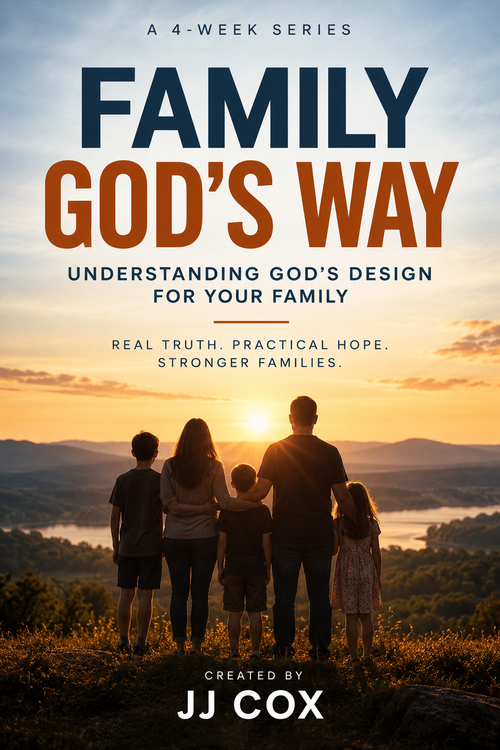
FAMILY GOD’S WAY
Understanding God’s Design for Your Family
INTRODUCTION
The family is one of the most important institutions God has designed.
It is also one of the places where we experience some of the greatest joy—and sometimes some of the deepest pain.
Families can be complicated. They can be messy. They can carry years of history, wounds, misunderstandings, expectations, disappointments, and failures. Some families seem to have it all together from the outside, while others know just how broken things can become behind closed doors.
But the brokenness does not mean the family is without hope.
God has a design for the family.
He has a purpose for marriage. He has a purpose for parents. He has a purpose for children and siblings. And He has given us a picture of what it looks like to live together in a way that honors Him.
The question is not whether our families will experience difficulty.
The question is what we will do when difficulty comes.
Over the course of this series, we will look at four foundational truths about the family:
●Love is the foundation.
●Communication matters.
●Marriage is a covenant.
●Our faith creates a spiritual legacy.
The goal is simple: that every person would leave with an understanding of God's design for the family, their role within that design, and what it looks like to honor God by living that out.
And perhaps most importantly, we will discover that changing a family doesn't always begin with changing everyone else.
Sometimes it begins with us.
CHAPTER 1
BROKEN BUT FIXABLE
“Now Israel loved Joseph more than any of his other sons, because he had been born to him in his old age; and he made an ornate robe for him. When his brothers saw that their father loved him more than any of them, they hated him and could not speak a kind word to him.”
—Genesis 37:3–4
Some of you are living in family relationships right now that are not healthy.
There are parents and/or siblings that you have not talked to in weeks and even years. There was abuse in your family and you are still dealing with that all these years later. You have such a dysfunctional family history that it keeps you from appreciating fully the family God has given you today.
And I am not asking you to pretend all that is not there.
But what I am asking you to do is to be willing to listen to what God has to say through His Word—and then be willing to pray about what steps God might be calling you to take where your family is involved.
With that said, let's look at the family that God will work through today.
In Genesis 37 we see the family of Israel.
Israel was once Jacob, brother of Esau. He was the same guy who stole his brother's inheritance from him with the help of his mother. Jacob got into a wrestling match with God back in Genesis 32 and got his hip dislocated and a new name.
That new name was Israel.
Israel now lives in the land of Canaan and has a large family.
Twelve sons and one daughter.
The sons' names were Reuben, Simeon, Levi, Judah, Dan, Naphtali, Gad, Asher, Issachar, Zebulun, Joseph, and Benjamin. His daughter was named Dinah.
Thirteen children.
Four different mothers.
Anyone who has grown up in a large family knows right away that things aren't always peaceful.
Well, things go south faster starting in verse 3.
“Now Israel loved Joseph more than any of his other sons…”
The other sons clearly recognized this, and they hated Joseph for it.
So much so that they wouldn't say anything kind to him at all.
Joseph doesn't help the situation because he keeps having dreams that showed him ruling over his brothers, and he would tell them all about them.
The Bible says that this made his brothers hate him even more.
The end result of this situation is this:
The brothers plotted to kill him. They didn't do it, so they just sold him into slavery.
Then they went back home and lied to their father, Israel, and told him that Joseph had been eaten by a “ferocious animal.”
This is a broken family.
It's got everything a reality TV show would kill for today:
●Favoritism
●Hatred
●Murder plot
●Human trafficking
And you think your family has issues.
So how can a family with this much brokenness possibly be fixable?
Well, the answer to that is this:
1. Love is the foundation.
Now, we have to all be working from the same definition of love to be able to move forward together.
We are not talking about romantic love.
We are not talking about love between friends.
We are not even talking about the natural love within a family.
We are talking about Agape love.
The love God shows us and that we are to show others.
And that looks like this:
“I love you and seek nothing but your greatest good regardless of how you think about me, or treat me.”
Now this definition was tested in Israel's family.
Israel loved his boys—but not all equally.
This damaged his family and wounded his sons.
Those wounds forged division among his family.
The brothers, because of their wounds, didn't even love their brother.
They hated him.
And that hatred cost their family two decades of grief.
But Joseph chose Agape love.
He was hated, talked about, schemed against, and sold into slavery.
Anyone who had gone through all of that should have every reason to seek revenge.
And yet, he didn't.
As a matter of fact, the love that he chose not only saved his family from famine, it was the love that would later produce the twelve tribes of Israel.
And here is the lesson that we need to see in this situation.
That kind of love is a choice.
Being a family is not always easy.
Parents fight. Siblings fight. Parents and children fight.
People want their privacy. They want their own space and stuff.
They want the perfect family, and they think everyone but them has it.
The parents think other people's kids are better behaved and more respectful.
The children think their friend's parents are cooler and easier to talk to.
And the truth is, those families have their issues too.
The family that survives is the family that chooses that they will love one another in the face of their own individual failures, and in the failures of the family as a whole.
We should seek the best for each other—regardless of the brokenness.
And parents, it starts with you.
2. Roles within the family.
You set the tone.
You plant the seeds for what love looks like in your family.
You not only model what love looks like, but you model where that love is directed.
Deuteronomy 6:4–9 tells parents to:
“Love the Lord your God with all your heart and with all your soul and with all your strength…”
And to “impress that upon your children.”
This is your role as a godly parent.
That means if you favor one child over another, you're making the same mistake as Israel.
If you point your children to love sports, academics, hobbies, or anything else more than they love the Lord, you are teaching them to love things and not the Creator of those things.
Take your children to church.
Let them see you study God's Word.
Let them see you pray for—and over—your family.
Teach them what love looks like when they fail.
Teach them what love looks like when you fail.
Hug them.
Discipline them.
And make sure they always feel secure and safe in your presence.
Choose them and their greatest good because you love them the same way God loves you.
Children, your role is to your parents and your siblings.
First, honor your parents.
That's not a suggestion I am giving you.
That is a command from God.
Deuteronomy 5:16 says:
“Honor your mother and father, so that you may live long and it may go well with you…”
Your parents are not always perfect.
They don't always deserve to be loved that way.
But here's the catch.
You're not perfect either.
You choose to love your parents in their imperfections because God chose to love you in your imperfections.
Second, your siblings are not your rivals.
They are partners with you in this life given to you by God Himself.
Joseph could have gone no contact with his brothers for what they did to him. He could easily have chosen to let them die from starvation.
But he chooses their greatest good instead.
Genesis 45:7 says:
“God sent me ahead of you to preserve for you a remnant on earth and to save your lives by a great deliverance.”
Some of you have cut your siblings off for far less, and I am begging you this morning to reconsider that position.
We are called to honor God's design of the family.
3. Honoring God's design.
I am not trying to tell anyone here this morning that you don't have reason to be wounded or angry.
You've been given reasons, I'm sure, to be jealous.
You've probably been treated with disrespect, and that created a bitterness within you that stings every time you think about it.
The abuse that some of you have lived through damaged you, and it is difficult to overcome.
But God's Word teaches us to love our family the way that Christ loves us.
He doesn't love us because we earned it or deserved it.
He chose our greatest good while we were still dead in our sin.
Romans 5:8 says:
“God demonstrates His own love for us in this: While we were still sinners, Christ died for us.”
God designed the family.
God designed your role in the family.
Honor the place that God has given you within His design.
Consider this question.
What would change in your family if you decided—not felt, but decided—to love the hardest people in your family the way that Joseph loved his brothers?
How does your family legacy change starting now because of the choice that you make to really live out a love that looks like Christ?
And perhaps that is where a broken family begins to become fixable.
Not because everything suddenly becomes perfect.
But because someone makes a choice.
A choice to love.
A choice to seek the greatest good.
A choice to honor God's design.
A choice to begin doing something different.
CHAPTER 2
A BETTER WAY TO COMMUNICATE
“Her husband Elkanah would say to her, ‘Hannah, why are you weeping? Why don't you eat? Why are you downhearted? Don't I mean more to you than ten sons?’”
—1 Samuel 1:8
Let's get an overview now of this week's family so we can learn from them a better way to communicate.
Husband — Elkanah
Elkanah loved the Lord.
He took his family to worship.
He also had two wives.
Wife — Peninnah
Peninnah had sons and daughters with Elkanah.
She was a bit of a mean girl to Hannah.
Wife — Hannah
Hannah was greatly loved by Elkanah, and he always took great care of her.
But she was broken-hearted because she had no children.
The Priest — Eli
Eli had two sons of his own that were a problem.
And he misunderstands what he sees from Hannah.
There are your characters in today's family.
Now what I want us to do is look at how they communicated and what we need to learn from them.
Let's begin with the mean girl.
1. Peninnah communicated to WIN.
The Bible tells us that she was one of two wives of Elkanah and that she had many sons and daughters with him.
1 Samuel 1:6–7 says:
“Because the Lord had closed Hannah's womb, her rival kept provoking her in order to irritate her. This went on year after year. Whenever Hannah went up to the house of the Lord, her rival provoked her till she wept and would not eat.”
I don't feel like I need to spend a lot of time laying out what is wrong with this style of communication.
Peninnah clearly is self-centered and self-serving.
She is competing for position and will say whatever is needed in order to make herself feel better—and Hannah feel worse.
Her objective in communicating is not peace.
It is to win.
She wants to establish herself as superior in the relationship.
Let me give some Scripture to the people who treat people this way.
Proverbs 18:21 says:
“The tongue has the power of life and death.”
Proverbs 6:16–19 says that there are seven things that the Lord detests, and three of those are:
●A lying tongue
●A false witness
●One who stirs up dissension
And Jesus tells us in Matthew 12:37:
“For by your words you will be acquitted, and by your words you will be condemned.”
This is obviously not the style of communication that we need to have within our family.
Jesus tells us in Matthew 5:9:
“Blessed are the peacemakers, for they will be called the sons of God.”
Your family is not designed to be your rival.
They are designed to walk with you through life.
They are there to:
●Encourage you.
●Protect you.
●Point you toward God.
If this is not what you are doing, or experiencing, then there is a problem that needs to be worked out.
2. Elkanah communicated in FRUSTRATION.
Let me start by saying that I have probably never connected with a reaction more in my life, and I have a feeling that most men might agree with me.
1 Samuel 1:4–5 tells us that whenever Elkanah sacrificed, he would give portions of the meat to his wife Peninnah and to all her sons and daughters. But to Hannah he gave a double portion because he loved her, and the Lord had closed her womb.
But when she would continue to cry and be sad about the situation, his response is not helpful.
1 Samuel 1:8 says:
“Her husband Elkanah would say to her, ‘Hannah, why are you weeping? Why don't you eat? Why are you downhearted? Don't I mean more to you than ten sons?’”
In his mind, it was not something to be crying over.
In his mind, he had shown her he loved her.
In his mind, he could not understand why she was upset and not eating.
Then he did the one thing that we all tend to do at times.
We take someone else's pain, and we make it about ourselves.
“Don't I mean more to you than ten sons?”
Here's where I fail, and I think most men might agree.
When I hear my wife or kids complain because they are hurting about something, I take it personally because it is my job to protect and to provide for them.
And my first reaction is that they are complaining about me and my lack of ability to do what I believe I have tried hard to provide.
And I make something about myself that has absolutely nothing to do with me.
And I will ask the same question:
“Why are you crying?”
Not so I can understand, but because I feel frustrated that someone, I am supposed to protect and provide for, does not feel that way.
I have taken a situation and turned it into a problem because I made it about me—and didn't really listen to understand their heart.
What I should be doing is asking them about the experience.
What I should be doing is connecting with them where they are emotionally.
What I should be doing is asking them what they need instead of offering a solution.
Paul writes in Galatians 6:2 that we are to:
“…carry each other's burdens and in this way you will fulfill the law of Christ.”
3. Eli communicated in MISUNDERSTANDING.
Eli, in all his wisdom, doesn't get it right either.
He watches from a distance.
Makes a judgment from what he sees.
Then opens his mouth without fully understanding.
1 Samuel 1:12–14 tells us:
“As she kept on praying to the Lord, Eli observed her mouth. Hannah was praying in her heart, and her lips were moving but her voice was not heard. Eli thought she was drunk and said to her, ‘How long are you going to stay drunk? Put away your wine.’”
How many times have we been here?
We know our family better than anyone else.
We think we know everything they are going through and what they are feeling.
We have our finger on the pulse of their lives, and we think we know them better than they know themselves.
And the truth is, sometimes we just get a glimpse of a situation, and we take what we think we know and make a judgment.
And to make the judgment worse, we give commentary that completely misses the mark.
And because we didn't completely understand the situation, we say things that make people feel:
●Accused — like Hannah felt.
●Guilty — for something beyond their control.
●Judged — for circumstances they didn't initiate.
●Or even ashamed — as if they are the reason the situation occurred at all.
The truth is, if we had stopped and listened, gathered a little more information, we would have been able to communicate in a more productive way.
Proverbs 18:13 says:
“To answer before listening—that is folly and shame.”
Proverbs 29:20 says:
“Do you see someone who speaks in haste? There is more hope for a fool than for them.”
We don't have to say everything that pops in our head.
And one of the greatest tools of great communication is being smart enough to know when to say nothing at all.
4. Hannah communicated in HONESTY.
1 Samuel 1:10–11 says:
“In her deep anguish Hannah prayed to the Lord, weeping bitterly. And she made a vow, saying, ‘Lord Almighty, if you will only look on your servant's misery and remember me, and not forget your servant but give her a son, then I will give him to the Lord for all the days of his life, and no razor will ever be used on his head.’”
What do we learn from Hannah?
She's honest.
She's unguarded.
She brings to God her actual feelings.
A family that loves one another with the Agape love that we have talked about and is fulfilling their roles within the family can handle honest, grace-filled communication.
And in that kind of communication there is:
●Accountability
●Honest evaluation
●Deepening of the relationships
●Ministry opportunity to one another
Families need to be able to communicate clearly and honestly with one another.
Parents, it starts with us.
We must model it.
We must allow it—respectfully.
And we should practice it in our prayer life with our family.
Hannah walked out of the temple changed—not because her circumstances had changed, but because she felt heard.
First, by God.
Then by Eli.
Every person in your family needs to experience that.
They need to know that when they speak, someone that loves them is listening—and that what they say matters.
Are you Peninnah who wants to provoke and win?
Are you Elkanah speaking out of frustration without listening?
Are you Eli speaking from confusion and assumption?
Or are you Hannah speaking honestly with vulnerability?
Families grow stronger with healthy communication.
And that begins with you.
CHAPTER 3
A COVENANT, NOT A CONTRACT
“Then the Lord God made a woman from the rib he had taken out of the man, and he brought her to the man. The man said, ‘This is now bone of my bones and flesh of my flesh; she shall be called ‘woman,’ for she was taken out of man.’ That is why a man leaves his father and mother and is united to his wife, and they become one flesh.”
—Genesis 2:22–24
Today, we are going to talk about the importance of honoring the covenant of marriage even when it would seem easier to do something else.
Almost everyone has been touched by divorce in one way or another.
My objective is to emphasize how we honor the covenant of marriage, not rehash an experience that has happened in the past.
If you have walked through a divorce at some point, and have placed that under the blood of Christ, then we trust that God has been true to His character and forgiveness has taken place.
So, let's start by defining the marriage covenant from Scripture so that we are all on the same page.
First, we know that God establishes the covenant of marriage back in Genesis 2:22–24.
“Then the Lord God made a woman from the rib he had taken out of the man, and he brought her to the man.
The man said:
“This is now bone of my bones and flesh of my flesh; she shall be called ‘woman,’ for she was taken out of man.”
That is why a man leaves his father and mother and is united to his wife, and they become one flesh.”
In Matthew 19, Jesus refers back to this same passage in Genesis and then adds this in 19:6:
“What God has joined together, let man not separate.”
So, we know it is instituted by God.
And it is emphasized by Christ.
Second, the word covenant is Scripture's own word for marriage—not one we've tagged on later.
Malachi 2:14 says:
“…the Lord is the witness between you and the wife of your youth. You have been unfaithful to her, though she is your partner, the wife of your marriage covenant.”
And in Ezekiel 16:8, when God is describing His relationship with Israel, He says:
“I made my vow to you and entered into a covenant with you…and you became mine.”
So, marriage isn't like a covenant.
It is a covenant.
And there are clear differences.
Two people negotiate a contract. A covenant is made before God, who is the third party.
A contract protects everyone's self-interest. A covenant surrenders self-interest, first to God, then to the spouse.
A contract contains escape clauses. A covenant contains none.
One more important aspect.
When Paul is talking about the husband-and-wife relationship in Ephesians 5, he writes in verse 32:
“This is a profound mystery—but I am talking about Christ and the church.”
So, with all of those things in mind, here is the biblical definition of marriage:
A lifelong covenant, made before God, between one man and one woman who together are a picture of Christ and His church.
This covenant is the core of the family.
From this relationship worship is lifted. This is the vertical aspect.
From this relationship life is experienced. This is the horizontal aspect.
From this relationship children are often introduced into the covenant – either naturally or by adoption - and are an equal part of that promise. This is the legacy aspect.
Let’s take an honest look at what we lose when the covenant of marriage is broken.
1. We lose when we quit.
I have had the opportunity to perform countless weddings in my 22 years of ministry.
Each of those couples went through some form of marriage counseling with me, or someone else.
And I wish that I could tell you that each of those couples are still married today.
They are not.
The marriages that have broken up have happened for different reasons.
Some because of marital unfaithfulness.
Some because of abandonment by an unbelieving spouse.
Both of which are biblical reasons given for divorce.
But the ones that sting the most for me are the ones where someone just walked away without a fight.
The Bible is full of marriages that walked through difficult seasons.
Abraham and Sarah come to mind immediately.
They were spiritually pointed toward God.
Obedient in following Him.
Faithful to one another.
But Sarah had no children of her own even though God had made a covenant with them that she would indeed have a child.
And for 25 years they waited for Isaac.
Not patiently, because in the course of those 25 years they tried to fulfill God's promise through other individuals.
And they went through a very difficult season of life.
Where would we be today if they had quit?
If one just said to themselves, “I'm done. I am not doing this anymore.”
They would have lost the spiritual legacy that has been passed down through generations of people who have walked with the Lord.
Through their faithfulness we have seen the legacy of faith from Abraham to David, David to Solomon, Solomon to Joseph, Joseph to Jesus, and Jesus to you.
When we quit on the covenant of marriage we lose so much, but the most devastating is the spiritual legacy that is lost as a result.
I believe that every marriage that has been entered into under the direction of God Himself carries a spiritual component that will last for generations to come.
And I believe that is one of the blessings that God gives us in our marriages.
And I believe that is a blessing that is lost when we walk away from that covenant of marriage.
2. We lose when we put our own feelings ahead of the covenant.
In chapter One, I made the statement that not every opinion we have needs to be verbalized.
Now, I am telling you that not every feeling that we have needs to be acted on.
Our feelings are real and God-given.
God grieves in Genesis 6:6.
He rejoices with singing in Zephaniah 3:17.
And God tells us to rejoice in Philippians 4:4.
But understand this:
Feelings must follow obedience.
In Revelation 2, Jesus tells Ephesus they've abandoned the love they had at first—and He gives them a solution.
Do the work you did at first.
Not feel what you felt.
Do what you did.
When our feelings lead us out of our marriage covenant, everyone loses.
We lose because we have broken a spiritual connection between God and ourselves.
Our spouses lose because that same spiritual connection has been broken along with the wounds of emotional and physical abandonment.
Our families lose because they are left to pick up the pieces of everyone involved.
You're going to have bad days in your marriage.
As I was writing the message and asking people to pray about this message, I was given this quote from Ruth Graham, wife of the great preacher Billy Graham:
“I've never considered divorce, but I've considered murder several times.”
I have even been told this quote by people as well:
“I love him, but I don't always like him.”
My point is this:
Feelings should never be put ahead of the covenant because when they are, we become the one that Jesus was talking about when He says:
“What God has joined together, let man not separate.”
3. We lose when we allow the world to redefine the covenant.
The covenant is ordained and defined by God Himself.
It is emphasized by Jesus in His ministry.
It is solidified through God's Word consistently throughout the Old and the New Testament writers.
It is not up for negotiation because we live in a different time or culture from when it was established.
The world will tell you all kinds of things about marriage today.
Divorce is probably inevitable, so just plan on it.
Living together first is smart because you know what you're getting.
Or marriage is definable—by whoever is defining it.
But Scripture gives us a definition.
Marriage is a lifelong covenant, made before God, between one man and one woman who together are a picture of Christ and His church.
It is not to be entered into with the thought that if this doesn't work out for me or them, then we will just go our own way.
It is not something to test out through trial.
And it is not something to redefine because it makes me feel bad about the sin in my life.
The marriage covenant is not to be used to manipulate the physically, mentally, verbally, or spiritually abused.
Those who love you the way that God loves you will not abuse you and make you feel unsafe—and then tell you that you can't leave because you made a covenant.
God will not bless that.
We know that God protects the weak and the vulnerable.
We know that God's love does not abuse, break promises or misuse His character.
Let me finish with this…
God takes marriage seriously because it is what forms the family.
A marriage is only as good as the relationship between the individual and God.
Someone who knows how valuable they are in the eyes of the Father has the ability to look with those same eyes into the eyes of their spouse.
We make a commitment to our spouse because we believe with our whole heart that God has brought the two of us together.
We maintain that commitment because of the covenant that we made with God as our witness.
We honor that covenant by choosing Agape love for our spouse.
“I love you, and seek your greatest good, regardless of how I feel…regardless of what would be easier…regardless of what the world says…regardless of how you feel some days and how you think of me some days.”
I love you the way Christ loves His church.
I love my family because it is born from the covenant of marriage between two people that God has brought together.
CHAPTER 4
MAKE THE DECLARATION
“But if serving the Lord seems undesirable to you, then choose for yourselves this day whom you will serve, whether the gods your ancestors served beyond the Euphrates, or the gods of the Amorites, in whose land you are living. But as for me and my household, we will serve the Lord.”
—Joshua 24:15
Now, we are going to finish this series by talking about Joshua.
Joshua first appears in Scripture in Exodus 17 leading Israel against their enemies.
He serves as the helper to Moses.
And his defining moment is when he is sent into the Promised Land with Caleb and eleven others to scout the land.
The other eleven come back and spread fear.
Joshua and Caleb come back and declare that the land can be taken because they have God.
After Moses dies, it is Joshua that leads the nation of Israel across the Jordan.
And when we reach Joshua 23, he has come to the end of his life.
He is old.
He has led for decades.
And he has watched the Israelites as they have experienced every high and low possible.
And he has witnessed firsthand the glory of God.
And it is in this chapter that Joshua begins to say his goodbyes and cement his legacy.
In Joshua 24:14–15:
“Now fear the Lord and serve him with all faithfulness. Throw away the gods your ancestors worshiped beyond the Euphrates River and in Egypt, and serve the Lord. But if serving the Lord seems undesirable to you, then choose for yourselves this day whom you will serve, whether the gods your ancestors served beyond the Euphrates, or the gods of the Amorites, in whose land you are living. But as for me and my household, we will serve the Lord.”
There it is.
The declaration that cemented the spiritual legacy of Joshua and his family.
And I believe that it is the same declaration that needs to be made for each of our families as well.
And I want to spend some time talking about why that declaration is so important for your family.
1. Declare it in CRISIS.
During the time of Joshua's leadership there were several difficult circumstances that he had to endure.
But the one that stands out to me the most is the defeat that his army took at the city of Ai.
They had just conquered Jericho—an incredible victory—and they were riding high.
Ai was not supposed to be a problem.
Until it was.
A man named Achan in his army had lied and stolen things from the “devoted things” of God.
He hid them under his tent.
And his selfishness affected the entire community of God.
A military exercise that should have easily ended in victory now cost the lives of 36 men and sent their army back without a win.
Joshua tore his clothes and fell facedown before the ark of the Lord.
He was in crisis.
He didn't know what to do except cry out to God.
And God answered him and told him what to do next.
But what I want you to see is that Joshua didn't melt in a crisis and immediately look to other gods, or self-help books, or an inspirational quote he found on the Facebook scrolls of his day.
What he did do, however, was cry out to God.
That is where his faith lay.
That is where he always turned in victory or in crisis, because he had made a declaration of his faith early on and had seen God work in his life.
The same thing should be true with us.
At some point in our lifetimes our faith must become our own.
Not our parent's faith.
Not our sibling's faith.
Not even our friend's faith.
We reach a point where we must make our own declaration of who God is in our life.
He is either everything—and I surrender all to Him.
Or He is nothing at all—and I surrender to myself.
But know this:
If you surrender to yourself, you fight your battles alone.
You fight with your strength.
You fight with your knowledge.
You fight with your own insecurities.
And you fight with limited resources.
But if you surrender all to God, and moments of crisis come along—and they will—you fight a completely different battle.
You fight with the strength of God Himself because you understand your strength comes from Him.
You fight with the knowledge that He already knows the outcome and has gone before you in this crisis.
You fight with the confidence that God—the Creator of the universe—has gifted you perfectly for what you must walk through.
And you fight with the full resources of heaven on your side.
That is why we can walk through things like betrayal from a friend, a terminal illness, or the loss of a child and not fall completely apart.
Our families will encounter crises along the way, but it is in the declaration of our faith where we find our strength to win and come out on the other side in victory, and not in devastation.
Not only do we declare our faith for a crisis, but we declare it to define it.
2. Declare it to DEFINE.
“But as for me and my household, we will serve the LORD.”
That is a simple declaration that defines the parameters of our faith.
We will not serve other gods.
We will not serve social standing.
We will not serve financial gain.
We will not serve positions of power.
We will not serve political agendas.
We will not serve our own self-interests.
And we will not serve this world and all it will tempt us with.
We will serve the LORD.
We will serve His calling.
We will serve in His holiness.
We will serve in His sovereignty.
We will serve in His faithfulness.
We will serve in His compassion.
We will serve in His strength.
And we will serve in this world but not be of this world.
Our declaration of faith lays out the parameters within which we live our lives.
When we declare God as our eternal salvation through His Son Jesus, we surrender to His character.
His character is what defines us from that moment forward.
Look what Paul writes in Galatians 2:20:
“I have been crucified with Christ and I no longer live, but Christ lives in me. The life I live in the body, I live by faith in the Son of God, who loved me and gave Himself for me.”
Then he fleshes that out in detail in Colossians 3:5–14.
Put to death, therefore, whatever belongs to your earthly nature: sexual immorality, impurity, lust, evil desires and greed, which is idolatry. Because of these, the wrath of God is coming. You used to walk in these ways; in the life you once lived. But now you must also rid yourselves of all such things as these: anger, rage, malice, slander, and filthy language from your lips. Do not lie to each other, since you have taken off your old self with its practices and have put on the new self, which is being renewed in knowledge in the image of its Creator. Therefore, as God’s chosen people, holy and dearly loved, clothe yourselves with compassion, kindness, humility, gentleness and patience. Bear with each other and forgive one another if any of you has a grievance against someone. Forgive as the Lord forgave you. And over all these virtues put on love, which binds them all together in perfect unity. Let the peace of Christ rule in your hearts…”
The world tries to define you by what box it can put you into.
You are white or Black or Asian or Hispanic.
You are athletic, nerdy, or average.
You are good-looking and popular with all the right connections, or you are ugly and unknown with no connections at all.
The world will tell you that you are the gender that you feel, and not that which you have been born.
It will tell you that there is no God, and that your truth is the only truth, and you can live however you want.
And the problem with the world—in that sense—is that this world is going to use you for what it can and then leave you face down in the ditch with no hope or peace because you allowed the world to define your faith.
But we declare this morning that we are:
●Made new in Christ.
●Sealed with the promised Holy Spirit.
●Raised to walk in the newness of Christ and reflect the glory of our Father in heaven.
God defines our faith by His character, and we are saved by Him through our belief and our confession of who He is.
And that declaration establishes our spiritual legacy.
3. Declare it for LEGACY.
The single greatest thing that you can give any member of your family is the peace of knowing to whom you belong.
When we make a declaration of faith, not only are we establishing where we will spend eternity, but we are giving the generations of our family that follow a map to get there themselves.
Think about something for a moment.
In order for you to be here today, the number of people that needed to meet, fall in love, survive and have children is pretty staggering.
Each generation doubles.
Two parents.
Four grandparents.
Eight great-grandparents.
And on it goes.
If you trace your heritage back just ten generations—or 250 years—that means that 2,046 people were needed for you to sit here this morning.
If you go back twenty generations—or 500 years—the number increases to 2,097,150.
Your spiritual legacy is not just about your children.
If Jesus tarries for another generation or longer, your spiritual legacy will be passed down through people you will never meet on this side of heaven.
As a child I remember going to my grandfather's home in Mineral Wells, Texas.
I would see my grandfather sitting at his desk reading his Bible and making notes for the sermons that he would preach in his small Church of Christ that he belonged to.
I would watch him preach those messages on the days that he was up in the rotation.
I would watch him lead his favorite song, “When the Roll is Called Up Yonder,” and everyone would sing with him.
In my office, to this day, I have a box of notes from his Bible studies and sermons that I will pull out and look at occasionally.
His legacy of faith still affects me to this day.
My mother and father-in-law raised their daughter in church every Sunday.
She witnessed their faith and obedience.
She watched them serve in the local church and community.
And she has watched them live that consistently her whole life.
Their legacy of faith still affects her—and me—to this day.
But the greatest pleasure I have as a parent is watching my children walk in their own relationship with the Lord.
And what I know is their walk didn't start with me or Stephanie.
It started one to two generations ago, and probably further than that.
My children are walking with God because people in my life and Stephanie's life made a declaration at some point in time and said:
“As for me and my house, we will serve the LORD.”
Make your declaration.
Choose this day whom you will serve.
Make a spiritual investment in your family by declaring your faith in God through His Son, Jesus.
We started with one question:
What is the family for?
The answer hasn't changed, and it never will.
The family is God's design for growing His kingdom—one generation at a time.
We love like Joseph loved.
We speak like Hannah spoke.
We commit like Abraham and Sarah.
And, like Joshua, we make a declaration of faith in God through Christ alone.
FINAL THOUGHT
The family is God's design.
That truth has been the foundation of everything we have talked about.
But God's design does not mean our families will always be perfect.
Joseph's family was broken.
Hannah's family struggled with painful communication.
Abraham and Sarah experienced seasons of waiting and difficulty.
Joshua's family and nation faced crisis after crisis.
The difference is not that these families avoided difficulty.
The difference is what they chose to do in the middle of it.
Joseph chose love when hatred would have been easier.
Hannah chose honesty when hiding her pain would have been easier.
Elkanah had to learn that loving someone means listening to their heart instead of making their pain about himself.
Eli reminds us that we need to listen before we speak.
Abraham and Sarah remind us that God's promises are worth waiting for.
And Joshua gives us the declaration that should become the foundation of every Christian family:
“As for me and my household, we will serve the LORD.”
Our families don't need to look perfect.
They need to be pointed in the right direction.
They need parents who understand that their first responsibility is to God.
They need husbands and wives who understand that marriage is more than a contract—it is a covenant.
They need children who understand that their siblings are not rivals, but partners given to them by God.
They need people who are willing to communicate with honesty and grace.
They need people who will choose Agape love even when it isn't easy.
And ultimately, they need people who are willing to make a declaration of faith that reaches beyond themselves.
Because the family is not just about today.
It is about the generations that come after us.
The faith you live today may become the faith your children live tomorrow.
And their faith may become the faith of children you will never meet.
So, make the declaration.
Choose this day whom you will serve.
Love your family.
Listen to your family.
Honor your covenant.
Point your family toward Christ.
And when the world asks what defines your home, may the answer be clear:
“As for me and my household, we will serve the LORD.”
Understanding God’s Design for Your Family
INTRODUCTION
The family is one of the most important institutions God has designed.
It is also one of the places where we experience some of the greatest joy—and sometimes some of the deepest pain.
Families can be complicated. They can be messy. They can carry years of history, wounds, misunderstandings, expectations, disappointments, and failures. Some families seem to have it all together from the outside, while others know just how broken things can become behind closed doors.
But the brokenness does not mean the family is without hope.
God has a design for the family.
He has a purpose for marriage. He has a purpose for parents. He has a purpose for children and siblings. And He has given us a picture of what it looks like to live together in a way that honors Him.
The question is not whether our families will experience difficulty.
The question is what we will do when difficulty comes.
Over the course of this series, we will look at four foundational truths about the family:
●Love is the foundation.
●Communication matters.
●Marriage is a covenant.
●Our faith creates a spiritual legacy.
The goal is simple: that every person would leave with an understanding of God's design for the family, their role within that design, and what it looks like to honor God by living that out.
And perhaps most importantly, we will discover that changing a family doesn't always begin with changing everyone else.
Sometimes it begins with us.
CHAPTER 1
BROKEN BUT FIXABLE
“Now Israel loved Joseph more than any of his other sons, because he had been born to him in his old age; and he made an ornate robe for him. When his brothers saw that their father loved him more than any of them, they hated him and could not speak a kind word to him.”
—Genesis 37:3–4
Some of you are living in family relationships right now that are not healthy.
There are parents and/or siblings that you have not talked to in weeks and even years. There was abuse in your family and you are still dealing with that all these years later. You have such a dysfunctional family history that it keeps you from appreciating fully the family God has given you today.
And I am not asking you to pretend all that is not there.
But what I am asking you to do is to be willing to listen to what God has to say through His Word—and then be willing to pray about what steps God might be calling you to take where your family is involved.
With that said, let's look at the family that God will work through today.
In Genesis 37 we see the family of Israel.
Israel was once Jacob, brother of Esau. He was the same guy who stole his brother's inheritance from him with the help of his mother. Jacob got into a wrestling match with God back in Genesis 32 and got his hip dislocated and a new name.
That new name was Israel.
Israel now lives in the land of Canaan and has a large family.
Twelve sons and one daughter.
The sons' names were Reuben, Simeon, Levi, Judah, Dan, Naphtali, Gad, Asher, Issachar, Zebulun, Joseph, and Benjamin. His daughter was named Dinah.
Thirteen children.
Four different mothers.
Anyone who has grown up in a large family knows right away that things aren't always peaceful.
Well, things go south faster starting in verse 3.
“Now Israel loved Joseph more than any of his other sons…”
The other sons clearly recognized this, and they hated Joseph for it.
So much so that they wouldn't say anything kind to him at all.
Joseph doesn't help the situation because he keeps having dreams that showed him ruling over his brothers, and he would tell them all about them.
The Bible says that this made his brothers hate him even more.
The end result of this situation is this:
The brothers plotted to kill him. They didn't do it, so they just sold him into slavery.
Then they went back home and lied to their father, Israel, and told him that Joseph had been eaten by a “ferocious animal.”
This is a broken family.
It's got everything a reality TV show would kill for today:
●Favoritism
●Hatred
●Murder plot
●Human trafficking
And you think your family has issues.
So how can a family with this much brokenness possibly be fixable?
Well, the answer to that is this:
1. Love is the foundation.
Now, we have to all be working from the same definition of love to be able to move forward together.
We are not talking about romantic love.
We are not talking about love between friends.
We are not even talking about the natural love within a family.
We are talking about Agape love.
The love God shows us and that we are to show others.
And that looks like this:
“I love you and seek nothing but your greatest good regardless of how you think about me, or treat me.”
Now this definition was tested in Israel's family.
Israel loved his boys—but not all equally.
This damaged his family and wounded his sons.
Those wounds forged division among his family.
The brothers, because of their wounds, didn't even love their brother.
They hated him.
And that hatred cost their family two decades of grief.
But Joseph chose Agape love.
He was hated, talked about, schemed against, and sold into slavery.
Anyone who had gone through all of that should have every reason to seek revenge.
And yet, he didn't.
As a matter of fact, the love that he chose not only saved his family from famine, it was the love that would later produce the twelve tribes of Israel.
And here is the lesson that we need to see in this situation.
That kind of love is a choice.
Being a family is not always easy.
Parents fight. Siblings fight. Parents and children fight.
People want their privacy. They want their own space and stuff.
They want the perfect family, and they think everyone but them has it.
The parents think other people's kids are better behaved and more respectful.
The children think their friend's parents are cooler and easier to talk to.
And the truth is, those families have their issues too.
The family that survives is the family that chooses that they will love one another in the face of their own individual failures, and in the failures of the family as a whole.
We should seek the best for each other—regardless of the brokenness.
And parents, it starts with you.
2. Roles within the family.
You set the tone.
You plant the seeds for what love looks like in your family.
You not only model what love looks like, but you model where that love is directed.
Deuteronomy 6:4–9 tells parents to:
“Love the Lord your God with all your heart and with all your soul and with all your strength…”
And to “impress that upon your children.”
This is your role as a godly parent.
That means if you favor one child over another, you're making the same mistake as Israel.
If you point your children to love sports, academics, hobbies, or anything else more than they love the Lord, you are teaching them to love things and not the Creator of those things.
Take your children to church.
Let them see you study God's Word.
Let them see you pray for—and over—your family.
Teach them what love looks like when they fail.
Teach them what love looks like when you fail.
Hug them.
Discipline them.
And make sure they always feel secure and safe in your presence.
Choose them and their greatest good because you love them the same way God loves you.
Children, your role is to your parents and your siblings.
First, honor your parents.
That's not a suggestion I am giving you.
That is a command from God.
Deuteronomy 5:16 says:
“Honor your mother and father, so that you may live long and it may go well with you…”
Your parents are not always perfect.
They don't always deserve to be loved that way.
But here's the catch.
You're not perfect either.
You choose to love your parents in their imperfections because God chose to love you in your imperfections.
Second, your siblings are not your rivals.
They are partners with you in this life given to you by God Himself.
Joseph could have gone no contact with his brothers for what they did to him. He could easily have chosen to let them die from starvation.
But he chooses their greatest good instead.
Genesis 45:7 says:
“God sent me ahead of you to preserve for you a remnant on earth and to save your lives by a great deliverance.”
Some of you have cut your siblings off for far less, and I am begging you this morning to reconsider that position.
We are called to honor God's design of the family.
3. Honoring God's design.
I am not trying to tell anyone here this morning that you don't have reason to be wounded or angry.
You've been given reasons, I'm sure, to be jealous.
You've probably been treated with disrespect, and that created a bitterness within you that stings every time you think about it.
The abuse that some of you have lived through damaged you, and it is difficult to overcome.
But God's Word teaches us to love our family the way that Christ loves us.
He doesn't love us because we earned it or deserved it.
He chose our greatest good while we were still dead in our sin.
Romans 5:8 says:
“God demonstrates His own love for us in this: While we were still sinners, Christ died for us.”
God designed the family.
God designed your role in the family.
Honor the place that God has given you within His design.
Consider this question.
What would change in your family if you decided—not felt, but decided—to love the hardest people in your family the way that Joseph loved his brothers?
How does your family legacy change starting now because of the choice that you make to really live out a love that looks like Christ?
And perhaps that is where a broken family begins to become fixable.
Not because everything suddenly becomes perfect.
But because someone makes a choice.
A choice to love.
A choice to seek the greatest good.
A choice to honor God's design.
A choice to begin doing something different.
CHAPTER 2
A BETTER WAY TO COMMUNICATE
“Her husband Elkanah would say to her, ‘Hannah, why are you weeping? Why don't you eat? Why are you downhearted? Don't I mean more to you than ten sons?’”
—1 Samuel 1:8
Let's get an overview now of this week's family so we can learn from them a better way to communicate.
Husband — Elkanah
Elkanah loved the Lord.
He took his family to worship.
He also had two wives.
Wife — Peninnah
Peninnah had sons and daughters with Elkanah.
She was a bit of a mean girl to Hannah.
Wife — Hannah
Hannah was greatly loved by Elkanah, and he always took great care of her.
But she was broken-hearted because she had no children.
The Priest — Eli
Eli had two sons of his own that were a problem.
And he misunderstands what he sees from Hannah.
There are your characters in today's family.
Now what I want us to do is look at how they communicated and what we need to learn from them.
Let's begin with the mean girl.
1. Peninnah communicated to WIN.
The Bible tells us that she was one of two wives of Elkanah and that she had many sons and daughters with him.
1 Samuel 1:6–7 says:
“Because the Lord had closed Hannah's womb, her rival kept provoking her in order to irritate her. This went on year after year. Whenever Hannah went up to the house of the Lord, her rival provoked her till she wept and would not eat.”
I don't feel like I need to spend a lot of time laying out what is wrong with this style of communication.
Peninnah clearly is self-centered and self-serving.
She is competing for position and will say whatever is needed in order to make herself feel better—and Hannah feel worse.
Her objective in communicating is not peace.
It is to win.
She wants to establish herself as superior in the relationship.
Let me give some Scripture to the people who treat people this way.
Proverbs 18:21 says:
“The tongue has the power of life and death.”
Proverbs 6:16–19 says that there are seven things that the Lord detests, and three of those are:
●A lying tongue
●A false witness
●One who stirs up dissension
And Jesus tells us in Matthew 12:37:
“For by your words you will be acquitted, and by your words you will be condemned.”
This is obviously not the style of communication that we need to have within our family.
Jesus tells us in Matthew 5:9:
“Blessed are the peacemakers, for they will be called the sons of God.”
Your family is not designed to be your rival.
They are designed to walk with you through life.
They are there to:
●Encourage you.
●Protect you.
●Point you toward God.
If this is not what you are doing, or experiencing, then there is a problem that needs to be worked out.
2. Elkanah communicated in FRUSTRATION.
Let me start by saying that I have probably never connected with a reaction more in my life, and I have a feeling that most men might agree with me.
1 Samuel 1:4–5 tells us that whenever Elkanah sacrificed, he would give portions of the meat to his wife Peninnah and to all her sons and daughters. But to Hannah he gave a double portion because he loved her, and the Lord had closed her womb.
But when she would continue to cry and be sad about the situation, his response is not helpful.
1 Samuel 1:8 says:
“Her husband Elkanah would say to her, ‘Hannah, why are you weeping? Why don't you eat? Why are you downhearted? Don't I mean more to you than ten sons?’”
In his mind, it was not something to be crying over.
In his mind, he had shown her he loved her.
In his mind, he could not understand why she was upset and not eating.
Then he did the one thing that we all tend to do at times.
We take someone else's pain, and we make it about ourselves.
“Don't I mean more to you than ten sons?”
Here's where I fail, and I think most men might agree.
When I hear my wife or kids complain because they are hurting about something, I take it personally because it is my job to protect and to provide for them.
And my first reaction is that they are complaining about me and my lack of ability to do what I believe I have tried hard to provide.
And I make something about myself that has absolutely nothing to do with me.
And I will ask the same question:
“Why are you crying?”
Not so I can understand, but because I feel frustrated that someone, I am supposed to protect and provide for, does not feel that way.
I have taken a situation and turned it into a problem because I made it about me—and didn't really listen to understand their heart.
What I should be doing is asking them about the experience.
What I should be doing is connecting with them where they are emotionally.
What I should be doing is asking them what they need instead of offering a solution.
Paul writes in Galatians 6:2 that we are to:
“…carry each other's burdens and in this way you will fulfill the law of Christ.”
3. Eli communicated in MISUNDERSTANDING.
Eli, in all his wisdom, doesn't get it right either.
He watches from a distance.
Makes a judgment from what he sees.
Then opens his mouth without fully understanding.
1 Samuel 1:12–14 tells us:
“As she kept on praying to the Lord, Eli observed her mouth. Hannah was praying in her heart, and her lips were moving but her voice was not heard. Eli thought she was drunk and said to her, ‘How long are you going to stay drunk? Put away your wine.’”
How many times have we been here?
We know our family better than anyone else.
We think we know everything they are going through and what they are feeling.
We have our finger on the pulse of their lives, and we think we know them better than they know themselves.
And the truth is, sometimes we just get a glimpse of a situation, and we take what we think we know and make a judgment.
And to make the judgment worse, we give commentary that completely misses the mark.
And because we didn't completely understand the situation, we say things that make people feel:
●Accused — like Hannah felt.
●Guilty — for something beyond their control.
●Judged — for circumstances they didn't initiate.
●Or even ashamed — as if they are the reason the situation occurred at all.
The truth is, if we had stopped and listened, gathered a little more information, we would have been able to communicate in a more productive way.
Proverbs 18:13 says:
“To answer before listening—that is folly and shame.”
Proverbs 29:20 says:
“Do you see someone who speaks in haste? There is more hope for a fool than for them.”
We don't have to say everything that pops in our head.
And one of the greatest tools of great communication is being smart enough to know when to say nothing at all.
4. Hannah communicated in HONESTY.
1 Samuel 1:10–11 says:
“In her deep anguish Hannah prayed to the Lord, weeping bitterly. And she made a vow, saying, ‘Lord Almighty, if you will only look on your servant's misery and remember me, and not forget your servant but give her a son, then I will give him to the Lord for all the days of his life, and no razor will ever be used on his head.’”
What do we learn from Hannah?
She's honest.
She's unguarded.
She brings to God her actual feelings.
A family that loves one another with the Agape love that we have talked about and is fulfilling their roles within the family can handle honest, grace-filled communication.
And in that kind of communication there is:
●Accountability
●Honest evaluation
●Deepening of the relationships
●Ministry opportunity to one another
Families need to be able to communicate clearly and honestly with one another.
Parents, it starts with us.
We must model it.
We must allow it—respectfully.
And we should practice it in our prayer life with our family.
Hannah walked out of the temple changed—not because her circumstances had changed, but because she felt heard.
First, by God.
Then by Eli.
Every person in your family needs to experience that.
They need to know that when they speak, someone that loves them is listening—and that what they say matters.
Are you Peninnah who wants to provoke and win?
Are you Elkanah speaking out of frustration without listening?
Are you Eli speaking from confusion and assumption?
Or are you Hannah speaking honestly with vulnerability?
Families grow stronger with healthy communication.
And that begins with you.
CHAPTER 3
A COVENANT, NOT A CONTRACT
“Then the Lord God made a woman from the rib he had taken out of the man, and he brought her to the man. The man said, ‘This is now bone of my bones and flesh of my flesh; she shall be called ‘woman,’ for she was taken out of man.’ That is why a man leaves his father and mother and is united to his wife, and they become one flesh.”
—Genesis 2:22–24
Today, we are going to talk about the importance of honoring the covenant of marriage even when it would seem easier to do something else.
Almost everyone has been touched by divorce in one way or another.
My objective is to emphasize how we honor the covenant of marriage, not rehash an experience that has happened in the past.
If you have walked through a divorce at some point, and have placed that under the blood of Christ, then we trust that God has been true to His character and forgiveness has taken place.
So, let's start by defining the marriage covenant from Scripture so that we are all on the same page.
First, we know that God establishes the covenant of marriage back in Genesis 2:22–24.
“Then the Lord God made a woman from the rib he had taken out of the man, and he brought her to the man.
The man said:
“This is now bone of my bones and flesh of my flesh; she shall be called ‘woman,’ for she was taken out of man.”
That is why a man leaves his father and mother and is united to his wife, and they become one flesh.”
In Matthew 19, Jesus refers back to this same passage in Genesis and then adds this in 19:6:
“What God has joined together, let man not separate.”
So, we know it is instituted by God.
And it is emphasized by Christ.
Second, the word covenant is Scripture's own word for marriage—not one we've tagged on later.
Malachi 2:14 says:
“…the Lord is the witness between you and the wife of your youth. You have been unfaithful to her, though she is your partner, the wife of your marriage covenant.”
And in Ezekiel 16:8, when God is describing His relationship with Israel, He says:
“I made my vow to you and entered into a covenant with you…and you became mine.”
So, marriage isn't like a covenant.
It is a covenant.
And there are clear differences.
Two people negotiate a contract. A covenant is made before God, who is the third party.
A contract protects everyone's self-interest. A covenant surrenders self-interest, first to God, then to the spouse.
A contract contains escape clauses. A covenant contains none.
One more important aspect.
When Paul is talking about the husband-and-wife relationship in Ephesians 5, he writes in verse 32:
“This is a profound mystery—but I am talking about Christ and the church.”
So, with all of those things in mind, here is the biblical definition of marriage:
A lifelong covenant, made before God, between one man and one woman who together are a picture of Christ and His church.
This covenant is the core of the family.
From this relationship worship is lifted. This is the vertical aspect.
From this relationship life is experienced. This is the horizontal aspect.
From this relationship children are often introduced into the covenant – either naturally or by adoption - and are an equal part of that promise. This is the legacy aspect.
Let’s take an honest look at what we lose when the covenant of marriage is broken.
1. We lose when we quit.
I have had the opportunity to perform countless weddings in my 22 years of ministry.
Each of those couples went through some form of marriage counseling with me, or someone else.
And I wish that I could tell you that each of those couples are still married today.
They are not.
The marriages that have broken up have happened for different reasons.
Some because of marital unfaithfulness.
Some because of abandonment by an unbelieving spouse.
Both of which are biblical reasons given for divorce.
But the ones that sting the most for me are the ones where someone just walked away without a fight.
The Bible is full of marriages that walked through difficult seasons.
Abraham and Sarah come to mind immediately.
They were spiritually pointed toward God.
Obedient in following Him.
Faithful to one another.
But Sarah had no children of her own even though God had made a covenant with them that she would indeed have a child.
And for 25 years they waited for Isaac.
Not patiently, because in the course of those 25 years they tried to fulfill God's promise through other individuals.
And they went through a very difficult season of life.
Where would we be today if they had quit?
If one just said to themselves, “I'm done. I am not doing this anymore.”
They would have lost the spiritual legacy that has been passed down through generations of people who have walked with the Lord.
Through their faithfulness we have seen the legacy of faith from Abraham to David, David to Solomon, Solomon to Joseph, Joseph to Jesus, and Jesus to you.
When we quit on the covenant of marriage we lose so much, but the most devastating is the spiritual legacy that is lost as a result.
I believe that every marriage that has been entered into under the direction of God Himself carries a spiritual component that will last for generations to come.
And I believe that is one of the blessings that God gives us in our marriages.
And I believe that is a blessing that is lost when we walk away from that covenant of marriage.
2. We lose when we put our own feelings ahead of the covenant.
In chapter One, I made the statement that not every opinion we have needs to be verbalized.
Now, I am telling you that not every feeling that we have needs to be acted on.
Our feelings are real and God-given.
God grieves in Genesis 6:6.
He rejoices with singing in Zephaniah 3:17.
And God tells us to rejoice in Philippians 4:4.
But understand this:
Feelings must follow obedience.
In Revelation 2, Jesus tells Ephesus they've abandoned the love they had at first—and He gives them a solution.
Do the work you did at first.
Not feel what you felt.
Do what you did.
When our feelings lead us out of our marriage covenant, everyone loses.
We lose because we have broken a spiritual connection between God and ourselves.
Our spouses lose because that same spiritual connection has been broken along with the wounds of emotional and physical abandonment.
Our families lose because they are left to pick up the pieces of everyone involved.
You're going to have bad days in your marriage.
As I was writing the message and asking people to pray about this message, I was given this quote from Ruth Graham, wife of the great preacher Billy Graham:
“I've never considered divorce, but I've considered murder several times.”
I have even been told this quote by people as well:
“I love him, but I don't always like him.”
My point is this:
Feelings should never be put ahead of the covenant because when they are, we become the one that Jesus was talking about when He says:
“What God has joined together, let man not separate.”
3. We lose when we allow the world to redefine the covenant.
The covenant is ordained and defined by God Himself.
It is emphasized by Jesus in His ministry.
It is solidified through God's Word consistently throughout the Old and the New Testament writers.
It is not up for negotiation because we live in a different time or culture from when it was established.
The world will tell you all kinds of things about marriage today.
Divorce is probably inevitable, so just plan on it.
Living together first is smart because you know what you're getting.
Or marriage is definable—by whoever is defining it.
But Scripture gives us a definition.
Marriage is a lifelong covenant, made before God, between one man and one woman who together are a picture of Christ and His church.
It is not to be entered into with the thought that if this doesn't work out for me or them, then we will just go our own way.
It is not something to test out through trial.
And it is not something to redefine because it makes me feel bad about the sin in my life.
The marriage covenant is not to be used to manipulate the physically, mentally, verbally, or spiritually abused.
Those who love you the way that God loves you will not abuse you and make you feel unsafe—and then tell you that you can't leave because you made a covenant.
God will not bless that.
We know that God protects the weak and the vulnerable.
We know that God's love does not abuse, break promises or misuse His character.
Let me finish with this…
God takes marriage seriously because it is what forms the family.
A marriage is only as good as the relationship between the individual and God.
Someone who knows how valuable they are in the eyes of the Father has the ability to look with those same eyes into the eyes of their spouse.
We make a commitment to our spouse because we believe with our whole heart that God has brought the two of us together.
We maintain that commitment because of the covenant that we made with God as our witness.
We honor that covenant by choosing Agape love for our spouse.
“I love you, and seek your greatest good, regardless of how I feel…regardless of what would be easier…regardless of what the world says…regardless of how you feel some days and how you think of me some days.”
I love you the way Christ loves His church.
I love my family because it is born from the covenant of marriage between two people that God has brought together.
CHAPTER 4
MAKE THE DECLARATION
“But if serving the Lord seems undesirable to you, then choose for yourselves this day whom you will serve, whether the gods your ancestors served beyond the Euphrates, or the gods of the Amorites, in whose land you are living. But as for me and my household, we will serve the Lord.”
—Joshua 24:15
Now, we are going to finish this series by talking about Joshua.
Joshua first appears in Scripture in Exodus 17 leading Israel against their enemies.
He serves as the helper to Moses.
And his defining moment is when he is sent into the Promised Land with Caleb and eleven others to scout the land.
The other eleven come back and spread fear.
Joshua and Caleb come back and declare that the land can be taken because they have God.
After Moses dies, it is Joshua that leads the nation of Israel across the Jordan.
And when we reach Joshua 23, he has come to the end of his life.
He is old.
He has led for decades.
And he has watched the Israelites as they have experienced every high and low possible.
And he has witnessed firsthand the glory of God.
And it is in this chapter that Joshua begins to say his goodbyes and cement his legacy.
In Joshua 24:14–15:
“Now fear the Lord and serve him with all faithfulness. Throw away the gods your ancestors worshiped beyond the Euphrates River and in Egypt, and serve the Lord. But if serving the Lord seems undesirable to you, then choose for yourselves this day whom you will serve, whether the gods your ancestors served beyond the Euphrates, or the gods of the Amorites, in whose land you are living. But as for me and my household, we will serve the Lord.”
There it is.
The declaration that cemented the spiritual legacy of Joshua and his family.
And I believe that it is the same declaration that needs to be made for each of our families as well.
And I want to spend some time talking about why that declaration is so important for your family.
1. Declare it in CRISIS.
During the time of Joshua's leadership there were several difficult circumstances that he had to endure.
But the one that stands out to me the most is the defeat that his army took at the city of Ai.
They had just conquered Jericho—an incredible victory—and they were riding high.
Ai was not supposed to be a problem.
Until it was.
A man named Achan in his army had lied and stolen things from the “devoted things” of God.
He hid them under his tent.
And his selfishness affected the entire community of God.
A military exercise that should have easily ended in victory now cost the lives of 36 men and sent their army back without a win.
Joshua tore his clothes and fell facedown before the ark of the Lord.
He was in crisis.
He didn't know what to do except cry out to God.
And God answered him and told him what to do next.
But what I want you to see is that Joshua didn't melt in a crisis and immediately look to other gods, or self-help books, or an inspirational quote he found on the Facebook scrolls of his day.
What he did do, however, was cry out to God.
That is where his faith lay.
That is where he always turned in victory or in crisis, because he had made a declaration of his faith early on and had seen God work in his life.
The same thing should be true with us.
At some point in our lifetimes our faith must become our own.
Not our parent's faith.
Not our sibling's faith.
Not even our friend's faith.
We reach a point where we must make our own declaration of who God is in our life.
He is either everything—and I surrender all to Him.
Or He is nothing at all—and I surrender to myself.
But know this:
If you surrender to yourself, you fight your battles alone.
You fight with your strength.
You fight with your knowledge.
You fight with your own insecurities.
And you fight with limited resources.
But if you surrender all to God, and moments of crisis come along—and they will—you fight a completely different battle.
You fight with the strength of God Himself because you understand your strength comes from Him.
You fight with the knowledge that He already knows the outcome and has gone before you in this crisis.
You fight with the confidence that God—the Creator of the universe—has gifted you perfectly for what you must walk through.
And you fight with the full resources of heaven on your side.
That is why we can walk through things like betrayal from a friend, a terminal illness, or the loss of a child and not fall completely apart.
Our families will encounter crises along the way, but it is in the declaration of our faith where we find our strength to win and come out on the other side in victory, and not in devastation.
Not only do we declare our faith for a crisis, but we declare it to define it.
2. Declare it to DEFINE.
“But as for me and my household, we will serve the LORD.”
That is a simple declaration that defines the parameters of our faith.
We will not serve other gods.
We will not serve social standing.
We will not serve financial gain.
We will not serve positions of power.
We will not serve political agendas.
We will not serve our own self-interests.
And we will not serve this world and all it will tempt us with.
We will serve the LORD.
We will serve His calling.
We will serve in His holiness.
We will serve in His sovereignty.
We will serve in His faithfulness.
We will serve in His compassion.
We will serve in His strength.
And we will serve in this world but not be of this world.
Our declaration of faith lays out the parameters within which we live our lives.
When we declare God as our eternal salvation through His Son Jesus, we surrender to His character.
His character is what defines us from that moment forward.
Look what Paul writes in Galatians 2:20:
“I have been crucified with Christ and I no longer live, but Christ lives in me. The life I live in the body, I live by faith in the Son of God, who loved me and gave Himself for me.”
Then he fleshes that out in detail in Colossians 3:5–14.
Put to death, therefore, whatever belongs to your earthly nature: sexual immorality, impurity, lust, evil desires and greed, which is idolatry. Because of these, the wrath of God is coming. You used to walk in these ways; in the life you once lived. But now you must also rid yourselves of all such things as these: anger, rage, malice, slander, and filthy language from your lips. Do not lie to each other, since you have taken off your old self with its practices and have put on the new self, which is being renewed in knowledge in the image of its Creator. Therefore, as God’s chosen people, holy and dearly loved, clothe yourselves with compassion, kindness, humility, gentleness and patience. Bear with each other and forgive one another if any of you has a grievance against someone. Forgive as the Lord forgave you. And over all these virtues put on love, which binds them all together in perfect unity. Let the peace of Christ rule in your hearts…”
The world tries to define you by what box it can put you into.
You are white or Black or Asian or Hispanic.
You are athletic, nerdy, or average.
You are good-looking and popular with all the right connections, or you are ugly and unknown with no connections at all.
The world will tell you that you are the gender that you feel, and not that which you have been born.
It will tell you that there is no God, and that your truth is the only truth, and you can live however you want.
And the problem with the world—in that sense—is that this world is going to use you for what it can and then leave you face down in the ditch with no hope or peace because you allowed the world to define your faith.
But we declare this morning that we are:
●Made new in Christ.
●Sealed with the promised Holy Spirit.
●Raised to walk in the newness of Christ and reflect the glory of our Father in heaven.
God defines our faith by His character, and we are saved by Him through our belief and our confession of who He is.
And that declaration establishes our spiritual legacy.
3. Declare it for LEGACY.
The single greatest thing that you can give any member of your family is the peace of knowing to whom you belong.
When we make a declaration of faith, not only are we establishing where we will spend eternity, but we are giving the generations of our family that follow a map to get there themselves.
Think about something for a moment.
In order for you to be here today, the number of people that needed to meet, fall in love, survive and have children is pretty staggering.
Each generation doubles.
Two parents.
Four grandparents.
Eight great-grandparents.
And on it goes.
If you trace your heritage back just ten generations—or 250 years—that means that 2,046 people were needed for you to sit here this morning.
If you go back twenty generations—or 500 years—the number increases to 2,097,150.
Your spiritual legacy is not just about your children.
If Jesus tarries for another generation or longer, your spiritual legacy will be passed down through people you will never meet on this side of heaven.
As a child I remember going to my grandfather's home in Mineral Wells, Texas.
I would see my grandfather sitting at his desk reading his Bible and making notes for the sermons that he would preach in his small Church of Christ that he belonged to.
I would watch him preach those messages on the days that he was up in the rotation.
I would watch him lead his favorite song, “When the Roll is Called Up Yonder,” and everyone would sing with him.
In my office, to this day, I have a box of notes from his Bible studies and sermons that I will pull out and look at occasionally.
His legacy of faith still affects me to this day.
My mother and father-in-law raised their daughter in church every Sunday.
She witnessed their faith and obedience.
She watched them serve in the local church and community.
And she has watched them live that consistently her whole life.
Their legacy of faith still affects her—and me—to this day.
But the greatest pleasure I have as a parent is watching my children walk in their own relationship with the Lord.
And what I know is their walk didn't start with me or Stephanie.
It started one to two generations ago, and probably further than that.
My children are walking with God because people in my life and Stephanie's life made a declaration at some point in time and said:
“As for me and my house, we will serve the LORD.”
Make your declaration.
Choose this day whom you will serve.
Make a spiritual investment in your family by declaring your faith in God through His Son, Jesus.
We started with one question:
What is the family for?
The answer hasn't changed, and it never will.
The family is God's design for growing His kingdom—one generation at a time.
We love like Joseph loved.
We speak like Hannah spoke.
We commit like Abraham and Sarah.
And, like Joshua, we make a declaration of faith in God through Christ alone.
FINAL THOUGHT
The family is God's design.
That truth has been the foundation of everything we have talked about.
But God's design does not mean our families will always be perfect.
Joseph's family was broken.
Hannah's family struggled with painful communication.
Abraham and Sarah experienced seasons of waiting and difficulty.
Joshua's family and nation faced crisis after crisis.
The difference is not that these families avoided difficulty.
The difference is what they chose to do in the middle of it.
Joseph chose love when hatred would have been easier.
Hannah chose honesty when hiding her pain would have been easier.
Elkanah had to learn that loving someone means listening to their heart instead of making their pain about himself.
Eli reminds us that we need to listen before we speak.
Abraham and Sarah remind us that God's promises are worth waiting for.
And Joshua gives us the declaration that should become the foundation of every Christian family:
“As for me and my household, we will serve the LORD.”
Our families don't need to look perfect.
They need to be pointed in the right direction.
They need parents who understand that their first responsibility is to God.
They need husbands and wives who understand that marriage is more than a contract—it is a covenant.
They need children who understand that their siblings are not rivals, but partners given to them by God.
They need people who are willing to communicate with honesty and grace.
They need people who will choose Agape love even when it isn't easy.
And ultimately, they need people who are willing to make a declaration of faith that reaches beyond themselves.
Because the family is not just about today.
It is about the generations that come after us.
The faith you live today may become the faith your children live tomorrow.
And their faith may become the faith of children you will never meet.
So, make the declaration.
Choose this day whom you will serve.
Love your family.
Listen to your family.
Honor your covenant.
Point your family toward Christ.
And when the world asks what defines your home, may the answer be clear:
“As for me and my household, we will serve the LORD.”